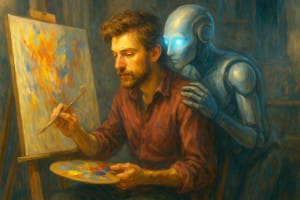
What if the future of art isn’t about machines replacing humans — but machines whispering strange, beautiful ideas into our ears? Yeah, that sounds a little creepy, but hear me out.
This is the path more artists are exploring as they embrace AI, not as a crutch, but as a muse. Amidst the controversy over AI-generated images that mimic living artists’ styles, a quieter revolution is happening. Creatives are using tools like ChatGPT, Sora, and Claude to provoke their own imagination, not outsource it.
Welcome to the new studio: part sketchpad, part silicon oracle.
The AI as Collaborator
Let’s be honest: it’s easy to feel threatened by AI’s ability to crank out music, images, and prose with disturbing speed. But what’s getting lost in the noise is how many artists are using these tools in a slower, more intimate way.
Think of ChatGPT not as an artist, but as a really intense, slightly surreal conversation partner. One who throws out wild metaphors, strange titles, unexpected color palettes, and story ideas that feel half-dreamed.
I once asked ChatGPT to give me names for imaginary art shows based on the theme “silence.” It came back with:
- The Geometry of Quiet
- Whispers of Secret Dreams
- Poetry of Butterflies
I then put “Whispers of Secret Dreams” into ChatGPT to create an image. This is what it created:
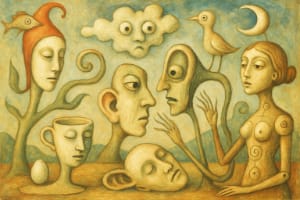
“Whispers of Secret Dreams”
Prompting as a Creative Ritual
Prompting a language model is part creative writing, part séance. Here are a few ways artists are using prompts as part of their daily practice:
For Writers:
- Ask for unusual metaphors for grief, joy, aging, or time.
- Request a dialogue between two imaginary creatures who live inside your closet.
- Generate random titles or first lines, then riff off them manually.
For Visual Artists:
- Feed it your own artist statement and ask it to give you surreal painting concepts based on your themes.
- Ask it to describe a dream landscape based on three emotions.
- Use it to “translate” music or poems into visual prompts.
For Musicians or Composers:
- Generate imaginary genres (“Ambient Baroque Punk” anyone?)
- Ask for a story or myth to base a suite or album around.
- Explore descriptions of unheard sounds, then try to recreate them.
In all cases, you’re not just accepting what the model spits out — you’re reacting to it, arguing with it, riffing off of it. Like jazz.
Real Artists Doing It Right
Some of my favorite examples of AI-as-muse come from creatives who treat it like a very peculiar studio assistant:
- A collage artist in Oregon who uses GPT to write poetic titles for their otherwise abstract pieces.
- A songwriter who brainstorms lyrics with Claude, then rewrites every single line to make it more personal.
- A digital painter who asks ChatGPT for “folk tales from a forgotten planet,” then illustrates them as storybook scenes.
None of them are blindly accepting the output. They’re wrestling with it. Which, honestly, is kind of the point.
The Soul Is in the Editing
If you’re worried about losing your creative identity to the machine — good. That worry means you care. It also probably means you won’t.
Because here’s the thing: real creativity doesn’t come from prompts. It comes from your response to the prompts. Your taste. Your weird inner logic. Your delight in breaking your own rules.
AI can offer the spark, but the fire? That’s yours.
Use the Machine For Your Art
If you’re an artist, you don’t have to reject AI outright. But you also don’t have to let it steal your spotlight. Use it like a mirror, a provocateur, a riddler.
Let it surprise you. Let it weird you out. Let it help you see something old in a new way.
But always remember: AI is not the artist. You are.