
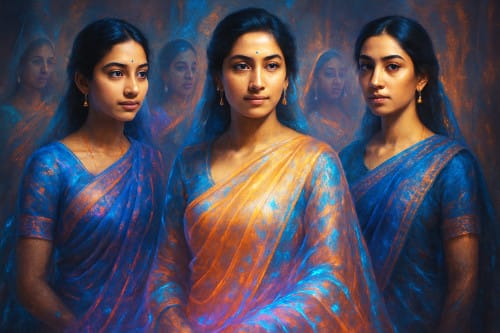
Every so often, the internet throws us something so oddly specific, so strangely irresistible, that it ricochets across social media feeds before anyone has time to ask, “Wait, why are we all doing this?”
In September 2025, that “something” was the so-called Nano Banana effect — a viral AI filter that transforms everyday selfies into dreamy, hyper-stylized portraits of people wearing elegant sarees. Almost overnight, Instagram, X (Twitter), and WhatsApp groups filled up with friends and strangers alike draped in digital silk, looking as though they’d just walked out of an art-house film.
It may sound like just another passing internet fad, but the AI saree trend has tapped into something deeper. It’s not only about playing dress-up with technology; it’s also about how people see themselves, how AI is shaping beauty standards, and what “authenticity” means in an era of effortless transformation.
What Is the “Nano Banana” AI Saree Trend?
The phrase “Nano Banana” itself is as bizarre as it is catchy. The name comes from a quirky labeling inside Google’s Gemini Nano system, which some users noticed while experimenting with AI photo editing. Developers and meme-makers seized on the name, and before long it became shorthand for an effect that draped digital sarees over user photos.
Here’s how it works:
- A user uploads a selfie into the Gemini Nano interface (or other apps that quickly adopted the filter).
- The AI reimagines the person wearing a saree, often with stylized lighting, jewelry, and a cinematic backdrop.
- The results are shared widely, both because they look stunning and because they carry that irresistible blend of novelty and cultural resonance.
People who might never have worn a saree in real life suddenly found themselves experimenting with the look virtually. For many in South Asia and the diaspora, the trend felt celebratory — like a digital festival where everyone could play a part.
Why Did It Go Viral?
1. Universality with a Twist
Unlike niche filters that target small subcultures, sarees have a broad cultural resonance. They’re traditional, glamorous, and recognizable around the world. Even if you’ve never worn one, you know what one is. AI gave people a low-effort way to try it on.
2. Aesthetic Quality
The filter doesn’t just slap a saree PNG onto your shoulders. The AI generates soft lighting, artistic textures, and an almost painterly finish. It flatters people in a way that most social filters don’t, making participants feel beautiful.
3. The Meme Factor
The absurdity of the name “Nano Banana” added just enough humor to make the trend playful. People weren’t only sharing their AI saree portraits because they looked good; they were also in on the joke.
4. Accessible Technology
Unlike earlier viral AI fads that required hefty computing power, this one worked on smartphones. Accessibility supercharged participation. If grandma could try it on her phone, so could everyone else.
What This Says About Visual Culture
AI as a Mirror of Desire
Filters like this aren’t neutral. They reflect our collective fantasies — about elegance, beauty, nostalgia, or cultural connection. When millions of people choose to see themselves in a saree, it highlights both personal curiosity and broader cultural appreciation (or appropriation, depending on who you ask).
Democratization of Aesthetics
In the past, getting a glamorous saree portrait required a photographer, stylist, and wardrobe. Now it requires about 15 seconds and an internet connection. That’s democratization in action: tools once reserved for fashion shoots are now in the hands of everyday users.
The Question of Authenticity
Of course, there’s also discomfort. When AI puts cultural dress on people who’ve never worn it, does it trivialize tradition? Or does it extend it into new digital realms? Opinions differ. What’s clear is that AI is blurring the line between authentic expression and imaginative play.
The Double-Edged Sword of Virality
Privacy Risks
As with all viral filters, users are handing over selfies to AI platforms. That means sensitive biometric data (like faces) is being stored and processed. Fun today, but what about tomorrow?
Flattening Culture
Cultural garments like sarees have rich, specific histories. When reduced to a generic AI overlay, some argue they risk becoming aesthetic wallpaper rather than respected traditions.
Reinforcing Beauty Norms
While the filter flatters, it also standardizes. Many users noticed that the AI tended to lighten skin tones, smooth features, and apply Eurocentric beauty standards. In other words, even in a saree, the AI “ideal” is not always culturally accurate.
Why the Name Matters
It may seem silly, but the name “Nano Banana” played a huge role in the spread of the trend. Internet culture thrives on absurdity. A filter called “Elegant Saree Generator” might have attracted modest attention. But “Nano Banana”? That’s meme fuel. The name gave people permission not to take it too seriously, which made sharing easier.
This reminds us that virality often depends as much on framing as on substance. The same tech, with a boring label, might never have made headlines.
What Comes Next?
If history is a guide, the AI saree trend will fade, just like the “AI baby face” craze, the “yearbook photo” wave, or the “anime selfie” boom. But its cultural footprint matters. It shows:
- AI fashion filters are here to stay. Expect more culturally specific dress-up filters. Kimonos, kilts, Victorian gowns — the library will grow.
- Identity is increasingly fluid. People are willing to try on looks, traditions, and identities in digital spaces without commitment.
- Visual culture is accelerating. Trends used to last years, then months, now sometimes only weeks. The pace of AI-driven aesthetics is only speeding up.
For digital artists and creators, the takeaway is clear: AI is no longer just a tool; it’s a cultural engine, producing aesthetics and narratives at unprecedented speed.
That’s the power, and the danger, of these tools. They let us see ourselves in ways we might never otherwise imagine. Sometimes that’s liberating. Sometimes it’s unsettling. But either way, it’s a window into how AI isn’t just shaping our images — it’s shaping our sense of self.