
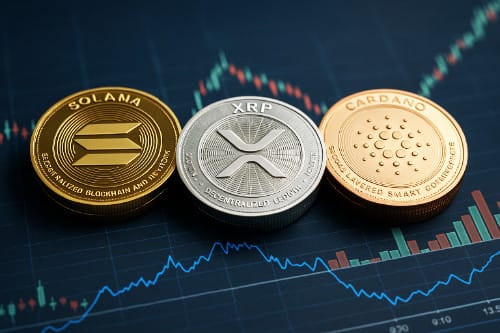
For years, the cryptocurrency market has danced to the rhythm of Bitcoin and Ethereum, with everyone else trying to keep up. But something new is stirring. The U.S. Securities and Exchange Commission (SEC) appears to be softening its stance on digital assets, hinting at potential approval for a wave of exchange-traded funds tied to other cryptocurrencies. Among the contenders, three names keep coming up: Solana (SOL), Ripple’s XRP, and Cardano (ADA). If these coins receive ETF approval, it could mark a defining moment for the broader crypto ecosystem.
The new regulatory opening
In late 2025, the SEC introduced generic listing standards for commodity-based exchange-traded products. That might sound like paperwork, but it’s a quiet revolution. Until now, every crypto ETF crawled through a lengthy and highly public approval process. The new framework streamlines that ordeal, allowing issuers to list ETFs tracking eligible digital assets as long as they meet defined requirements.
This shift also prompted applicants to withdraw and resubmit ETF filings for coins like Solana, XRP, Cardano, and others under the new rules. The message is straightforward: resubmit on the new rails and the timeline shortens. Windows that once stretched across half a year could compress to a couple of months. For investors, that change isn’t just procedural; it’s a signal that crypto is getting a clearer regulatory on-ramp.
A second back-office update also matters. “In-kind” creation and redemption — the ability for ETFs to transact in the underlying crypto rather than cash — reduces frictions and costs. Most people never see that machinery, yet it is the kind of infrastructure improvement that invites larger pools of capital to participate without operational headaches.
Why Solana, XRP, and ADA lead the pack
Solana (SOL) is the high-performance chain that developers lean on when speed and cost matter. With fast block times and low fees, it has become home base for a wide range of decentralized apps, from DeFi to consumer-facing experiments. Institutions like SOL because it behaves more like a modern tech platform than a speculative meme. If a Solana ETF gains approval, expect liquidity to deepen and spreads to tighten. That combination often attracts additional flows, which can snowball into momentum. Solana’s critics point to historic network outages and congestion. Those are real concerns, yet the recent trend has been toward better stability. If the chain continues to hold up under heavy load, SOL could become the “Apple-like” infrastructure layer of crypto — streamlined, efficient, and ready for mainstream adoption.
XRP brings something different. Its central story is payments. Ripple’s technology aims to move value across borders quickly and at low cost, and that makes XRP less of a casino chip and more of a bridge asset. After a long legal slugfest, XRP has clearer precedent than most altcoins. That doesn’t erase risk, but it reduces the fog. If an XRP ETF hits the market, it is easy to imagine conservative institutions warming to it as part of their “plumbing” allocation — an asset that helps them express a view on the future of settlement and tokenized value transfer. The potential upside is meaningful if a wave of cautious capital decides XRP is the safest way to gain altcoin exposure inside a traditional wrapper.
Cardano (ADA) takes the methodical route. It is built on peer-reviewed research and emphasizes security, sustainability, and energy efficiency. That slower, academic cadence has earned ADA a reputation for reliability rather than flash. If ADA secures ETF status, the initial surge might be gentler than SOL or XRP, yet it could prove more durable. ESG-minded allocators who want long-term exposure to a utility-first blockchain may find it appealing. Patience is the keyword: if approvals for ADA arrive after SOL or XRP, the delayed timeline could still work in Cardano’s favor by aligning with its steady-build narrative.
How ETF approval could reshape the market
ETF approval for these coins would do more than stir prices. It would change how money flows in the crypto economy. When capital enters through regulated ETFs, it often stays longer. Institutional investors prefer compliance, liquidity, and transparency, and ETFs deliver exactly that.
If ETFs for SOL, XRP, and ADA become available, traders will finally have familiar, regulated vehicles to gain exposure without the operational burden of custody and direct token handling. That invites pension funds, endowments, insurance companies, and large family offices to participate with clearer guardrails. A likely outcome is the gradual erosion of the Bitcoin-and-Ether near-monopoly on institutional attention. Capital that once concentrated in those two giants may begin to diversify into a compact set of “infrastructure” altcoins.
Diversification can also affect volatility. Deeper liquidity and tighter spreads generally tame wild swings. Expect the beta of SOL, XRP, and ADA to adjust if ETF volumes are significant. That doesn’t mean prices will move in a straight line. In the short term, regulation tends to spark speculation. Solana has a history of overreacting to hype, and XRP holders are famous for conviction. Short-term rallies and sharp corrections are likely. Cardano’s reaction may be smoother but still positive, especially if it benefits from slow-and-steady institutional accumulation.
What could go wrong
The biggest risk is political. A change in regulatory tone or a new round of enforcement could delay or even unwind progress. Even mundane issues, such as a government funding lapse, can slow reviews. If timelines slip, traders may rotate back into Bitcoin and Ether as safer holdings.
Another risk is fragmentation. If only one or two ETFs are approved initially, capital could rush into those while others languish. That can create choppy relative performance. Once ETFs exist, derivatives will proliferate. Options and futures on these funds can amplify both optimism and fear, raising the stakes for risk management.
What to watch and how to navigate
Investors should track the SEC announcement cadence and watch how issuers amend filings. On-chain activity is also a useful compass: developer traction, total value locked, and user adoption often foreshadow how resilient any post-approval rally will be.
Position sizing is more important than prediction. Regulatory momentum can move prices faster than fundamentals justify. If you catch a pop, it may be wise to realize gains methodically and leave room for consolidation. The market rewards those who plan exits as carefully as entries.
A quiet revolution
The SEC’s evolving approach to altcoin ETFs could turn out to be one of the decade’s most consequential financial shifts. Once institutional capital can flow freely into multiple regulated crypto funds, digital assets will no longer sit at the edge of the capital markets. They will live beside gold, oil, and equities in diversified portfolios.
Solana could mature into the chain of choice for speed and consumer apps. XRP might take root as the bridge for fast settlement and tokenized value. Cardano could become the patient investor’s pick for sustainable, research-driven infrastructure. Together, they offer a picture of a crypto market that looks less like a speculative carnival and more like a structured opportunity set for long-term builders and savers.
I think of it like switching from a gravel road to a paved highway. The destination doesn’t change — a digital, programmable financial system — but the ride becomes smoother, safer, and more accessible. With ETFs opening the on-ramps, the next stretch could be where crypto finally drives like a mainstream asset class.