It used to be easy to spot a crypto scam. The fake websites were clunky, the “support agents” barely coherent, and the grammar was a dead giveaway. But 2025 has ushered in a darker, more sophisticated era. Today’s scams don’t look fake; they sound and feel real. They speak in familiar tones, reference your past transactions, and even mimic the voices of people you trust.
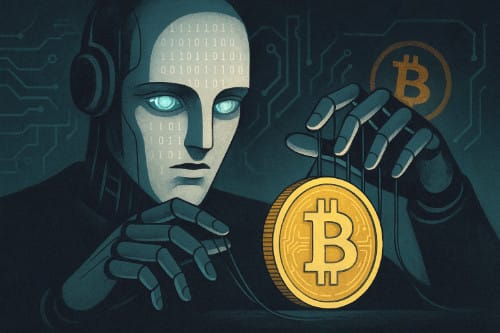
Welcome to the world of AI-powered fraud, where deepfakes, cloned voices, and generative chatbots are turning digital deception into a scalable industry.
The New Breed of AI-Fueled Crypto Scams
A few years ago, most crypto scams came as poorly written emails promising free Bitcoin. Then came fake Telegram groups, phishing links, and imposter influencers. Now, the game has changed entirely.
Scammers have begun using large language models (LLMs) to generate realistic chat conversations and voice cloning software to call victims directly. One high-profile case involved a deepfake “Coinbase support agent” who convinced users to “verify” their wallet access, only to drain their funds. Another used an AI-generated video of a well-known crypto YouTuber promoting a non-existent “AI token.” The production quality was so convincing that even his long-time subscribers were fooled.
We’re witnessing the merging of two forces: AI’s ability to imitate human trust signals and crypto’s irreversible, high-stakes nature. Once your digital assets are gone, they’re gone.
Why These Scams Are So Convincing
Traditional scams relied on social engineering — getting someone to click a link or reveal a password. AI has made that manipulation feel eerily human.
- Voice cloning allows scammers to reproduce speech patterns, accent, and even laughter.
- LLM chatbots can carry on long, emotionally calibrated conversations.
- Generative images and video can create false “proof of identity” documents that pass basic KYC checks.
In essence, AI has turned the scammer’s toolkit into a full-fledged studio of deception. The irony isn’t lost on the creative community: the same tools that help artists generate realistic portraits or 3D textures are now being weaponized by criminals. It’s a powerful reminder that technology itself isn’t moral or immoral — it’s the human intent behind it that matters.
The Psychology Behind the Scam
Most of these new scams don’t rely on technical exploits; they exploit emotions. AI can identify your stress patterns, your FOMO triggers, even your patience level — and tailor its persuasion accordingly.
A deepfake “customer support” agent might sound empathetic when you express frustration or stern when you hesitate. The scam adjusts in real time, guided by emotion-detection algorithms. It’s digital manipulation at scale.
What’s chilling is how personal it feels. These bots don’t just sound real — they feel like they care. And when you’re dealing with something as volatile as crypto markets, that illusion of reassurance can be dangerously persuasive.
Artists and Creators: You’re Now Targets Too
For artists and digital creators, the risks go beyond stolen wallets. Scammers are increasingly targeting the creative community with fake “AI art contests,” gallery collaborations, or NFT showcases that require wallet connections or “submission fees.”
Others impersonate curators or influencers, offering partnership deals via email or DMs. Some even create AI-generated versions of real art dealers, complete with profile photos, bios, and recent posts — all scraped and synthesized from social media.
Another growing trend is the “AI feedback scam.” Artists receive messages claiming to offer “AI-powered portfolio reviews.” The link they share looks professional but leads to a credential-harvesting site.
Rule of thumb: if someone you don’t know offers to “collaborate,” “sponsor,” or “verify,” stop and verify them first through a known official channel — never via the link they send.
Practical Defense: Your AI Scam Survival Kit
There’s no silver bullet, but you can make yourself a hard target. Here’s a simple self-defense kit for creatives and investors alike:
- Use separate wallets — one for experiments, one for storage. Never connect your primary wallet to new projects.
- Enable multi-factor authentication on all crypto and email accounts.
- Don’t trust voice or video alone. Verify identity through written, platform-linked messages.
- Slow down. Scammers thrive on urgency. A pause is the best security feature you have.
- Bookmark official URLs. Never follow links from messages, even if they look familiar.
- Learn to read tone. AI-generated texts are often overly formal, polite, and “perfect.” Humans rarely sound like that.
And if you want an extra layer of vigilance, tools like Deepware Scanner and Hive Moderation can help detect AI-generated voices and images. It’s not foolproof, but it’s progress.
How AI Is Fighting Back
Fortunately, the same technology that enables scams is also being used to fight them.
Blockchain analytics firms like Chainalysis and Elliptic are training AI models to detect fraudulent transaction patterns faster than any human could. Exchanges are experimenting with voiceprint verification — using your unique vocal signature as a biometric key.
Meanwhile, projects like World ID and Civic are exploring “proof-of-personhood” systems, aiming to distinguish real humans from synthetic agents on the blockchain. These won’t eliminate scams entirely, but they could make it much harder to impersonate legitimate users.
According to Chainalysis, AI-enhanced crypto scams have grown by over 40% this year; but AI-based detection and auditing tools have improved nearly as fast. It’s a digital arms race, and awareness remains our best weapon.
The Human Element
The most powerful defense still isn’t a piece of software; it’s the person behind the screen. The scammers are counting on speed, fear, and confusion. What they can’t outsmart is patience, curiosity, and human intuition.
Before clicking a link, pause. Before responding to a “support call,” breathe. Before sharing your credentials, ask yourself: Would a real company ever ask for this?
The truth is, AI is neither hero nor villain. It’s a mirror. It reflects whatever intent we bring to it. As artists, investors, and creators, our best path forward isn’t paranoia — it’s awareness.
Maybe the most intelligent thing we can do in this new digital age is the simplest of all: slow down and think.