
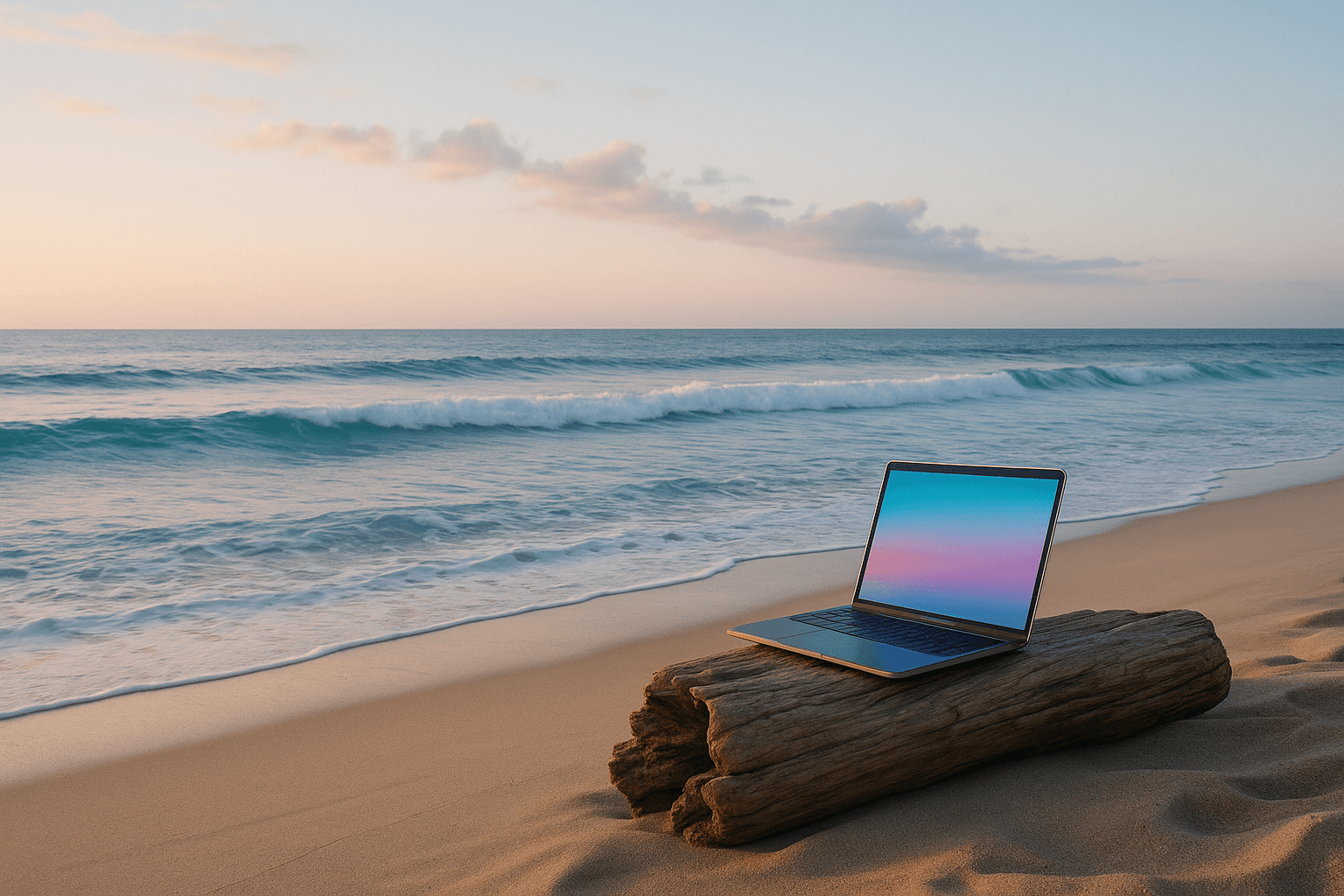
Creativity rarely shows up on command. You can open your laptop, cue your favorite playlist, even brew the perfect cup of coffee, and still find your ideas stubbornly silent. But walk toward the ocean, and something shifts. The chatter in your head starts to soften. Thoughts become lighter, looser. Somewhere between the sound of surf and the scent of salt, your creative mind quietly wakes up.
The beach, it turns out, might be one of the best creative studios there is. No rent, no deadlines, no desk. Just an open invitation to see differently.
The Natural Reset Button
Modern life keeps us perpetually switched on. We scroll, swipe, and refresh more often than we breathe deeply. Our brains are remarkable at processing information, but they are terrible at resting while doing it. The result is a kind of low-grade static that dulls imagination.
The beach doesn’t participate in that noise. Its rhythm is ancient, steady, and impossible to rush. The tide will come in, whether your notifications do or not. When we spend time near that rhythm, we subconsciously match it. Our thoughts slow to something closer to the pace of waves. That slowness is not laziness. It is space, and space is where creativity lives.
The Science Behind the Calm
Marine biologist Wallace J. Nichols calls this state Blue Mind. It is a calm yet alert condition that often appears when we are near, on, or under water. In that state, stress hormones drop and alpha brain waves increase, the same gentle waves of relaxed focus that artists and meditators know well.
Science has finally caught up to what poets always suspected: proximity to water changes how we think. It helps ideas link together more fluidly, almost as if the brain itself starts to drift and merge like currents. Instead of forcing solutions, you begin to notice them. Instead of pushing for originality, you rediscover curiosity.
That simple shift is powerful. When you create from calm instead of pressure, the work feels more like discovery than effort.
A Studio Without Walls
There is something liberating about a workspace that never holds still. The beach is never the same two days in a row. Light moves across the sand like a brushstroke. Colors appear and fade. Even the air feels creative, reshaping every few seconds.
When you make art, write, or think in that environment, the landscape itself becomes a collaborator. You respond to it. You listen. You notice how sound carries differently when it moves across open space. You remember that impermanence can be beautiful, not inconvenient. In that sense, the beach is a lesson in creative flow. Nothing stays fixed. Neither should your ideas.
Bring only a notebook, a sketchpad, or an iPad if you must. Leave the perfectionism at home. Let the environment guide you instead of the outline. The result may surprise you.
Light, Air, and the Digital Detox
Most of us spend our creative hours bathed in artificial light. Screens tell us what color the world should be. Indoors, we work in rectangles, both literal and mental. When you step into natural light, something changes physiologically. Your pupils relax. Your posture opens. Your sense of depth returns.
The ocean reminds your body that you exist in more than two dimensions. The breeze moves across your skin. The light shifts minute by minute. This sensory variety feeds the mind’s need for novelty without overwhelming it. It is stimulation with space built in.
When you create in that kind of light, your attention expands. You stop producing and start participating. That is a rare feeling in a world that measures everything by output.
Imperfection as Inspiration
Sand is not a perfect surface. The wind will move your pages. Seagulls will critique your work loudly. The sun will shift at the worst possible moment. Yet all those inconveniences are part of the creative experience. They remind you that art and life are not meant to be frictionless.
Perfectionism is a form of control, and control is the enemy of discovery. The beach offers gentle resistance. It reminds you that beauty often comes from impermanence, just like wabi-sabi teaches in Japanese aesthetics. The sketch you make in uneven light might not be technically precise, but it might feel truer than anything you’ve made indoors.
The creative process, like the tide, erases itself and begins again. That impermanence is not a flaw. It is freedom.
Bringing It Back Home
Eventually, you pack up and leave the sand behind. You rinse off, open your laptop again, and return to deadlines. But something subtle lingers. Your mind feels less like a machine and more like a landscape. The noise is quieter. The work feels lighter. You realize that the beach did not just inspire you; it recalibrated you.
Creativity is not about running away from life. It is about reentering it with clearer vision. The beach reminds us that ideas grow in cycles, not straight lines. Every tide leaves something behind. Every retreat makes room for something new.
So the next time your mind feels crowded, skip the productivity hacks. Go outside. Let the ocean reset your inner studio. You might come home with pages of ideas, or maybe just a better way of seeing. Either is enough.