
The best way I know to get better at AI right now is also the most obvious one: ask AI to teach you.
I don’t mean that in a cute, circular way. I mean it very literally. If you want to understand what large language models are, ask one to explain them at your current level. If you want to build an agentic system, ask one to walk you through the pieces. If you hit a term you don’t understand, stop and ask. If the answer is too technical, say that. If it’s too basic, say that too.
That is the part people still seem to underestimate. AI is unusually good at adjusting to the person in front of it.
I’ve been getting more requests lately from friends and family who want me to hand-hold them through AI. Not just “what’s ChatGPT?” anymore, but how to actually use it, how to think about agents, how to set up workflows, how to keep up with the pace of all this. I get why they ask. AI is moving so quickly that even if you’re paying attention, it feels like drinking through a firehose.
But that’s also why I don’t really have the bandwidth to become everyone’s personal AI tutor. And perhaps more importantly, I may not be the best tutor!
The advice I keep wanting to give is: use the thing itself.
Start with one question you genuinely care about. Not “teach me AI,” because that’s too broad. Try something like: “Explain AI agents to me like I’m comfortable with computers but not a programmer.” Or: “I want to use AI to organize my notes. What do I need to understand first?” Or: “Give me a beginner path for learning how people are using AI in creative work.”
Then keep correcting it.
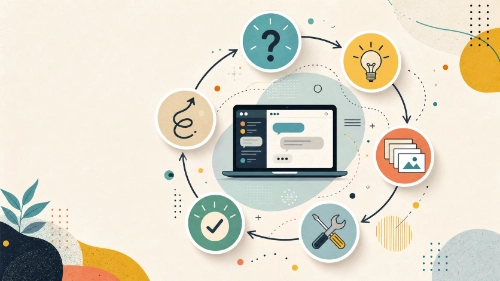
That’s the part that matters. Don’t treat the first answer as the lesson. Treat it like the beginning of a conversation. Tell it what confused you. Ask for an example. Ask it to compare the idea to something you already know. Ask it to quiz you. Ask it to make a tiny project you can actually try.
A human teacher can do that too, of course. A good one can do it beautifully. But a human teacher has limited time, patience, and availability. AI doesn’t mind if you ask the same question five different ways. It doesn’t mind if you need the simpler version, then the slightly more technical version, then the “okay, now show me what this looks like in practice” version.
That makes it weirdly useful for self-teaching.
And for AI specifically, the feedback loop is even better because the tool you’re learning about is the same tool you’re using to learn. You’re not just reading about prompts. You’re writing them. You’re not just hearing that AI can adapt to context. You’re watching it adapt to you. You’re not just learning what an agentic workflow might be. You can ask it to help you sketch one for your own actual life.
That last part is where things start to click. AI stops being a vague category of “new tech” and becomes a working material. More like Photoshop, a camera, a synthesizer, or a programming language. You don’t really learn it by having someone explain every menu item. You learn it by trying to make something, getting stuck, and asking better questions.
So if you’re trying to understand AI, don’t wait until you feel ready. Pick a thing you want to know or make, then make AI teach you the next step.
Not the whole mountain. Just the next step.