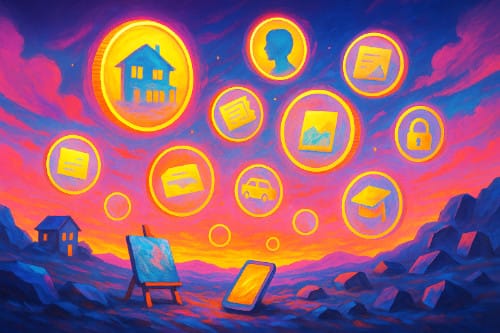
Imagine a world where everything you own, from your beach house to your concert ticket to the tiny watercolor you just painted, exists as a digital token—a unique, verifiable object on a global network. Not a copy, not a file on your computer, but a token that proves ownership, authenticity, and sometimes even emotion. That’s the tokenized world we’re heading toward, and whether we notice it or not, it’s already taking shape beneath our feet.
The New Language of Value
For most of history, ownership was physical. You held a deed, a coin, or a painting. The internet shattered that logic. Suddenly, value could move at light speed, but proof of ownership couldn’t. Blockchain technology fixed that gap. It introduced the idea of a token, which is a kind of digital certificate that says, “This belongs to me.”
Bitcoin was the first major example. It proved digital scarcity was possible. Then Ethereum showed we could tokenize just about anything: art, music, even tweets. And now, as the technology matures, we’re moving toward a world where every object, idea, or access point can be represented by a token.
Tokenization in Everyday Life
Think beyond crypto collectibles or meme coins. Imagine these scenarios:
- A musician releases a limited run of songs as collectible tokens. Fans can trade them or use them as keys to private shows.
- A photographer sells access to their entire portfolio as a fractionalized token, allowing patrons to share in its future value.
- Real estate gets tokenized, making it possible to invest in a slice of a vacation home rather than buying the whole thing.
- Even your reputation or social media presence could be tokenized, transforming online influence into tangible value.
In this sense, tokenization becomes a kind of digital fabric. It’s an invisible layer of ownership that threads through our economy and culture.
The Psychological Shift
When everything becomes tokenized, the way we think about value changes. Ownership is no longer about possession; it’s about participation. A digital artist might still “own” their original file, but the value of their token lies in its story and the network of people who believe in it.
We’re already seeing this with NFTs. A painting in your living room might have sentimental value, but a digital token can carry community value. It blurs the line between collector and creator. Everyone becomes part of the creative economy.
There’s something almost poetic about that. The world becomes a gallery, and each token a brushstroke in a collective artwork.
The Good, the Weird, and the Inevitable
Like any major shift, tokenization comes with tension. It’s not just about technology; it’s about human behavior.
On the good side, tokenization democratizes access. It opens doors for people who never had them—small creators, global investors, artists in remote towns. It makes the economy more liquid, more transparent, and potentially more fair.
On the weird side, it also risks commodifying everything. When even your digital identity has a token price, what happens to authenticity? Will art still feel sacred when it’s instantly tradeable? Will friendship or community lose something if loyalty points become financial assets?
And yet, this evolution feels inevitable. The internet has always pushed us toward abstraction. From gold to paper to pixels to tokens, we keep reimagining what “value” means.
Art in the Age of Tokens
For artists, tokenization is both liberation and labyrinth. It means direct connection with audiences, verifiable provenance, and income streams that don’t rely on middlemen. But it also means navigating marketplaces, smart contracts, and the psychological weight of constant monetization.
Still, artists have always been at the forefront of new mediums. From the first cave painter to the first crypto artist, creation and experimentation go hand in hand. In many ways, tokenization restores something ancient: the human need to prove, “I made this,” and to have that statement echo across time.
When the World Itself Becomes a Ledger
One day, we may wake up and realize that tokenization isn’t just a feature of the economy; it’s the economy. Your car’s maintenance record, your diploma, your medical data, your digital garden of AI-generated art—each tokenized, portable, and under your control.
It’s easy to see this as dystopian or utopian, depending on your mood. The truth, as usual, will probably be somewhere in between. The key question is not whether everything will be tokenized, but how we’ll behave once it is.
Will we treat tokens as mere assets, or as meaningful artifacts of human creativity? Will we use them to build trust and community, or to speculate and divide?
If we get it right, tokenization could become one of the most empowering technologies of our lifetime. It’s a bridge between art and math, between ownership and identity. A world where value is no longer confined to banks and galleries, but flows freely, beautifully, and verifiably among us.
And maybe, when everything becomes a token, we’ll finally see that the real value was never in the token itself, but in the human stories behind it.