
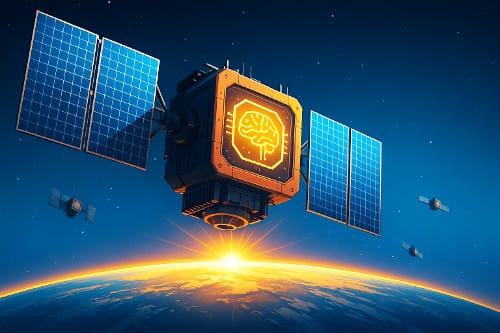
If you’ve ever wondered where all our data actually lives, you’ve probably heard the comforting term “the cloud.” Of course, that cloud is really a collection of physical servers packed inside noisy, power-hungry warehouses scattered across the globe. But what if the next version of the cloud doesn’t sit on Earth at all?
That is exactly what a handful of innovators are exploring. And with Google’s new Project SunCatcher, the concept of space-based AI infrastructure is moving from science fiction into real-world research. The idea is simple enough to sound crazy: move AI data centers into orbit, where they can soak up endless sunlight, operate in microgravity, and power the next generation of intelligent systems.
The Great Leap from Cloud to Cosmos
Our current data infrastructure is impressive but under pressure. Every time someone asks ChatGPT to draft an email, or Midjourney to render an image, or Gemini to summarize an article, those requests pull from massive GPU clusters that consume staggering amounts of electricity. Some AI training runs now use more energy than a small city.
That rising demand has pushed engineers to look upward, literally. Above the atmosphere, solar energy is abundant, cooling is efficient, and there’s no need for land, water, or zoning. A satellite in orbit can harvest continuous sunlight and radiate waste heat into the dark cold of space.
Google’s SunCatcher is built around that simple idea. Instead of expanding data centers outward across the planet, the company is experimenting with expanding upward into space, building compute constellations powered entirely by sunlight.
Project SunCatcher
Announced in late 2025, Project SunCatcher is Google’s research initiative to design a scalable AI compute system that lives in orbit. It’s still in the early stages, but it comes with real engineering blueprints and published research describing how it could work.
SunCatcher envisions constellations of AI satellites operating in sun-synchronous orbits, where they are almost always exposed to sunlight. Their solar arrays could generate power nearly 24 hours a day. Each satellite would contain high-performance processors, likely versions of Google’s Tensor Processing Units (TPUs), and communicate with others through laser-based optical links capable of transmitting data at terabits per second.
In theory, this could create a kind of orbital neural network. Each satellite would work together with others in real time, training or running large language models and vision systems without relying on ground-based data centers.
Why Space Makes Sense for AI
The first advantage is energy. Solar power in space is far more efficient than on Earth because there’s no atmosphere to block or scatter light. In some orbits, solar panels receive up to eight times more usable energy than those on the ground.
The second advantage is cooling. AI computation generates intense heat, and data centers on Earth spend nearly half their energy budget on cooling. In space, radiative cooling is naturally efficient. Heat can be emitted through carefully engineered panels that glow in infrared and release thermal energy directly into the void.
A third advantage is independence from Earth’s resources. Data centers require land, water, and access to power grids. Space-based systems need none of that. They don’t compete with agriculture or local utilities, and they avoid political or environmental disputes tied to infrastructure.
Finally, there’s the potential for real-time processing. AI models in orbit could process satellite imagery, weather data, or planetary sensor streams directly, without transmitting raw data back to Earth. This creates what researchers call “cosmic edge computing,” an AI network hovering above the planet that can analyze, learn, and act on information as it happens.
Technical Challenges
Of course, none of this is easy. Space is unforgiving. Radiation, temperature swings, and micrometeoroids can quickly damage electronics. Every launch costs money, and maintenance hundreds of miles above Earth is extremely difficult.
To address that, Google’s engineers have been testing radiation-hardened TPUs. Early prototypes have shown resilience up to about fifteen kilorads, which is surprisingly robust for commercial chips.
Communication is another challenge. To link satellites together into a functional network, Google proposes using optical communication rather than radio. Laser-based links could deliver multi-terabit bandwidth, potentially making orbital AI as fast and interconnected as the biggest terrestrial cloud clusters.
Managing heat is tricky too. While space is cold, getting rid of excess heat from tightly packed electronics requires thoughtful design. Radiators must be large, lightweight, and capable of radiating in the right wavelengths to keep chips stable.
And then there’s cost. Even with launch prices dropping below two hundred dollars per kilogram by the mid-2030s, sending large amounts of hardware into orbit is expensive. Yet Google’s research suggests that at scale, orbital AI compute could become economically competitive with Earth-based facilities, especially when you account for free solar energy and reduced cooling costs.
A Broader Movement Beyond Google
Google is not the only player thinking about orbital computing. Microsoft’s Azure Space division is integrating satellite connectivity with its cloud systems. Amazon’s AWS Ground Station lets researchers control satellites directly from their cloud consoles. IBM and the European Space Agency are experimenting with in-orbit AI analysis of telescope data.
Smaller companies are also entering the picture. Lonestar Data Holdings is testing lunar-based servers. Others are exploring mesh networks of satellites dedicated to environmental AI systems that might monitor deforestation or ocean health from orbit, running machine learning locally.
All these efforts point toward the same idea: compute is leaving the ground. Just as the internet moved from local servers to the cloud, we may now be witnessing the early move from the cloud to the cosmos.
The Creative Possibilities
For artists, writers, and independent technologists, this future has surprising implications. Every creative tool we use—from image generators to video editors—depends on computing power. If that power becomes abundant, clean, and orbital, creative freedom expands dramatically.
Imagine a generative art project that uses live satellite data to paint cloud movements across a digital canvas. Imagine a composer tapping into magnetospheric sensors to turn the Earth’s natural rhythms into music. Or imagine a filmmaker using orbital rendering farms that run entirely on solar energy, their radiators glowing gently in the night sky.
Throughout history, new infrastructure has always fueled new art forms. The printing press gave us the novel. Photography gave us cinema. The cloud gave us AI-assisted creation. It’s easy to picture orbital computing giving rise to a new creative medium—one that turns real-time planetary data into color, sound, and motion.
The Deeper Meaning Behind SunCatcher
There’s a poetic side to all this. Artificial intelligence began as a reflection of human reasoning, built from circuits and code. Now it’s rising into space, orbiting the very planet that imagined it. It’s as if intelligence itself is beginning to wrap around Earth, illuminated by sunlight.
Google’s researchers note that the Sun provides over one hundred trillion times more energy than humanity currently uses. The idea of drawing just a fraction of that to power computation reframes the relationship between AI and nature. Instead of seeing AI as an energy glutton, SunCatcher imagines it as something that harmonizes with the cosmos.
It’s an audacious but strangely organic vision: a planetary mind fueled by the same light that grows our food and warms our skin.
What Comes Next
Project SunCatcher is still experimental. Google has not announced any specific launch schedule, though the company hints that prototype missions could happen before 2030. If successful, these would be the first true orbital data centers, proof that AI can live and work in space.
But with innovation come responsibilities. Space is already crowded with satellites, and debris is a growing concern. The more infrastructure we add, the more we must think about regulation, sustainability, and global access.
Even so, the vision is inspiring. A future where AI compute is powered by sunlight and cooled by starlight is one where technology feels a little less extractive and a little more symbiotic.
So the next time you ask an AI to create a painting or write a melody, imagine your request traveling not through server farms in Virginia or Oregon, but through beams of light connecting satellites above the planet. Somewhere, in orbit, an array of processors is catching the Sun, turning pure energy into thought.