
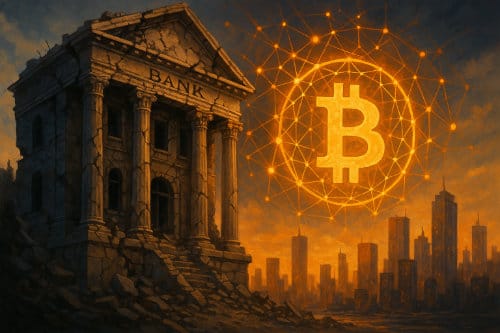
The U.S. banking system is, to put it kindly, creaking at the hinges. With recent bank failures, mounting distrust in central institutions, and a persistent sense that the financial rules are being rewritten in boardrooms far from public view, more Americans are beginning to question whether the current system still serves them. For decades, traditional banks have acted as gatekeepers to wealth, credit, and stability. But now, Bitcoin—a decentralized, internet-born currency once dismissed as a geeky pipe dream—is beginning to look like a serious alternative.
The irony is rich: a technology created to bypass the financial system might end up rescuing it, or at least forcing it to evolve.
A House of Cards in a Windstorm
The financial house Americans are told to trust is built on a system called fractional reserve banking. Banks take your deposits, promise to keep them safe, and then lend most of that money out to others. In good times, this model hums along. But when interest rates jump or borrowers get nervous, the whole thing can wobble—fast. That’s precisely what happened with Silicon Valley Bank in 2023. What looked like a healthy institution collapsed in the span of days when too many depositors tried to pull out cash that simply wasn’t there.
Even when they’re not failing outright, banks are growing increasingly centralized. The biggest institutions—JPMorgan Chase, Bank of America, and a few others—now dominate the sector. Smaller banks are either folding or getting swallowed up. The phrase “too big to fail” isn’t just a political talking point—it’s the reality of modern American finance. This consolidation leads to fragility, not resilience.
And while all this is going on, the dollar itself is quietly losing value. Years of aggressive money printing, especially during COVID-19, have pushed inflation into everything from eggs to housing. For most people, wages haven’t kept up. The bank account may say the same number, but what that number buys is shrinking.
The Bitcoin Provocation
Enter Bitcoin, stage left, wearing a digital hoodie and refusing to play by the rules. From the moment of its birth in the shadow of the 2008 financial crisis, Bitcoin positioned itself as a radical alternative—a system that didn’t need banks, or governments, or trust. Just code.
For those raised in the old system, this idea can be unsettling. But to a growing number of people around the world, it’s starting to feel like liberation. If you can store your savings in a decentralized network that no central bank can inflate, and if you can send money to anyone, anywhere, anytime—without needing a middleman or begging for permission—that changes the very definition of what a bank is. Or whether we need them at all.
Bitcoin’s fixed supply is perhaps its most audacious feature. Only 21 million coins will ever exist. Compare that to the dollar, whose supply can expand at the stroke of a Federal Reserve keyboard. For savers in places like Argentina, Lebanon, or even the U.S., Bitcoin offers something rare: predictability.
More Than a Protest, a Practical Tool
Still, Bitcoin is not just a protest against the old world. It’s already solving real problems. In Nigeria and Venezuela, people use it to escape hyperinflation. In Ukraine, it helped fund grassroots resistance during wartime when banks were offline. And in the U.S., where millions are unbanked or underbanked, it offers a way to store and move value outside a system that too often excludes or exploits.
Of course, Bitcoin has its flaws. It’s volatile. It can be complex and intimidating to new users. Its energy use has drawn criticism, though much of that is being addressed through renewable mining initiatives. And while the technology continues to evolve (the Lightning Network being a promising layer for faster payments), it’s still early days.
But to dismiss Bitcoin for these imperfections is to miss the larger picture. It’s not just a new kind of money—it’s a pressure valve. A challenge to the idea that financial power must be centralized. A call to reimagine what money can be in a world where trust in institutions is eroding.
A Future with Two Paths
It’s unlikely that Bitcoin will replace the U.S. banking system outright. But it doesn’t need to. Its very existence is forcing a reckoning. Some banks will resist, lobbying against crypto innovation and doubling down on control. Others will adapt, offering Bitcoin custody, integrating blockchain infrastructure, and rethinking how they serve customers in a world that demands more transparency, fairness, and access.
What’s becoming clear is that the status quo is no longer enough. The cracks are visible. Bitcoin might not be the final answer—but it’s asking the right questions.