Back in the day, the invention of the paint tube changed everything. Suddenly, artists didn’t need to grind their own pigments or stay indoors—they could take their easels outside and paint the world as they saw it. It was a small shift in materials, but a massive leap in creative possibility.
Oil paints were once controversial.
When photography first came on the scene, some folks speculated it would be the end of painting..
Today, we’re facing something similar with AI art. Tools like Midjourney, DALL·E, and Stable Diffusion have arrived on the scene, stirring up both excitement and concern. Some see these tools as threats to traditional artistry. Others see them as toys or shortcuts. But for many of us—especially those curious about the intersection of creativity and technology—they offer something far more nuanced: a new way to explore our imagination.
A Brush That Listens
At its core, AI art is collaborative. You don’t just click a button and get a masterpiece. You describe what you see in your mind’s eye. You experiment, revise, and refine. You coax the image into existence through prompts, much like a sculptor chips away at marble. The results often surprise you. Sometimes, they’re flat-out wrong. But that back-and-forth, that act of shaping and reacting, is the creative process.
It’s easy to underestimate the skill involved until you try it for yourself. Crafting the right prompt takes intuition, clarity, and persistence. It’s not unlike directing a team—except your “team” happens to be a statistical model trained on billions of images.
Standing on the Shoulders of Giants (and Algorithms)
It helps to remember that artists have always used the tools available to them. The camera obscura once seemed like a trick. Photoshop was once debated in the world of photography. Even the idea of digital painting was initially met with skepticism. And yet, each of these innovations opened up new forms of expression.
AI might feel different because it seems to “create” on its own. But it doesn’t. It mirrors patterns and reflects inputs—it needs a human guide. If anything, it holds up a mirror to your own imagination and asks, “Is this what you meant?” Often, the answer is no. So you adjust. Try again. And somewhere in that process, art happens.
Personal Notes from the Prompt Trenches
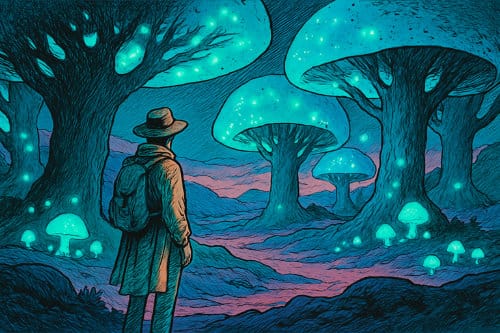
When I first started using Midjourney, I wasn’t trying to replace anything. I was just curious. I’d type in a phrase—something like “a lone figure under bioluminescent trees, painted in the style of Moebius”—and see what came back. Most of the time, the results weren’t quite right. But every so often, I’d get something that made me stop and stare. Not because it was perfect, but because it hinted at a story I hadn’t told yet. That moment of surprise—that’s the part that felt like art to me.
Over time, I began using AI not to finish work, but to start it. It became a sketchbook, a reference generator, a source of inspiration when I was stuck. It nudged me into new color palettes, strange compositions, and ideas I wouldn’t have thought of on my own.
A Tool, Not a Threat
None of this is to say that AI tools don’t raise serious questions—about authorship, copyright, originality. These are valid concerns, and we’ll need to grapple with them honestly. But dismissing AI outright, as if it’s cheating or lazy, misses the deeper truth: creativity has always been about making meaning with the tools we have. The brush changes, but the impulse to create, to express, to share—that doesn’t.
So maybe the real question isn’t whether AI art “counts.” Maybe it’s how we, as artists and humans, choose to use it.
Next time you feel a creative itch, try describing something impossible to an AI art generator. Not to show off or make a finished product—but to see what comes back. Treat it like a sketch, not a statement. You might just discover a new direction you hadn’t considered.
And if it feels weird or uncertain at first—that’s okay. Most good art does.