
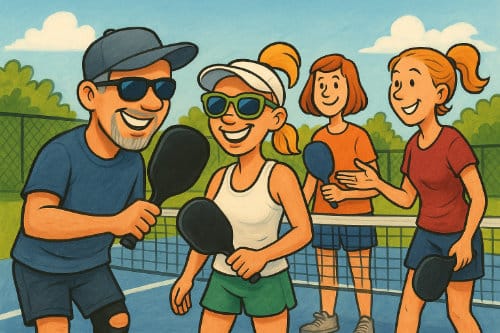
It started with a missed shot. Someone blamed the wind. Someone else blamed the paddle. And someone else blamed the cracks on the court. Then someone (let’s call him Patrick) said “Well, sometimes I am for the cracks.” Then the lady with the green glasses made one simple gesture: with an exaggerated surprised look on her face, she covered her butt with her paddle.
They laughed for minutes.
It’s not just a sport—it’s a stage. A recurring ensemble of characters shows up, paddles in hand, ready to rally and razz. And now, thanks to artificial intelligence, you can capture the drama, comedy, and chaos of your pickleball life in the form of a cartoon strip. No drawing skills required; just your imagination.
AI as Your New Comic Artist
I’ll admit, I was skeptical at first. Turning real-life moments into a cartoon seemed like something that required either years of practice or a teenager with Procreate. But AI image generators—like DALL·E, Bing Image Creator, Midjourney, and even ChatGPT—have gotten weirdly good at turning text descriptions into colorful, expressive visuals. Especially when you give them something playful to work with.
Pickleball, it turns out, is a perfect subject.
What Makes a Good Comic?
You don’t need much. Four or five panels is enough to tell a small story—something silly, familiar, and just exaggerated enough to make your friends laugh out loud (or groan).
The Characters
It helps to exaggerate a little. That quiet guy who’s secretly competitive? Turn him into a shadowy figure practicing dinks by moonlight. The friend who always shows up in matching visors and wristbands? She becomes the team fashion icon, complete with sparkles and a signature smirk.
To keep the AI from getting confused, I learned to describe characters consistently in every prompt. “Slim man with grey cap and right knee brace, cartoon style” became shorthand for Patrick. Cari? “Petite woman with green sunglasses and a white visor, energetic expression.” AI doesn’t remember from panel to panel, so you have to guide it carefully. But once you get the hang of it, it becomes a fun little collaboration—part art project, part improv comedy.
The Joy of Seeing It on the Screen
I think what surprised me most was how satisfying it was to see these ridiculous court moments frozen in cartoon form. Not polished. Not perfect. But funny in a way that felt both personal and sharable.
And the process—assembling the panels, adding text bubbles, tweaking expressions—reminded me that storytelling doesn’t have to be high art. Sometimes it’s just four friends on a pickleball court, trying to figure out which paddle is which, or which cracks are which.
It’s Not About the Art. It’s About the Memory.
AI can’t replace the warmth of real-life friendships, or the squeak of shoes on the court, or the quiet satisfaction of a well-placed drop shot. But it can help you capture those fleeting moments in a form that’s easy to share and impossible not to smile at.
You don’t need to be a tech expert. You don’t need to understand how neural networks work. All you need is a story—and a willingness to play with it.
Pickleball already gives you the characters, the drama, and the punchlines. All AI does is draw the panels.