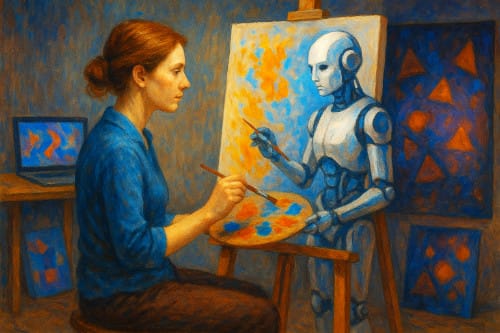
Artist residencies have always been a bit magical. They’re those rare stretches of time when an artist gets to step out of the noise of daily life and dive into their work, supported by space, resources, and a sense of community. For centuries, they’ve been hosted in forests, converted barns, and quirky urban lofts. But now there’s a new twist: residencies where the central “studio mate” isn’t another painter or poet, but an artificial intelligence system.
Welcome to the world of AI art residencies—a place where human creativity and machine learning share the canvas.
What Makes an AI Art Residency Different?
At their core, AI art residencies take the traditional framework of a retreat and superimpose a new collaborator: artificial intelligence. Instead of just providing a studio and a stipend, these programs give participants access to high-powered computers, advanced AI models, technical mentors, and communities of artists all wrestling with the same question: what happens when creativity meets code?
The difference is subtle but profound. Traditional residencies focus on solitude or natural inspiration. AI residencies focus on interaction—with a system that can generate thousands of images in seconds, respond in unpredictable ways, and force the artist to redefine what it means to make something “original.”
Why Now?
It’s no accident that AI art residencies are blossoming in 2025. Over the last few years, generative AI systems like MidJourney, DALL·E, and GPT have exploded into public consciousness. Suddenly, anyone can type in a prompt and get an image, a poem, or even a song.
That accessibility is exciting—but it also raises questions. Who owns the art? What biases are baked into the models? Is the artist still the author if the machine provides the brushstrokes?
Residencies are emerging as the perfect container to explore these questions. They offer time, space, and mentorship to dig beneath the surface, to go beyond quick prompts and memes, and to push the boundaries of what’s possible with AI as a medium.
Real-World Examples
- Runway’s AI Film Residency: Focused on filmmaking, it allows participants to experiment with generative video tools for storytelling.
- Google Artists + Machine Intelligence (AMI): A longstanding initiative pairing artists with researchers to explore the cultural impact of AI.
- AIxDesign Residency in Europe: Brings together artists, designers, and activists to prototype new futures—and critique the ones we’re heading toward.
- Smaller independent collectives are also offering residencies, sometimes run on shoestring budgets, where the main offering is GPU access and peer-to-peer learning.
What unites these programs is not the specific output but the sense of collaboration with an alien partner—a system that doesn’t know beauty or meaning until humans interpret its patterns.
What Do Artists Actually Make?
The outcomes vary wildly, but here are some common directions:
- Generative aesthetics: Pushing visual AI tools to make surreal or hauntingly detailed works.
- Performance art: Staging live shows where AI generates text, visuals, or music in real time.
- Critical design: Projects that reveal AI’s biases or limitations, turning flaws into creative material.
- Cross-disciplinary hybrids: Pairing AI with sculpture, biology, or even food to expand what “digital art” can mean.
One artist described the experience as “collaborating with a slightly unhinged but endlessly productive studio partner.” Sometimes the AI suggests nonsense, sometimes it sparks genius, and often the magic is in the dialogue between the two.
Why It Matters
For artists, these residencies provide something increasingly rare: the chance to shape the narrative of technology rather than just react to it. Too often, AI is framed only by engineers and corporations. By placing artists in the mix, residencies encourage play, critique, and alternative visions.
There’s also a practical benefit. Residencies provide access to tools and computing power that would otherwise be out of reach for most individuals. Training or running advanced models can be expensive, and residencies lower that barrier.
And finally, they expand the very definition of art. Just as photography and film once forced society to rethink what counts as artistic expression, AI is pushing us into new territory. Residencies are where the most thoughtful experiments are taking shape.
A Metaphor for the Moment
Imagine the classic artist retreat: a cabin in the woods, surrounded by birdsong, a canvas propped against the window. Now swap the forest for a server room, the birdsong for the low hum of GPUs, and your quiet studio mate for a machine that speaks in code and images.
It may sound sterile, but the resonance is the same: a place to explore, to get weird, to test boundaries. And just like the forests of old, this new environment is fertile ground—only now the soil is digital.
Why ArtsyGeeky Readers Should Care
For the curious, semi-tech-savvy readers who want to stay connected to both creativity and modern technology, AI art residencies are a glimpse into the near future. They’re not just for coders or gallery insiders. They show how anyone with curiosity and imagination might enter into dialogue with the tools of tomorrow.
Whether you’re a retiree with time to explore new outlets, a digital artist eager to expand your practice, or simply someone who wonders how AI will shape culture, residencies are where those questions are being asked—and sometimes answered.
And who knows? The next great residency might be open to applicants like you.