
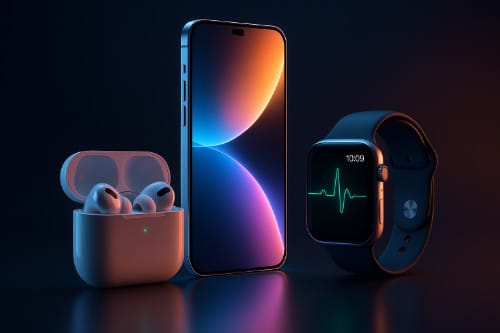
Apple’s September 9, 2025, event had all the hallmarks of Cupertino stagecraft: gleaming video montages, big claims about breakthroughs, and that familiar undercurrent of “one more thing.” Yet what struck me most was not the spectacle but the consistency. This year’s announcements weren’t gimmicks. They were Apple’s careful attempt to make its products thinner, smarter, and more integrated into daily life.
From the ultra-slim iPhone Air to AirPods that double as heart monitors, to watches edging closer to true medical companions, Apple is threading design with health, convenience, and creative potential. For retirees, hobbyist filmmakers, or anyone looking to blend technology with lifestyle, the 2025 lineup is worth unpacking.
iPhone 17 Lineup and the Ultra-Slim iPhone Air
The iPhone Air stole the spotlight. At just 5.6 millimeters thin and weighing 165 grams, it is the slimmest iPhone Apple has ever made. Wrapped in grade-5 titanium, it feels less like a smartphone and more like a precision-milled piece of jewelry. Apple even redesigned the back into a plateau that maximizes battery space while still leaving room for its upgraded cameras.
Despite the diet, the Air doesn’t skimp on display or performance. It sports a 6.5-inch Super Retina XDR screen capable of 120 hertz refresh rates and brightness peaking at 3,000 nits. Ceramic Shield 2 glass on the front and back adds three times the scratch resistance and four times the crack resistance of the previous generation—an acknowledgment that thin should not mean fragile.
Inside, Apple’s new A19 Pro chip drives the show, paired with a C1X modem and N1 networking chip to support Wi-Fi 7, Bluetooth 6, and Thread. The result is a phone that connects faster, streams smoother, and should stay viable through several software generations. Battery life surprised many reviewers: up to 27 hours of video playback on a single charge, extendable to 40 hours with a $99 MagSafe battery pack.
Camera lovers will notice the biggest upgrades. The Air’s 48-megapixel Fusion system simulates the flexibility of multiple lenses without actually having them. Combined with a 12-megapixel telephoto and an 18-megapixel Center Stage front camera, the device also supports dual recording, letting you capture yourself and your subject at once. For storytellers and family archivists, that’s a gift.
The iPhone Air starts at $999 for 256 gigabytes of storage and comes in space black, cloud white, light gold, and sky blue. Preorders begin September 12, with shipments rolling out September 19.
Of course, the Air wasn’t alone. The iPhone 17 keeps Apple’s mainstream audience happy with a slightly larger 6.3-inch display, a 120 hertz panel, and upgraded dual 48-megapixel cameras. Priced from $799 for 256 gigabytes, it hits the sweet spot for most people. The Pro and Pro Max models remain the tools for creators and enthusiasts. Starting at $1,099 and $1,199 respectively, they add vapor-chamber cooling for heavy workloads, tetraprism camera systems with up to 16-times optical zoom, and video capabilities like ProRes RAW and GenLock synchronization.
AirPods Pro 3: Your Earbuds, Now with a Pulse
Apple’s wireless earbuds have long been the company’s stealth success story. This year’s AirPods Pro 3 take them into new territory. Yes, they sound better—the active noise cancellation is now billed as “the world’s best,” twice as effective as the previous model and four times more than the original. But the bigger story is health.
Each pair comes with a built-in photoplethysmography (PPG) sensor, which uses subtle light changes to monitor your heart rate. Paired with the Fitness app, the earbuds can track over 50 workout types. Imagine going for a morning walk, podcast in your ears, while your heart rate is quietly logged without needing a watch. For people who find wearables intrusive, this is a clever alternative.
Then there’s the translation feature. Apple has introduced live translation that plays spoken words directly into your ear and offers transcription on your device. For travelers or bilingual families, that could be transformative.
Comfort has been refined as well. Apple scanned over 10,000 ears to design new foam-infused tips, adding an extra-small size to make the fit more universal. Durability gets a bump with IP57 water resistance. Battery life stretches to eight hours on a charge and about 30 hours with the case—a 33 percent improvement. Pricing stays at $249, with availability starting September 19.
Apple Watch: Health on Your Wrist
Apple’s watch lineup this year shows a clear focus on health. The entry-level SE 3, priced at $249, now offers an always-on display, a faster S10 chip, and sleep apnea detection. It can also provide retrospective ovulation estimates, wrist temperature sensing, and new double-tap and wrist-flick gestures for quick navigation. Fast charging means 15 minutes on the puck gives you about eight hours of use, while a full charge lasts 18 hours. It runs watchOS 26, which introduces the fluid new Liquid Glass interface and tighter integration with Apple Intelligence.
The Series 11, starting around $399, pushes into medical territory with hypertension alerts and more advanced sleep metrics. It’s thinner, tougher, and designed to withstand daily wear without losing polish.
The Ultra 3, Apple’s rugged flagship at $799, adds satellite connectivity for emergencies, extended low-power mode lasting up to 72 hours, and a build aimed at adventurers. For hikers, divers, or anyone who likes to wander outside the range of cell towers, this is the watch you want on your wrist.
Why It All Matters
Apple’s 2025 event didn’t introduce wild surprises. Instead, it polished the formula: thinner phones that still last all day, earbuds that blend entertainment with wellness, and watches that inch closer to becoming medical companions.
The iPhone Air proves that thin doesn’t have to mean compromised—an ultra-portable device that still packs professional-grade hardware. AirPods Pro 3 show Apple’s knack for embedding health features in accessories we already use daily. The watch lineup demonstrates that health tracking is no longer an add-on; it’s the main event.
Underneath it all is Apple Intelligence and the new Liquid Glass interface, weaving a subtler kind of AI into the experience. Rather than demanding your attention, it quietly adapts, offering context, translation, or workout guidance when needed.