by Patrix | Nov 21, 2025
If you’ve been refreshing your news feeds like I have for the past 48 hours, you know the wait is finally over. Google officially dropped Gemini 3 on Tuesday, and to say it’s a “step up” would be the understatement of the year. It feels less like a software update and more like we just unlocked a new tier of the simulation.We’ve seen AI that can paint, and we’ve seen AI that can code. But Gemini 3 is the first model that genuinely feels like it understands the soul of both disciplines. Whether you’re a digital painter trying to render perfect typography or a developer building the next big agentic app on the newly released Antigravity platform, everything just shifted.Let’s start with the visuals, because this is where the leap is most visceral. For the longest time, AI image generation was a game of “prompt roulette”—spinning the wheel and hoping for six fingers instead of seven.Enter: Nano Banana Pro
I know, the name sounds like a smoothie ingredient, but Nano Banana Pro is the official name of the new image generation engine built on the Gemini 3 foundation, and it is an absolute beast.
- Text That Actually Reads: We can finally say goodbye to the days of gibberish alien languages on AI-generated signs. Gemini 3 renders text within images with near-perfect accuracy. If you need a cyberpunk street scene with a neon sign that says “Artsy Geeky 2025,” it just does it. No Photoshop patch-up required.
- 4K Native Resolution: We are talking about crisp, 4K output straight out of the gate. The details in lighting, texture, and depth of field are startlingly photorealistic.
- Fine-Tune Controls: This is the “Pro” part. You aren’t just prompting; you’re directing. You can now adjust specific parameters like camera angle, f-stop (depth of field), and lighting temperature using natural language.
Multimodal “Vibe” Checks
The “multimodal” buzzword gets thrown around a lot, but Gemini 3 lives it. You can now upload a video clip—say, a scene from a movie you love—and ask Gemini to “capture this mood for a short story.” It analyzes the lighting, the pacing, the audio cues, and the emotional subtext to generate writing that feels like that video looks. It’s synesthesia as a service.
PhD-Level Reasoning
Okay, devs and data nerds, huddle up. The pretty pictures are nice, but what’s under the hood is where the real revolution is happening.
The “Deep Think” Protocol
Google has introduced a new mode called Deep Think, and it’s terrifyingly smart. In benchmark tests (specifically the GPQA Diamond), Gemini 3 is hitting PhD-level reasoning scores that leave previous models in the dust.
This isn’t just about answering questions faster; it’s about thinking longer. When you hit “Deep Think,” the model allocates more compute time to structure its chain of thought before outputting a single character.
- Complex Logic Chains: It can dismantle multi-layered logic puzzles that would trip up Gemini 2.5.
- Code Architecture: Instead of just spitting out a Python script, it plans the entire directory structure, dependencies, and edge-case handling before writing a line of code.
The Antigravity Platform
This is the big one for the builders. Alongside Gemini 3, Google launched Antigravity, a dedicated platform for building “Agentic” apps.
We aren’t just building chatbots anymore; we are building agents that do things.
- Autonomous Workflows: You can task a Gemini 3 agent to “monitor this GitHub repo, and if a PR matches these criteria, run this specific test suite and Slack me the results.”
- 1 Million Token Context (Stable): The 1M context window isn’t experimental anymore; it’s the standard. You can dump an entire legacy codebase into the context and ask Gemini to refactor it for modern standards, and it won’t “forget” the beginning of the file halfway through.
Vibe Coding
“Vibe Coding” is the term getting tossed around the developer discords right now. It refers to using Gemini 3’s natural language capabilities to build apps based on a “vibe” rather than a spec sheet.
Because Gemini 3 understands visual and tonal nuance so well, you can describe an app: “I want a to-do list app that feels like a calm, rainy Sunday morning in Tokyo.”
Gemini 3 won’t just build a to-do list; it will:
- Select a muted, cool-toned color palette.
- Suggest a minimalist UI with soft rounded corners.
- Write the CSS and React components to match that specific aesthetic.
Gemini 2.5 vs. Gemini 3: The Cheat Sheet
For those scanning for the upgrade incentives, here is the raw data:
| Feature | Gemini 2.5 Pro | Gemini 3 |
|---|
| Reasoning | Strong | PhD-Level (Deep Think) |
| Context Window | 1M (Experimental) | 1M (Stable/Native) |
| Image Gen | Standard (Imagen 3) | Nano Banana Pro (Text + 4K) |
| Dev Platform | Vertex AI Standard | Antigravity (Agent First) |
| Video Understanding | ~83% MMMU Score | 87.6% MMMU Score |
The Elephant in the Room
We can’t talk about this without addressing the creative anxiety. I’ve seen the threads. Artists are worried. Writers are worried. And honestly? That fear is valid.
When a machine can replicate a “mood” or render perfect typography, the barrier to entry for creating “good enough” art drops to zero. But here is my take after 48 hours with Gemini 3: It raises the ceiling more than it lowers the floor.
The “Deep Think” mode is brilliant, but it still needs a Thinker. The Nano Banana engine renders beautiful pixels, but it needs a Visionary to direct the camera. Gemini 3 is the most powerful co-pilot we have ever seen, but it is still sitting in the passenger seat. The destination? That’s still up to us.
Gemini 3 isn’t just an upgrade; it’s a challenge. It challenges us to dream bigger, code smarter, and create with more audacity than ever before. The tools are no longer the bottleneck. The only limit now is your own imagination.
by Patrix | Nov 17, 2025
There is a quiet shift happening in small business offices, garages, studios, and spare bedrooms everywhere. Owners are discovering that generic AI use is helpful, but strategic AI use is transformative. The key is pairing the right model with the right task instead of treating every problem as something a single chatbot should solve. That approach wastes time, produces mediocre results, and hides the true power of these tools.
Choosing the right AI model for each job is similar to building a reliable toolbox. A socket wrench, a Phillips screwdriver, and a hammer all sit under the same lid, but nobody expects them to do the same thing. Models differ the same way. Some are built for writing, some for vision, some for coding, some for speech, some for data analysis, and some for workflow automation. Organizing them intentionally can simplify daily operations for any small business owner.
What follows is a practical and creative look at how specific AI models fit into specific functions of small business life. None of this replaces real judgment or real craftsmanship. It simply makes room for more of it.
Content Creation with Language Models
The most obvious use of AI in small business is writing. Marketing copy, newsletters, proposals, product descriptions, and internal documentation all eat time. General chat models can handle these tasks, but targeted language models make them smoother and more accurate.
Modern text generation models excel when you give them clear roles. Instead of asking a generic model to write everything, choose specialized versions or specialized prompt structures tuned for tone, length, and consistency. Use them to generate drafts, refine messages, or rewrite material into a house voice that feels natural to customers. Language models are also ideal for repurposing content across platforms so one idea can serve Instagram, a blog post, an email, and a short video script.
Small businesses benefit most when they treat writing models as partners, not printers. They help clarify ideas, break creative blocks, document processes, and keep communications steady even when schedules get chaotic.
Vision Models for Product, Branding, and Operations
Image generation and vision analysis models open a second arena of opportunity. They are useful far beyond creating pretty pictures. Vision models help develop product prototypes, test packaging ideas, explore branding directions, and even analyze photos from real environments.
Small retailers use vision tools to stage products in hypothetical rooms without paying for studio time. Local restaurants use them to explore menu display ideas or experiment with digital signage looks. Artists or makers use them to visualize variations of a piece before committing materials. Service businesses use them for brand moodboards or social media assets that match a unified style.
Vision models also help with practical tasks. They can interpret images from a job site, identify materials, compare before and after results, and speed up quality control. They do not replace the human eye, but they save time and reduce uncertainty.
Speech Models for Calls, Voice Notes, and Transcription
Many small business owners run companies through conversations. Calls with clients, voice memos after appointments, quick walkthroughs of ideas, and fast notes between meetings all contain valuable information. The trouble is getting that information into a usable form.
Speech models solve this. They transcribe, summarize, and extract action items from phone calls, meetings, field recordings, and brainstorming sessions. They turn days of scattered notes into structured plans. They can even translate or clean up audio for clear communication with clients who prefer verbal updates.
When used consistently, speech models create a living record of daily operations. That record supports continuity, training, onboarding, and future planning.
Data Models for Analysis and Forecasting
Small businesses generate data without realizing it. Sales, appointments, website traffic, customer feedback, inventory cycles, and marketing performance all point to patterns worth understanding. Data analysis models take these raw numbers and reveal practical insights.
These tools help answer real operational questions. Which items sell together. Which days will likely be busy. Which marketing channels actually convert. How long new customers tend to stay engaged. Where waste happens in production. Which tasks slow down growth.
Data models are not there to replace accountants or financial professionals. They provide a clear picture so owners can walk into those meetings prepared. They give clarity without requiring a degree in statistics.
Automation Models for Workflow and Integration
The true efficiency of AI shows up when models are connected. Workflow engines and automation models coordinate multiple steps so tasks run in the background instead of eating up the business owner’s time.
Imagine this chain happening automatically:
- A customer fills out a form.
- A structured summary is created by a language model.
- A vision model processes any images attached.
- A data tool updates the CRM.
- A writing model drafts a follow up email.
- A workflow runner sends the email.
- A speech model generates a voicemail script.
This is normal now. Small businesses can run sophisticated systems without hiring teams. When each model does what it does best, workflows become smooth instead of fragile.
Choosing the Right Model for Each Job
There is no universal chart that works for everyone. Each business has its own rhythm, its own pressure points, and its own creative style. The most effective approach is to start by identifying where time disappears.
Look at weekly patterns. Identify repetitive tasks. Examine where bottlenecks happen. Notice what work gets dropped when the schedule fills up. Then assign the right model to take pressure off that region. Use writing models for content, vision models for branding and review, speech models for knowledge capture, data models for clarity, and workflow tools to tie everything together.
The value is cumulative. Each improvement frees the owner to think, create, and lead rather than chase small tasks.
The Creative Advantage
Every small business is ultimately a creative act. AI models, when used with intention, protect that creative energy. They allow owners to shift from constant reaction to thoughtful direction. They help transform scattered effort into focused momentum.
The point is not automation. The point is space. Space for ideas. Space for listening. Space for customers. Space for building something that reflects its founder.
Small businesses that choose models intentionally do not work more. They work better.
by Patrix | Nov 14, 2025
Rain taps against the window with the persistence of a jazz drummer who never learned to keep time. Outside, the world is washed in slate gray, but inside, creativity stirs like a pot left on simmer. If you’ve ever found yourself staring at a wet street and wondering what to do with your day, you’re in good company. Let’s lean into the drizzle and discover why rainy days just might be the unsung heroes of creative living.
Coffee, Creativity, and Crypto
The first step is obvious: brew something comforting. For some, it’s a robust pour-over; for others, a tea so fragrant it might tempt the cat to investigate. As the rain rattles the window, the world shrinks to the size of your living room or studio. Here’s where the magic happens.
This is prime time for creative side gigs. If you’ve ever thought about selling AI-generated art, now’s the moment to experiment. Open Midjourney or DALL-E and prompt it for “an umbrella garden on the California coast, seen through the eyes of Monet.” The results might be wild, slightly surreal, and worthy of sharing or making into a watercolor.
Rain also has a funny way of reminding us about the delights of low-stakes tinkering. Maybe you’ll finally organize your Bitcoin notes, sketch out a new investment plan, or see if you can get ChatGPT to help you compose a rain-inspired haiku. (“Drizzle on my pane / Satoshi’s ghost counts the drops / Dreams accumulate.”)
The Indoor Explorer’s Toolkit
Technology and rainy days go together like tomato soup and grilled cheese. If you’re an Apple aficionado, rainy weather is the perfect excuse to rediscover old devices. Diig up that forgotten iPod classic, or experiment with Shortcuts on your iPhone to automate your rainy day ritual. Maybe you set your HomePod to play vintage jazz whenever precipitation is detected. The possibilities, as any weather app will tell you, are scattered with occasional brilliance.
For the more analog-inclined, today’s the day to sketch out your next garden plan with a watercolor set, fingers smudged and page edges curling as you imagine next spring’s riot of color. Or dig through your old travel journals and map out a dream trip, preferably somewhere sun-soaked and bougainvillea-lined, but with a page or two dedicated to “charming rainy day cafés.”
Soggy Socks, Soundscapes, and Serendipity
Let’s not forget the simple joy of opening the window (just a crack) and letting the cool air in. There’s a particular scent—earth, ozone, something green and alive—that reminds you the world is still out there, growing quietly while you hunker down.
Play with sound. Try layering rain recordings with Bill Evans or Esperanza Spalding, letting piano and water weave together until you forget which is which. Maybe you’ll sample the sound of rain on your roof, feeding it into GarageBand and creating a beat so hypnotic even the dog cocks an ear in appreciation.
If you’re feeling particularly adventurous, put on a raincoat and take a walk with your phone camera. Seek out reflections in puddles, snails on sidewalks, or the single, defiant geranium blooming despite the drizzle. Upload the photos to your favorite creative app and see what emerges—rain is the ultimate filter, softening edges, adding a little mystery.
Community, Connection, and the Art of Waiting It Out
Rainy days are naturally communal. If you’re lucky, there’s someone nearby who doesn’t mind your slightly odd taste in jazz or your insistence on explaining how blockchains work over soup. Invite them for a potluck of creative endeavors—perhaps one of you bakes while the other writes, or you collaborate on a digital collage that captures the many moods of a Central Coast storm.
Or connect online, sharing your day’s projects in an art or tech forum. Nothing breaks the ice like posting a photo of your rain-soaked tomato plants and asking, “Anyone else thinking of NFT-ing their gardening misadventures?”
When the clouds finally part, the world looks new, rinsed and a little brighter. But you might find you’re reluctant to leave the cocoon of creative focus a rainy day brings. Maybe, just maybe, you’ll hope for a little drizzle tomorrow.
by Patrix | Nov 7, 2025
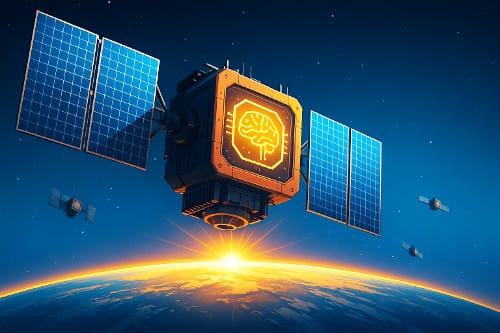
If you’ve ever wondered where all our data actually lives, you’ve probably heard the comforting term “the cloud.” Of course, that cloud is really a collection of physical servers packed inside noisy, power-hungry warehouses scattered across the globe. But what if the next version of the cloud doesn’t sit on Earth at all?
That is exactly what a handful of innovators are exploring. And with Google’s new Project SunCatcher, the concept of space-based AI infrastructure is moving from science fiction into real-world research. The idea is simple enough to sound crazy: move AI data centers into orbit, where they can soak up endless sunlight, operate in microgravity, and power the next generation of intelligent systems.
The Great Leap from Cloud to Cosmos
Our current data infrastructure is impressive but under pressure. Every time someone asks ChatGPT to draft an email, or Midjourney to render an image, or Gemini to summarize an article, those requests pull from massive GPU clusters that consume staggering amounts of electricity. Some AI training runs now use more energy than a small city.
That rising demand has pushed engineers to look upward, literally. Above the atmosphere, solar energy is abundant, cooling is efficient, and there’s no need for land, water, or zoning. A satellite in orbit can harvest continuous sunlight and radiate waste heat into the dark cold of space.
Google’s SunCatcher is built around that simple idea. Instead of expanding data centers outward across the planet, the company is experimenting with expanding upward into space, building compute constellations powered entirely by sunlight.
Project SunCatcher
Announced in late 2025, Project SunCatcher is Google’s research initiative to design a scalable AI compute system that lives in orbit. It’s still in the early stages, but it comes with real engineering blueprints and published research describing how it could work.
SunCatcher envisions constellations of AI satellites operating in sun-synchronous orbits, where they are almost always exposed to sunlight. Their solar arrays could generate power nearly 24 hours a day. Each satellite would contain high-performance processors, likely versions of Google’s Tensor Processing Units (TPUs), and communicate with others through laser-based optical links capable of transmitting data at terabits per second.
In theory, this could create a kind of orbital neural network. Each satellite would work together with others in real time, training or running large language models and vision systems without relying on ground-based data centers.
Why Space Makes Sense for AI
The first advantage is energy. Solar power in space is far more efficient than on Earth because there’s no atmosphere to block or scatter light. In some orbits, solar panels receive up to eight times more usable energy than those on the ground.
The second advantage is cooling. AI computation generates intense heat, and data centers on Earth spend nearly half their energy budget on cooling. In space, radiative cooling is naturally efficient. Heat can be emitted through carefully engineered panels that glow in infrared and release thermal energy directly into the void.
A third advantage is independence from Earth’s resources. Data centers require land, water, and access to power grids. Space-based systems need none of that. They don’t compete with agriculture or local utilities, and they avoid political or environmental disputes tied to infrastructure.
Finally, there’s the potential for real-time processing. AI models in orbit could process satellite imagery, weather data, or planetary sensor streams directly, without transmitting raw data back to Earth. This creates what researchers call “cosmic edge computing,” an AI network hovering above the planet that can analyze, learn, and act on information as it happens.
Technical Challenges
Of course, none of this is easy. Space is unforgiving. Radiation, temperature swings, and micrometeoroids can quickly damage electronics. Every launch costs money, and maintenance hundreds of miles above Earth is extremely difficult.
To address that, Google’s engineers have been testing radiation-hardened TPUs. Early prototypes have shown resilience up to about fifteen kilorads, which is surprisingly robust for commercial chips.
Communication is another challenge. To link satellites together into a functional network, Google proposes using optical communication rather than radio. Laser-based links could deliver multi-terabit bandwidth, potentially making orbital AI as fast and interconnected as the biggest terrestrial cloud clusters.
Managing heat is tricky too. While space is cold, getting rid of excess heat from tightly packed electronics requires thoughtful design. Radiators must be large, lightweight, and capable of radiating in the right wavelengths to keep chips stable.
And then there’s cost. Even with launch prices dropping below two hundred dollars per kilogram by the mid-2030s, sending large amounts of hardware into orbit is expensive. Yet Google’s research suggests that at scale, orbital AI compute could become economically competitive with Earth-based facilities, especially when you account for free solar energy and reduced cooling costs.
A Broader Movement Beyond Google
Google is not the only player thinking about orbital computing. Microsoft’s Azure Space division is integrating satellite connectivity with its cloud systems. Amazon’s AWS Ground Station lets researchers control satellites directly from their cloud consoles. IBM and the European Space Agency are experimenting with in-orbit AI analysis of telescope data.
Smaller companies are also entering the picture. Lonestar Data Holdings is testing lunar-based servers. Others are exploring mesh networks of satellites dedicated to environmental AI systems that might monitor deforestation or ocean health from orbit, running machine learning locally.
All these efforts point toward the same idea: compute is leaving the ground. Just as the internet moved from local servers to the cloud, we may now be witnessing the early move from the cloud to the cosmos.
The Creative Possibilities
For artists, writers, and independent technologists, this future has surprising implications. Every creative tool we use—from image generators to video editors—depends on computing power. If that power becomes abundant, clean, and orbital, creative freedom expands dramatically.
Imagine a generative art project that uses live satellite data to paint cloud movements across a digital canvas. Imagine a composer tapping into magnetospheric sensors to turn the Earth’s natural rhythms into music. Or imagine a filmmaker using orbital rendering farms that run entirely on solar energy, their radiators glowing gently in the night sky.
Throughout history, new infrastructure has always fueled new art forms. The printing press gave us the novel. Photography gave us cinema. The cloud gave us AI-assisted creation. It’s easy to picture orbital computing giving rise to a new creative medium—one that turns real-time planetary data into color, sound, and motion.
The Deeper Meaning Behind SunCatcher
There’s a poetic side to all this. Artificial intelligence began as a reflection of human reasoning, built from circuits and code. Now it’s rising into space, orbiting the very planet that imagined it. It’s as if intelligence itself is beginning to wrap around Earth, illuminated by sunlight.
Google’s researchers note that the Sun provides over one hundred trillion times more energy than humanity currently uses. The idea of drawing just a fraction of that to power computation reframes the relationship between AI and nature. Instead of seeing AI as an energy glutton, SunCatcher imagines it as something that harmonizes with the cosmos.
It’s an audacious but strangely organic vision: a planetary mind fueled by the same light that grows our food and warms our skin.
What Comes Next
Project SunCatcher is still experimental. Google has not announced any specific launch schedule, though the company hints that prototype missions could happen before 2030. If successful, these would be the first true orbital data centers, proof that AI can live and work in space.
But with innovation come responsibilities. Space is already crowded with satellites, and debris is a growing concern. The more infrastructure we add, the more we must think about regulation, sustainability, and global access.
Even so, the vision is inspiring. A future where AI compute is powered by sunlight and cooled by starlight is one where technology feels a little less extractive and a little more symbiotic.
So the next time you ask an AI to create a painting or write a melody, imagine your request traveling not through server farms in Virginia or Oregon, but through beams of light connecting satellites above the planet. Somewhere, in orbit, an array of processors is catching the Sun, turning pure energy into thought.
by Patrix | Nov 5, 2025
Imagine a world where everything you own, from your beach house to your concert ticket to the tiny watercolor you just painted, exists as a digital token—a unique, verifiable object on a global network. Not a copy, not a file on your computer, but a token that proves ownership, authenticity, and sometimes even emotion. That’s the tokenized world we’re heading toward, and whether we notice it or not, it’s already taking shape beneath our feet.
The New Language of Value
For most of history, ownership was physical. You held a deed, a coin, or a painting. The internet shattered that logic. Suddenly, value could move at light speed, but proof of ownership couldn’t. Blockchain technology fixed that gap. It introduced the idea of a token, which is a kind of digital certificate that says, “This belongs to me.”
Bitcoin was the first major example. It proved digital scarcity was possible. Then Ethereum showed we could tokenize just about anything: art, music, even tweets. And now, as the technology matures, we’re moving toward a world where every object, idea, or access point can be represented by a token.
Tokenization in Everyday Life
Think beyond crypto collectibles or meme coins. Imagine these scenarios:
- A musician releases a limited run of songs as collectible tokens. Fans can trade them or use them as keys to private shows.
- A photographer sells access to their entire portfolio as a fractionalized token, allowing patrons to share in its future value.
- Real estate gets tokenized, making it possible to invest in a slice of a vacation home rather than buying the whole thing.
- Even your reputation or social media presence could be tokenized, transforming online influence into tangible value.
In this sense, tokenization becomes a kind of digital fabric. It’s an invisible layer of ownership that threads through our economy and culture.
The Psychological Shift
When everything becomes tokenized, the way we think about value changes. Ownership is no longer about possession; it’s about participation. A digital artist might still “own” their original file, but the value of their token lies in its story and the network of people who believe in it.
We’re already seeing this with NFTs. A painting in your living room might have sentimental value, but a digital token can carry community value. It blurs the line between collector and creator. Everyone becomes part of the creative economy.
There’s something almost poetic about that. The world becomes a gallery, and each token a brushstroke in a collective artwork.
The Good, the Weird, and the Inevitable
Like any major shift, tokenization comes with tension. It’s not just about technology; it’s about human behavior.
On the good side, tokenization democratizes access. It opens doors for people who never had them—small creators, global investors, artists in remote towns. It makes the economy more liquid, more transparent, and potentially more fair.
On the weird side, it also risks commodifying everything. When even your digital identity has a token price, what happens to authenticity? Will art still feel sacred when it’s instantly tradeable? Will friendship or community lose something if loyalty points become financial assets?
And yet, this evolution feels inevitable. The internet has always pushed us toward abstraction. From gold to paper to pixels to tokens, we keep reimagining what “value” means.
Art in the Age of Tokens
For artists, tokenization is both liberation and labyrinth. It means direct connection with audiences, verifiable provenance, and income streams that don’t rely on middlemen. But it also means navigating marketplaces, smart contracts, and the psychological weight of constant monetization.
Still, artists have always been at the forefront of new mediums. From the first cave painter to the first crypto artist, creation and experimentation go hand in hand. In many ways, tokenization restores something ancient: the human need to prove, “I made this,” and to have that statement echo across time.
When the World Itself Becomes a Ledger
One day, we may wake up and realize that tokenization isn’t just a feature of the economy; it’s the economy. Your car’s maintenance record, your diploma, your medical data, your digital garden of AI-generated art—each tokenized, portable, and under your control.
It’s easy to see this as dystopian or utopian, depending on your mood. The truth, as usual, will probably be somewhere in between. The key question is not whether everything will be tokenized, but how we’ll behave once it is.
Will we treat tokens as mere assets, or as meaningful artifacts of human creativity? Will we use them to build trust and community, or to speculate and divide?
If we get it right, tokenization could become one of the most empowering technologies of our lifetime. It’s a bridge between art and math, between ownership and identity. A world where value is no longer confined to banks and galleries, but flows freely, beautifully, and verifiably among us.
And maybe, when everything becomes a token, we’ll finally see that the real value was never in the token itself, but in the human stories behind it.