by Patrix | May 14, 2025
You wouldn’t leave a gold bar on your kitchen counter, right? So why would you leave your Bitcoin sitting on an exchange or in a hot wallet that’s always online?
If you’re serious about crypto—especially as a long-term holder—cold wallets are the digital equivalent of a high-security vault. In this article, we’ll walk through what they are, why they matter, best practices for using them, and how the top cold wallets stack up in 2025.
What Is a Cold Wallet?
A cold wallet is a type of Bitcoin wallet that is not connected to the internet. It stores your private keys offline, drastically reducing the risk of hacks, phishing, and malware.
Why Use a Cold Wallet?
- Protection from hackers: If it’s offline, it can’t be remotely hacked.
- Self-custody: You hold your private keys, not some third-party exchange.
- Resilience: Immune to exchange failures (FTX, anyone?).
- Long-term storage: Ideal for HODLing without worry.
- If you believe in “not your keys, not your coins,” cold storage is your insurance policy.
Best Practices for Cold Wallet Use
Before we get into the gear, here are some time-tested tips:
- Buy directly from the manufacturer: Avoid resellers to prevent tampering.
- Backup your seed phrase (preferably offline, ideally etched in metal).
- Use a passphrase (but don’t forget it—it’s not recoverable).
- Keep your device offline unless signing transactions.
- Don’t take photos of your seed phrase (no, not even “just once”).
The Top Cold Wallets of 2025: Compared
Let’s size up the current heavyweights: Tangem, Ledger, Trezor, and ColdCard.
1. Tangem Wallet (Card-Based Simplicity)
What it is: A smartcard-style wallet that stores keys in a secure chip, used via NFC with your phone.
Pros:
- Extremely easy to use—ideal for beginners.
- No seed phrase to write down (uses backup cards instead).
- Truly “set and forget.”
Cons:
- Trust model depends on their chip provider and firmware transparency.
- Limited transparency vs. fully open-source wallets.
Best for: Casual users or gift-giving, but not for deep cold storage.
2. Ledger Nano X
What it is: A sleek, Bluetooth-enabled hardware wallet with a built-in battery and mobile support.
Pros:
- Very portable and easy to pair with smartphones.
- Secure Element chip for hardware-based protection.
- Supports a wide range of cryptocurrencies.
Cons:
- Firmware is not fully open-source.
- Past controversy around “Ledger Recover” shook community trust.
Best for: Multi-asset users who prioritize convenience and mobility.
3. Trezor Safe 3
What it is: Trezor’s latest wallet, featuring a Secure Element chip and USB-C support.
Pros:
- Combines open-source firmware with modern hardware security.
- Offers a Bitcoin-only version for purists.
- Excellent transparency and usability.
Cons:
- No touchscreen.
- No Bluetooth (which could be a plus for security-focused users).
Best for: Users who value transparency, open-source ethics, and straightforward cold storage.
4. ColdCard Mk4
What it is: Bitcoin-only wallet designed for maximum privacy and air-gapped use.
Pros:
- Completely air-gapped via microSD.
- Built with multisig and PSBT workflows in mind.
- Fully open-source and security-obsessed.
Cons:
- Intimidating for beginners.
- UI feels like a throwback to early computing.
Best for: Advanced users, cypherpunks, and Bitcoin maximalists.
Which Cold Wallet Is Right for You?
It depends on your comfort level, goals, and geek quotient:
- Just getting started? Try Tangem or Ledger Nano X.
- Want transparency with modern security? Go with Trezor Safe 3.
- All in on Bitcoin and privacy? You’ll love ColdCard Mk4.
But no matter what you choose, here’s the real win: You’re moving your Bitcoin off exchanges and into your own custody. That’s where it belongs.
Still storing your Bitcoin on an exchange? Now’s the time to take control. Pick a wallet that matches your style and secure your future. Got questions? Drop a comment or message us at ArtsyGeeky—we’re always up for a good wallet debate.
by Patrix | May 5, 2025
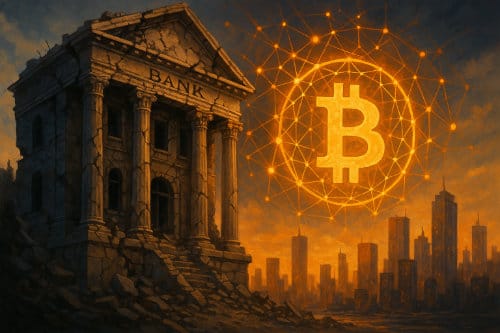
The U.S. banking system is, to put it kindly, creaking at the hinges. With recent bank failures, mounting distrust in central institutions, and a persistent sense that the financial rules are being rewritten in boardrooms far from public view, more Americans are beginning to question whether the current system still serves them. For decades, traditional banks have acted as gatekeepers to wealth, credit, and stability. But now, Bitcoin—a decentralized, internet-born currency once dismissed as a geeky pipe dream—is beginning to look like a serious alternative.
The irony is rich: a technology created to bypass the financial system might end up rescuing it, or at least forcing it to evolve.
A House of Cards in a Windstorm
The financial house Americans are told to trust is built on a system called fractional reserve banking. Banks take your deposits, promise to keep them safe, and then lend most of that money out to others. In good times, this model hums along. But when interest rates jump or borrowers get nervous, the whole thing can wobble—fast. That’s precisely what happened with Silicon Valley Bank in 2023. What looked like a healthy institution collapsed in the span of days when too many depositors tried to pull out cash that simply wasn’t there.
Even when they’re not failing outright, banks are growing increasingly centralized. The biggest institutions—JPMorgan Chase, Bank of America, and a few others—now dominate the sector. Smaller banks are either folding or getting swallowed up. The phrase “too big to fail” isn’t just a political talking point—it’s the reality of modern American finance. This consolidation leads to fragility, not resilience.
And while all this is going on, the dollar itself is quietly losing value. Years of aggressive money printing, especially during COVID-19, have pushed inflation into everything from eggs to housing. For most people, wages haven’t kept up. The bank account may say the same number, but what that number buys is shrinking.
The Bitcoin Provocation
Enter Bitcoin, stage left, wearing a digital hoodie and refusing to play by the rules. From the moment of its birth in the shadow of the 2008 financial crisis, Bitcoin positioned itself as a radical alternative—a system that didn’t need banks, or governments, or trust. Just code.
For those raised in the old system, this idea can be unsettling. But to a growing number of people around the world, it’s starting to feel like liberation. If you can store your savings in a decentralized network that no central bank can inflate, and if you can send money to anyone, anywhere, anytime—without needing a middleman or begging for permission—that changes the very definition of what a bank is. Or whether we need them at all.
Bitcoin’s fixed supply is perhaps its most audacious feature. Only 21 million coins will ever exist. Compare that to the dollar, whose supply can expand at the stroke of a Federal Reserve keyboard. For savers in places like Argentina, Lebanon, or even the U.S., Bitcoin offers something rare: predictability.
More Than a Protest, a Practical Tool
Still, Bitcoin is not just a protest against the old world. It’s already solving real problems. In Nigeria and Venezuela, people use it to escape hyperinflation. In Ukraine, it helped fund grassroots resistance during wartime when banks were offline. And in the U.S., where millions are unbanked or underbanked, it offers a way to store and move value outside a system that too often excludes or exploits.
Of course, Bitcoin has its flaws. It’s volatile. It can be complex and intimidating to new users. Its energy use has drawn criticism, though much of that is being addressed through renewable mining initiatives. And while the technology continues to evolve (the Lightning Network being a promising layer for faster payments), it’s still early days.
But to dismiss Bitcoin for these imperfections is to miss the larger picture. It’s not just a new kind of money—it’s a pressure valve. A challenge to the idea that financial power must be centralized. A call to reimagine what money can be in a world where trust in institutions is eroding.
A Future with Two Paths
It’s unlikely that Bitcoin will replace the U.S. banking system outright. But it doesn’t need to. Its very existence is forcing a reckoning. Some banks will resist, lobbying against crypto innovation and doubling down on control. Others will adapt, offering Bitcoin custody, integrating blockchain infrastructure, and rethinking how they serve customers in a world that demands more transparency, fairness, and access.
What’s becoming clear is that the status quo is no longer enough. The cracks are visible. Bitcoin might not be the final answer—but it’s asking the right questions.
by Patrix | Apr 21, 2025
It started with a missed shot. Someone blamed the wind. Someone else blamed the paddle. And someone else blamed the cracks on the court. Then someone (let’s call him Patrick) said “Well, sometimes I am for the cracks.” Then the lady with the green glasses made one simple gesture: with an exaggerated surprised look on her face, she covered her butt with her paddle.
They laughed for minutes.
It’s not just a sport—it’s a stage. A recurring ensemble of characters shows up, paddles in hand, ready to rally and razz. And now, thanks to artificial intelligence, you can capture the drama, comedy, and chaos of your pickleball life in the form of a cartoon strip. No drawing skills required; just your imagination.
AI as Your New Comic Artist
I’ll admit, I was skeptical at first. Turning real-life moments into a cartoon seemed like something that required either years of practice or a teenager with Procreate. But AI image generators—like DALL·E, Bing Image Creator, Midjourney, and even ChatGPT—have gotten weirdly good at turning text descriptions into colorful, expressive visuals. Especially when you give them something playful to work with.
Pickleball, it turns out, is a perfect subject.
What Makes a Good Comic?
You don’t need much. Four or five panels is enough to tell a small story—something silly, familiar, and just exaggerated enough to make your friends laugh out loud (or groan).
The Characters
It helps to exaggerate a little. That quiet guy who’s secretly competitive? Turn him into a shadowy figure practicing dinks by moonlight. The friend who always shows up in matching visors and wristbands? She becomes the team fashion icon, complete with sparkles and a signature smirk.
To keep the AI from getting confused, I learned to describe characters consistently in every prompt. “Slim man with grey cap and right knee brace, cartoon style” became shorthand for Patrick. Cari? “Petite woman with green sunglasses and a white visor, energetic expression.” AI doesn’t remember from panel to panel, so you have to guide it carefully. But once you get the hang of it, it becomes a fun little collaboration—part art project, part improv comedy.
The Joy of Seeing It on the Screen
I think what surprised me most was how satisfying it was to see these ridiculous court moments frozen in cartoon form. Not polished. Not perfect. But funny in a way that felt both personal and sharable.
And the process—assembling the panels, adding text bubbles, tweaking expressions—reminded me that storytelling doesn’t have to be high art. Sometimes it’s just four friends on a pickleball court, trying to figure out which paddle is which, or which cracks are which.
It’s Not About the Art. It’s About the Memory.
AI can’t replace the warmth of real-life friendships, or the squeak of shoes on the court, or the quiet satisfaction of a well-placed drop shot. But it can help you capture those fleeting moments in a form that’s easy to share and impossible not to smile at.
You don’t need to be a tech expert. You don’t need to understand how neural networks work. All you need is a story—and a willingness to play with it.
Pickleball already gives you the characters, the drama, and the punchlines. All AI does is draw the panels.