by Patrix | Nov 3, 2025
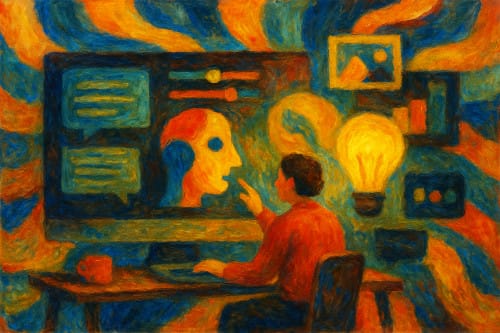
The first time you open Google AI Studio, it feels like walking into a modern art lab. There are buttons, sliders, and glowing boxes full of potential. It looks technical at first, but within minutes you realize it’s less like coding and more like sketching with light.
For creative people such as writers, painters, designers, retired tinkerers, or anyone curious about artificial intelligence, Google AI Studio might be one of the most quietly powerful creative tools of the year.
A Playground for AI Curiosity
Google AI Studio is Google’s free, browser-based interface for exploring its Gemini AI models. These are the same language models that power Gemini, formerly Bard, but here you can guide and shape their responses directly. It’s a conversational sandbox where you can build your own digital assistant, art muse, or idea generator.
There’s no software to install and no coding experience required. You sign in with your Google account and step into a workspace where you can type prompts, test responses, and adjust the “temperature” of the model. That setting controls how imaginative or precise the AI behaves. A lower temperature produces steady, factual answers. A higher one lets the AI wander creatively, like a jazz musician exploring a theme.
Turning Ideas Into Quick Prototypes
Imagine you’re brainstorming a new story concept. You can feed a short description into AI Studio and ask for possible character arcs, emotional tones, or even snippets of dialogue. A digital artist could use it to refine Midjourney prompts until the imagery matches what they see in their mind. A small business owner might experiment with product descriptions or short ad scripts.
Because you can adjust the AI’s settings on the fly, it feels like jamming with a creative partner. The tool doesn’t just answer questions; it helps you iterate. You can keep nudging the idea until it feels right.
The experience is less like programming and more like co-creating.
Build Something You Can Share
Once you’ve shaped an idea or prompt that works well, Google AI Studio lets you turn it into a shareable prototype. With just a few clicks, you can generate a public link or even an API endpoint that developers can connect to a website or app.
Even if you never plan to code, this means you can design experiences that others can use. Imagine creating a journaling assistant, a creative writing coach, or a generator that helps artists craft better image prompts. It’s possible to do all of this inside AI Studio without touching a single line of code.
In a sense, Google has made it easy for non-engineers to start thinking like toolmakers.
A Transparent Window Into AI Thinking
One of the most fascinating parts of AI Studio is how clearly it shows what the AI is doing. You can see how changes in your prompt structure affect responses. You can watch how adjusting one parameter alters the tone or level of detail.
It’s a friendly introduction to the new skill of prompt engineering. Understanding how AI responds to language is becoming as practical today as knowing how to use Photoshop was twenty years ago.
For creative people, this kind of visibility removes the mystery. It shows that AI is not an oracle but a mirror that reflects human patterns. Once you see that, you can use it more consciously and with more playfulness.
Seamless with the Google Ecosystem
If you already live inside Google’s world with Docs, Drive, and Gmail, AI Studio will feel familiar. It connects easily to Google Cloud Vertex AI if you decide to expand into more serious development. You can begin as a hobbyist and grow into a builder without switching platforms.
Collaboration is simple too. You can share a project with a friend, student, or teammate. They can run the same prompt, tweak it, and send feedback. It’s like passing your sketchbook across the digital table.
A Creative Bridge, Not a Technical Barrier
AI Studio represents a quiet but important shift. It takes something deeply technical and makes it human again. The interface invites exploration rather than intimidation.
For artists and writers, it’s a place to test what AI can do for your craft. For educators, it’s a playground for designing interactive lessons. For retirees or lifelong learners, it’s a relaxed way to understand the next big leap in technology.
The beauty of AI Studio is that it rewards curiosity. You don’t need to know how it all works under the hood. You just need a question, an idea, or a dream to start with.
The Joy of Experimenting
The more time you spend in AI Studio, the more it starts to feel like a sketchpad that responds. Some experiments fail, others surprise you. But every session leaves you with a deeper sense of what’s possible.
That’s what makes it special. It encourages play. It encourages curiosity. It helps you see that AI is not just a tool for tech companies. It’s a new kind of creative partner.
Next time you’re sipping coffee and wondering what to make next, open Google AI Studio. You might find yourself building something delightfully unexpected.
by Patrix | Oct 31, 2025
If 2025 was the year everyone started talking to machines, 2026 will be the year we learn to talk beautifully to computers.
Across studios, coffee shops, and kitchen tables, artists and writers are discovering something quietly revolutionary: words are becoming brushstrokes. The way we describe an image to an AI model is starting to feel less like coding and more like painting. The prompt has evolved into a genuine art form, and how we craft it may soon define our creative era.
This isn’t about replacing artistry. It’s about extending it.
The Rise of the Prompt Era
There was a time when learning digital art meant memorizing software shortcuts. You knew your brushes in Photoshop or your layers in Procreate. But in 2026, the most powerful tool in the artist’s kit will language. It’s not what you click, it’s what you say.
Large language and diffusion models have matured. Tools like ChatGPT, Midjourney, DALL·E, and Google’s Gemini all interpret our phrases with nuance. Instead of telling a computer what to do, we tell it what to feel. A single sentence can now conjure entire worlds.
Why Prompts Are Like Brushstrokes
Think about how a painter works. A brushstroke can be gentle or bold, abstract or precise. The same goes for prompts. Every word carries a texture, a rhythm, a tone.
Try it.
Type this: “a cat in a garden.”
Now try this: “a sleepy Siamese cat lounging under pink bougainvillea, morning sunlight dappling its fur, watercolor style.”
Both describe a cat. Only one feels alive.
The difference isn’t in the AI; it’s in you. The artist’s voice has moved from the canvas to the sentence. The AI merely reflects it back.
We are discovering that the smallest change in phrasing—adding warmth, mystery, or mood—shifts everything. Like brush pressure or pigment density, language becomes the medium of emotion.
Finding Your Prompting Voice
Every artist has a signature. You can spot a Van Gogh sky or a Hopper shadow from a distance. The same individuality is emerging in prompt writing.
Your “prompting voice” is a mix of vocabulary, rhythm, and worldview. Some artists lean poetic. Others think in cinematic scenes or music-inspired imagery. The key is to write the way you see.
- Think in senses. Use texture, sound, and atmosphere. Instead of “a city,” say “a rain-washed city humming with neon reflections.”
- Reference artistic movements. “In the style of mid-century poster art” gives AI cultural context.
- Combine opposites. “Surreal yet minimalist” creates friction that often sparks originality.
Prompting is no longer about commanding a tool. It’s about conversing with one. The more personal your phrasing, the more the result feels yours.
Curation: The Hidden Art Form
Even the best prompts don’t always yield perfect images. That’s where curation steps in—the quiet act of choosing and refining.
Scrolling through a dozen AI outputs is like flipping through contact sheets from an old film shoot. Somewhere in that grid lies the soul of your idea. The trick is knowing which frame speaks to you.
Artists today are mixing worlds. They blend Midjourney generations with Procreate touch-ups or combine AI drafts with watercolor washes. The computer’s precision meets the human hand’s imperfection. The two together create something new and strangely honest.
Ethics, Originality, and Intention
Let’s be honest: AI art still walks a tricky line. These systems learn from vast pools of human-created work. So where does originality begin?
For me, it begins with intention.
If your goal is expression, exploration, and emotional truth, then the machine becomes a collaborator, not a thief. Artists have always borrowed from the past. Think of the way jazz riffs on older melodies or how painters reinterpret myths. The AI simply amplifies that process.
The key is transparency. Know what tools you’re using. Acknowledge influence. Mix in your own layers, words, or paint. Authenticity lives not in the medium but in the maker’s awareness.
A Simple Experiment
If you want to feel the magic firsthand, try this:
- Write one short, plain prompt: “a sunset over the ocean.”
- Then rewrite it with emotion and imagery: “the last glow of an orange sun dissolving into calm Pacific waters, a lone pelican gliding through the reflection.”
- Generate both, and compare.
Most people are stunned. The second image feels like it carries a soul. That’s not because the AI suddenly became smarter. It’s because you did.
The Future of Creative Language
By early 2026, new tools will make this collaboration even richer. We’re already seeing AI systems that merge text, sound, and movement. Type a scene and watch it unfold as animation. Speak a mood and hear music adapt in real time.
Soon, art students might study “prompt literacy” alongside color theory and composition. The brush and the pen are still here—they’ve just gained a digital cousin.
What excites me most is not what AI can do, but what it reveals: that creativity has never been about medium or tool. It’s about translation—turning the invisible inner world into something shareable. Whether through oil paint or text prompts, the mission is the same.
History Rhymes
We are the first generation to paint with words that machines can see. It feels a little like magic, and a little like history repeating itself.
Painters once feared photography. Writers feared the typewriter. Musicians feared the synthesizer. Each time, creativity adapted. And each time, art became more human, not less.
So yes, prompts are becoming the brushstrokes of our time. But they are still guided by the same hand, the same heart.
by Patrix | Oct 29, 2025
When I first picked up watercolor, I assumed it would be the easy, meditative cousin of acrylics. After all, how hard could a few transparent washes be? Two hours later, I was staring at a murky brown puddle that had once been a hopeful sunset. That was the moment I realized watercolor isn’t just a medium. It’s a mindset.
Learning watercolor is like learning to surf or meditate or even use new tech tools. It punishes your need for control and rewards your willingness to adapt.
The Myth of Control
If you come from the world of digital art or even acrylics, watercolor feels like chaos. There is no “undo” button. Once that paint blooms across the paper, it is there for good. The brush hesitates for half a second too long, and the pigment decides to take a vacation in an unexpected direction.
Here’s the secret: watercolor teaches you to work with the medium, not against it. You start to notice how water moves, how paper absorbs, how color settles. You learn that a little patience and a lot of humility go further than a thousand “perfect” strokes.
Over time, you stop fighting the unpredictability, and that is when things start getting beautiful.
Mistakes That Make Magic
Every watercolorist has that moment when you spill water on your nearly finished piece. Panic sets in. But when it dries, the paper’s texture adds something you never could have planned — a subtle bloom, a soft transition, a hint of life.
Watercolor thrives on accidents. The best painters know this and use it deliberately. They will drop in clear water to create halos or tilt the page to let gravity paint for them. It is part skill, part surrender.
That is a life lesson in disguise. We spend so much energy trying to “fix” our mistakes in art, in work, in relationships. But sometimes the trick isn’t to fix them. It is to look closer and see what new texture they add.
What Watercolor Teaches About Technology
I once tried to paint while an AI tool “watched” me, with my webcam feeding into a style-analyzing app that predicted what I would do next. The irony was rich. Watercolor does not want to be predicted. That is its charm.
In a way, painting with watercolor is the analog antidote to our algorithmic lives. It resists control. It refuses perfection. It demands presence. And yet, that makes it oddly compatible with the digital world, a reminder that creativity isn’t about precision, it is about participation.
We talk a lot about “training data” in AI. Watercolor trains you. It rewires your expectations. It teaches you to enjoy the unpredictability and to trust that not every splash needs to be optimized.
The Tools Don’t Matter as Much as You Think
Watercolorists love to debate brushes and paper brands. Cold press or hot press, synthetic or sable, you will find endless opinions online. But here’s the truth: a two-dollar brush and a coffee mug of water are enough to start learning the watercolor mindset.
This is good news for tech lovers who already suffer from gear acquisition syndrome. With watercolor, the constraint is the freedom. The fewer choices you have, the more you notice what really matters — light, pigment, and patience.
I once painted an entire beach scene using leftover pigment on a travel palette and a hardware-store brush. It was not perfect, but it felt alive. That is the point.
Painting as a Metaphor for Living
Watercolor dries lighter than it looks. Every beginner learns this the hard way. You paint something bold and beautiful, only for it to fade into whispery pastels. It is frustrating, until you realize it is also kind of poetic.
Life is like that too. The moments that feel too intense, too messy, too heavy often dry softer than we expect. With a little time, the harsh edges fade, and what is left is something tender and worth keeping.
Maybe that is the ultimate watercolor mindset: not to chase perfection, but to stay curious about what the water will do next.
A Creative Life with a Bit of Blur
Learning watercolor will not make you rich or famous. But it might make you kinder, to yourself, to your mistakes, and to the process. You stop demanding that every attempt be “finished” and start seeing each page as an experiment in letting go.
And who knows? In that gentle blur between control and chaos, you might just find a clearer version of yourself.
by Patrix | Oct 28, 2025
If you run a small business, this is your wake-up call. Artificial intelligence is not a futuristic luxury or a tool reserved for tech giants. It is the new electricity, quietly rewiring every industry, every process, and every assumption about what it means to run a company. And here’s the hard truth: small businesses that do not learn how to use AI soon risk being left behind in a world that moves at algorithmic speed.
We are entering an era where hesitation can cost not just efficiency but survival. The pace of change is breathtaking, but the opportunity is even greater.
The New Business Divide: Those Who Adapt, and Those Who Disappear
Think back to the early days of the internet. Some small businesses shrugged off websites as unnecessary. “We are a local shop,” they said. “Our customers already know where to find us.” Fast forward a decade, and many of those shops were gone. AI is that same moment all over again, only faster and bigger.
Today, AI is not just about automating a few tasks. It is about redesigning how business gets done. It covers customer service, marketing, bookkeeping, logistics, HR, and creative direction, all enhanced by intelligent automation. Tools such as ChatGPT, Claude, and Perplexity can draft proposals, generate social media content, respond to customers, and analyze data patterns that humans would never notice. Midjourney and Runway can produce visuals that once required full design teams. Even small-town bakeries can use predictive analytics to know exactly how many croissants to make tomorrow morning.
This is not just innovation. It is a survival strategy.
You Don’t Need a Tech Department. You Need Curiosity
One of the biggest misconceptions is that AI is complicated. It is not. What is complicated is clinging to old habits.
Small businesses do not need data scientists or custom-built algorithms to begin. What they need are owners and managers who are willing to experiment. A solo entrepreneur can now access the kind of analytical power that once belonged only to corporations with large research budgets. Most AI tools are plug-and-play, cloud-based, and surprisingly affordable.
If you can type, you can prompt. If you can explain a task to an employee, you can explain it to an AI assistant. The real skill is learning how to ask the right questions, how to translate your goals into clear instructions. That is not a technical ability; it is a creative one.
The Real Urgency: The AI Advantage Compounds
Here is the part most people do not see. The AI learning curve has compounding returns. Businesses that start early do not just save time; they build data, refine workflows, and develop experience that keeps improving over time. Every week you wait is a week your competitors are teaching their AIs to serve their customers better, faster, and cheaper.
Picture two graphic design studios today. One experiments with generative design tools, AI upscaling, and automated proposal writing. The other decides to “wait and see.” In a year, the first studio’s productivity doubles while its costs drop. In two years, its client experience feels effortless and almost magical. The second studio is still wondering what happened.
Small Businesses Have a Superpower: Agility
Large corporations move like cruise ships. They take forever to turn. Small businesses are speedboats, quick to maneuver and capable of changing direction in a single day.
You do not need a committee to approve a new process. You can test an AI tool on Monday, refine it on Tuesday, and see results before the week is over. The smaller your team, the easier it is to adapt workflows, experiment with automation, and find the right balance between human creativity and machine efficiency.
Many small business owners still assume AI is a threat. In reality, it is their best equalizer. The same technology that makes billion-dollar companies more efficient can make your one-person operation feel ten times larger.
The Human Touch Still Matters, Even More So
AI does not replace human authenticity; it enhances it. The businesses that thrive in this new era will be the ones that blend automation with warmth. Imagine AI handling your scheduling, bookkeeping, or marketing drafts so that you can focus on what only you can do: personal connection, local storytelling, and exceptional service.
People crave realness, especially as more interactions move online. Use AI to streamline, not sterilize. Let it handle the heavy lifting so your humanity shines brighter.
Where to Begin (Today, Not Tomorrow)
Start small, but start now.
Use AI chat tools to draft emails or customer responses. Try an image generator for product photos or marketing visuals. Use AI bookkeeping assistants to track expenses. Experiment with automated analytics to understand sales patterns.
The goal is to build habits, small daily integrations that add up to major transformations. Once you see what is possible, you will never want to go back to doing everything manually.
The Bottom Line
The AI revolution is not on the horizon; it is already here, reshaping the foundation of modern commerce. For small businesses, this is not the time to hesitate or debate the meaning of change. It is the time to act, to learn, and to explore.
You do not need to become an expert. You just need to stay curious and nimble. The future will not wait for you to catch up, but if you start now, you may find that it is the most exciting and empowering era small business has ever seen.
by Patrix | Oct 27, 2025
Creativity rarely shows up on command. You can open your laptop, cue your favorite playlist, even brew the perfect cup of coffee, and still find your ideas stubbornly silent. But walk toward the ocean, and something shifts. The chatter in your head starts to soften. Thoughts become lighter, looser. Somewhere between the sound of surf and the scent of salt, your creative mind quietly wakes up.
The beach, it turns out, might be one of the best creative studios there is. No rent, no deadlines, no desk. Just an open invitation to see differently.
The Natural Reset Button
Modern life keeps us perpetually switched on. We scroll, swipe, and refresh more often than we breathe deeply. Our brains are remarkable at processing information, but they are terrible at resting while doing it. The result is a kind of low-grade static that dulls imagination.
The beach doesn’t participate in that noise. Its rhythm is ancient, steady, and impossible to rush. The tide will come in, whether your notifications do or not. When we spend time near that rhythm, we subconsciously match it. Our thoughts slow to something closer to the pace of waves. That slowness is not laziness. It is space, and space is where creativity lives.
The Science Behind the Calm
Marine biologist Wallace J. Nichols calls this state Blue Mind. It is a calm yet alert condition that often appears when we are near, on, or under water. In that state, stress hormones drop and alpha brain waves increase, the same gentle waves of relaxed focus that artists and meditators know well.
Science has finally caught up to what poets always suspected: proximity to water changes how we think. It helps ideas link together more fluidly, almost as if the brain itself starts to drift and merge like currents. Instead of forcing solutions, you begin to notice them. Instead of pushing for originality, you rediscover curiosity.
That simple shift is powerful. When you create from calm instead of pressure, the work feels more like discovery than effort.
A Studio Without Walls
There is something liberating about a workspace that never holds still. The beach is never the same two days in a row. Light moves across the sand like a brushstroke. Colors appear and fade. Even the air feels creative, reshaping every few seconds.
When you make art, write, or think in that environment, the landscape itself becomes a collaborator. You respond to it. You listen. You notice how sound carries differently when it moves across open space. You remember that impermanence can be beautiful, not inconvenient. In that sense, the beach is a lesson in creative flow. Nothing stays fixed. Neither should your ideas.
Bring only a notebook, a sketchpad, or an iPad if you must. Leave the perfectionism at home. Let the environment guide you instead of the outline. The result may surprise you.
Light, Air, and the Digital Detox
Most of us spend our creative hours bathed in artificial light. Screens tell us what color the world should be. Indoors, we work in rectangles, both literal and mental. When you step into natural light, something changes physiologically. Your pupils relax. Your posture opens. Your sense of depth returns.
The ocean reminds your body that you exist in more than two dimensions. The breeze moves across your skin. The light shifts minute by minute. This sensory variety feeds the mind’s need for novelty without overwhelming it. It is stimulation with space built in.
When you create in that kind of light, your attention expands. You stop producing and start participating. That is a rare feeling in a world that measures everything by output.
Imperfection as Inspiration
Sand is not a perfect surface. The wind will move your pages. Seagulls will critique your work loudly. The sun will shift at the worst possible moment. Yet all those inconveniences are part of the creative experience. They remind you that art and life are not meant to be frictionless.
Perfectionism is a form of control, and control is the enemy of discovery. The beach offers gentle resistance. It reminds you that beauty often comes from impermanence, just like wabi-sabi teaches in Japanese aesthetics. The sketch you make in uneven light might not be technically precise, but it might feel truer than anything you’ve made indoors.
The creative process, like the tide, erases itself and begins again. That impermanence is not a flaw. It is freedom.
Bringing It Back Home
Eventually, you pack up and leave the sand behind. You rinse off, open your laptop again, and return to deadlines. But something subtle lingers. Your mind feels less like a machine and more like a landscape. The noise is quieter. The work feels lighter. You realize that the beach did not just inspire you; it recalibrated you.
Creativity is not about running away from life. It is about reentering it with clearer vision. The beach reminds us that ideas grow in cycles, not straight lines. Every tide leaves something behind. Every retreat makes room for something new.
So the next time your mind feels crowded, skip the productivity hacks. Go outside. Let the ocean reset your inner studio. You might come home with pages of ideas, or maybe just a better way of seeing. Either is enough.