by Patrix | Oct 24, 2025
There is a quiet revolution happening in garages, spare rooms, and coffee shops around the world. It is not funded by venture capital or directed by tech giants. It is powered by curiosity, caffeine, and a handful of astonishingly capable AI tools. The people leading it are not CEOs or professional developers. They are artists, retirees, designers, and tinkerers. What they share is not scale or money but an inventive spirit.
This is the age of the AI Entrepreneur..
From Industrial Tech to Personal Tech
For the past two decades, technology has grown by getting bigger. Bigger models, bigger datasets, bigger budgets. The next decade may be defined by the opposite trend: shrinking the distance between a single human imagination and world-class capability.
AI has become the ultimate amplifier. A single person with a laptop can now prototype products, compose film scores, design buildings, and model markets. What once required a team of specialists now fits in a conversation window.
This does not mean collaboration is over. It means individuals can move at the speed of thought, guided by their own obsessions instead of corporate roadmaps. That is the real creative frontier.
The One-Person Studio
Imagine a retired architect using AI to design solar-powered beach cabins in 3D and selling the plans online. Or a poet training a small language model on her own writing so she can co-create new verses that feel like a dialogue with her younger self.
These are not fantasies. They are emerging realities. Tools such as Runway, ChatGPT, and Midjourney are dissolving the line between idea and execution. They let a person follow a spark of curiosity without needing to master every technical detail.
The result is a wave of new micro-studios: one-person creative engines that make, publish, and refine their work faster than most companies can organize a meeting.
Some call this “solopreneurship,” but that term feels too businesslike. What is really happening is a return to the workshop. It is a modern echo of the Renaissance artisan, only this time the apprentices are digital models, always available, endlessly patient, and surprisingly insightful.
The Rise of Intentional Obsession
Small-scale genius is not about doing everything. It is about focusing deeply on something that matters. AI provides leverage, but the direction still comes from human intention.
A photographer can use diffusion models to extend a visual style into motion. A gardener can train a simple plant-recognition model to understand what thrives in coastal soil. A musician can merge field recordings with generative harmonies to create soundscapes that feel alive.
The tools do not make the work meaningful. The curiosity of the creator does. The real genius lies in that pairing: a mind that notices something special and a machine that helps bring it into focus.
Why Big Companies Cannot Replicate This
Large companies are built for predictability. They need certainty, efficiency, and scale. Small-scale creators, on the other hand, can follow hunches. They can explore half-formed ideas, chase beauty, or build something just to see if it works.
That freedom is invaluable. It is why so many breakthroughs, from open-source software to indie games to early crypto projects, began as experiments by individuals rather than committees.
AI magnifies that effect. It allows one person to work at a scale that once required an organization while staying independent and agile. The creative economy of the future may look less like Silicon Valley and more like a constellation of small studios, each orbiting its own curiosity.
The Tools of Modern Genius
- ChatGPT or Claude: your thinking partner and idea refiner.
- Midjourney, Ideogram, or Leonardo AI: visual design studios in a browser tab.
- Runway, Pika, or Sora (when available): cinematic imagination engines.
- Canva, Notion, or Descript: finishing tools that make publishing effortless.
But the most powerful tool is not digital. It is the mindset that these tools encourage. They promote experimentation, speed, and reflection. You can fail quietly, learn fast, and share the results when ready. That is how real craft develops.
Rethinking Success
Small-scale genius does not need to go viral. It does not need millions of followers. Its measure of success is depth, not reach. Did you make something meaningful? Did you learn something new? Did your curiosity grow stronger?
This approach to creation feels almost rebellious in a culture obsessed with scale. But it is precisely that intimacy—the sense that a single person made this out of genuine fascination—that gives the work its power.
In a way, AI is restoring something ancient. It is making the individual workshop viable again. The world’s most advanced tools have become personal instruments. The future may not belong to whoever has the biggest model or the most GPUs, but to whoever has the clearest vision and the patience to refine it.
The Beauty of Staying Small
It is easy to confuse progress with expansion. Yet every ecosystem needs small, adaptive organisms that can thrive where giants cannot.
The small-scale creator can change direction overnight, follow inspiration instantly, and keep their work personal and distinctive. In that space, between curiosity and capability, innovation flourishes.
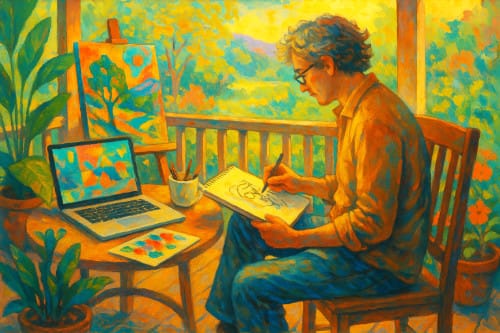
The genius of tomorrow will not be measured in patents or IPOs. It will live in quiet workshops, on handmade websites, in local galleries, and perhaps on a porch overlooking the Central Coast, where one person and a laptop are turning an idea into something that did not exist yesterday.
by Patrix | Oct 22, 2025
There is something quietly profound about the color grey. It does not shout. It does not sparkle. It does not demand your attention. Yet in the spaces between black and white, it holds the ground where most of life, and most of art, actually happens.
In a world obsessed with brightness and boldness, grey stands for something different. It suggests restraint, thoughtfulness, and quiet depth. Maybe that is why artists, designers, and philosophers return to it so often. Grey is the color of balance, and balance never goes out of style.
The Art of In Between
Grey is not a single color. It is a conversation. It is the meeting point of light and shadow, where the world stops being either or and becomes something more interesting.
Think of J. M. W. Turner and his stormy seas. He layered smoky greys to make the sky churn with emotion. Or think of the steel tones inside an Ansel Adams photograph, where texture and contrast tell more of the story than hue ever could. Grey is the pause that gives space to everything else.
For painters, grey anchors realism. You cannot capture light without an honest account of its absence. A well mixed neutral grey reveals the tone relationships that make a painting sing. For digital artists and designers, grey remains the secret backbone of good work. Every color is tested against it to see how it truly behaves on a screen or a print.
The magic of grey lies in its humility. It lets other colors shine while grounding them. It is the quiet friend in the room who makes everyone else more interesting.
Grey as Emotion
People often talk about seeing the world in black and white, as if clarity lives at the extremes. In truth, most inner lives unfold in shades of grey.
Grey carries the mood of a rainy afternoon when your thoughts feel both heavy and alive. It signals transition. It is the mist before dawn, the calm before a decision, the moment when you are open to a new angle you had not considered. Artists reach for it when they want to say something true that resists simple labels.
In Japanese aesthetics, this quiet restraint has a name. Wabi sabi celebrates imperfection and impermanence. It honors the soft patina of age and the beauty found in understatement. Grey lives comfortably in that space. It carries the wisdom that perfection is overrated and that time deepens form and feeling.
Even Apple, famous for minimalism, understands the emotional resonance of grey. Brushed aluminum, graphite cases, and muted tones communicate trust and calm. It is not the loud colors that make these objects beautiful. It is the greys that frame them and make small details feel intentional.
The Digital Shade
In the digital age, grey has taken on new meaning. It is the default background for many creative tools, including Photoshop, Figma, and Blender. Designers know that pure white can feel glaring and black can feel heavy. Grey creates a neutral ground where ideas can take shape without distraction.
There is a kind of poetry in that choice. Before any creation begins, you are greeted by a soft field of grey. It invites possibilities without prescribing them. It feels like a studio with even light and quiet air. Creativity breathes more easily in that environment.
In photography and film, colorists talk about the grey point. If that balance is wrong, everything feels off. If it is right, a scene takes on life and breath. The same principle carries over to printmaking and digital illustration. A reliable grey reference helps align tones, control contrast, and maintain cohesion across a series of images.
Grey also performs well across devices. Color management can be tricky. Saturated colors shift from screen to screen. A disciplined use of neutral greys stabilizes the visual experience and keeps the eye on composition and form.
Living in the Greys
Maybe the deeper lesson of grey is not just about art. It is also about how we see the world.
Modern life often rewards loud certainty. Opinions grow saturated. Timelines collapse into quick takes. Yet creativity and wisdom tend to show up in quieter places. The grey areas are where curiosity thrives and where good questions become better ones.
Grey reminds us that we can hold two ideas at once. Ambiguity is not weakness. Nuance is a form of respect. It gives complex subjects the room they deserve.
In painting, grey teaches patience. A painter learns to mix warms and cools into neutrals until the tones feel alive. In life, grey teaches perspective. Strong feelings do not disappear, but they gain context. You can see edges more clearly. You can choose with more care.
When you mix too much of any one color, things flatten out. When you let contrast breathe, and you allow the greys to speak, everything gains texture. The same is true of thinking. A measured approach creates depth that a quick certainty cannot match.
Grey is not indecision. It is complexity. It is the choice to refuse a simple story when the subject is richer than that.
A Palette for Creators
For the working artist or designer, grey is both tool and tutor. Here are a few practical ways to engage it with intention.
Start compositions on a neutral grey background. This helps you judge relative values and saturations more accurately than bright white. It also reduces eye fatigue during long sessions.
Test a palette in greyscale. Convert your scene to greyscale or use a value check layer in your software. If the piece reads well in values, the color choices will have stronger foundations.
Explore warm greys and cool greys. A touch of burnt umber or raw sienna shifts a neutral into warmth. A touch of ultramarine or phthalo blue shifts it into coolness. These small moves add emotional temperature without creating a crowded palette.
Use grey as a resting space. In layouts for web or print, neutral sections offer the eye a pause between saturated elements. This rhythm keeps the reader engaged without visual fatigue.
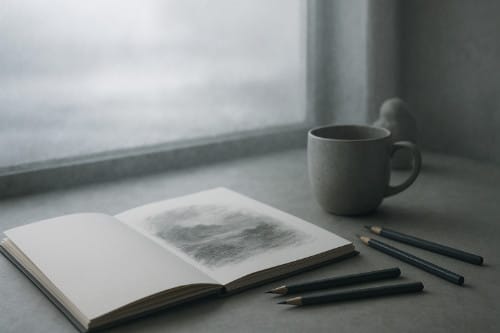
Treat graphite as a medium with its own voice. Sketches in pencil or charcoal show how vibrant greys can be. Pressure, paper tooth, and blending produce a surprising range of tones and textures.
The next time you notice fog over the ocean, a graphite line in a sketchbook, or the soft sheen of a well loved tool, pause for a moment. You are looking at the color of subtlety.
by Patrix | Oct 17, 2025
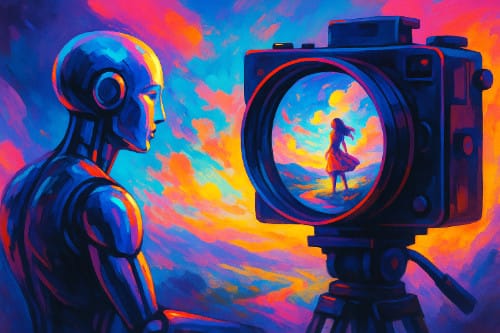
Every once in a while, a new technology feels less like an upgrade and more like an awakening. OpenAI’s Sora 2 is one of those moments. It doesn’t just generate video; it thinks in motion. Watching what it creates feels a bit like watching imagination learn how to use a camera.
When the first Sora appeared, it impressed people by turning short text prompts into moving images. But those clips felt like experiments: flashes of brilliance without continuity. Sora 2 is different. It connects scenes, sustains emotion, and follows light and logic the way a cinematographer would. For artists and filmmakers, it’s thrilling and unsettling all at once.
What Sora 2 Really Does
Sora 2 takes ordinary language and builds living, breathing video from it. You describe what you want — “a child chasing a red balloon through a rainy Paris street” — and Sora 2 delivers it in cinematic realism. Shadows stretch naturally. The camera tracks smoothly. The emotion holds.
What sets it apart is continuity. Earlier AI models could create five-second wonders but stumbled on sequences that needed flow. Now, Sora 2 handles longer scenes with believable transitions and consistent characters. It’s the difference between a flipbook and a film.
There’s also a new sense of interpretation. The model doesn’t just render what you type; it infers intent. It knows the tone behind the words and applies it to movement, light, and pacing. It’s like working with a gifted assistant who understands not just what you asked for, but what you meant.
From Tools to Creative Partners
Sora 2 changes our relationship with technology. For the first time, we’re not operating a machine; we’re directing it. You give guidance; it composes. That’s a quiet revolution in creativity.
When digital music first appeared, purists said it wasn’t “real” composition. Sampling, looping, and digital mixing felt like shortcuts. Yet those tools ended up expanding music itself. Sora 2 is the same kind of inflection point. It doesn’t eliminate artistry; it amplifies it. The keyboard becomes the director’s notebook, and language becomes the new lens.
Still, there’s a question that lingers: when an AI captures the rhythm of emotion, who’s the artist? That question isn’t a flaw. It’s the beginning of a new kind of authorship.
A Shift in Creative Work
For solo creators and small studios, Sora 2 is a windfall. You no longer need expensive cameras or editing suites to make compelling visuals. Storyboard, prompt, refine; that’s your workflow.
Educators can illustrate lessons instantly. Small brands can craft professional ads in an afternoon. Artists can test entire visual ideas without ever renting a light or scouting a location.
For larger studios, the news is more complicated. Routine work will likely move to AI generation. But that doesn’t mean the creative industry disappears. It evolves. The focus shifts from producing what everyone can make to telling what only you can.
Creativity, in other words, moves up the ladder. The new scarcity isn’t content; it’s perspective.
The End of Stock Footage
The stock video industry is quietly trembling. If anyone can generate a perfect “sunset surfer” clip in five seconds, who’s paying $300 for the licensed version? AI footage will outcompete traditional stock for speed, cost, and flexibility.
But something valuable may emerge in its place: authenticity. As synthetic media floods the web, “real” imagery will carry cultural weight again. Stock libraries could evolve into curators of truth, certifying what’s human-made, not machine-made. It’s ironic, but authenticity might soon become the new luxury.
Meanwhile, creators everywhere gain access to visual power once reserved for film studios. A travel vlogger could pre-visualize destinations. A journalist could reconstruct events for clarity. A teacher could animate an ancient civilization for tomorrow’s class. The visual language of the internet is about to grow richer — and noisier.
Learning to Watch Critically
As visuals become indistinguishable from reality, we’ll need to rethink trust. “Seeing is believing” no longer works. The realism of Sora 2 makes the term deepfake feel outdated.
The answer isn’t panic; it’s literacy. We’ll learn to watch the way we learned to read critically online. We’ll judge sources, not pixels. Truth will depend on credibility, not appearance. Over time, society adapts and this generation will develop sharper eyes and better instincts about what to believe.
Technology challenges perception, but it also refines it. In that sense, Sora 2 might be as much a teacher as a tool.
Blending the Creative Ecosystem
Sora 2 doesn’t stand alone. It fits into a growing ecosystem where AI and traditional software cooperate. You can imagine writing your story outline in ChatGPT, creating scenes in Sora, and finishing the cut in DaVinci Resolve.
This is where it gets exciting. The act of filmmaking becomes more like sketching with light. You draft ideas, see them unfold, and adjust. The process feels intuitive, almost playful. In that shift lies a profound truth: creativity is returning to spontaneity. Tools that once slowed us down are starting to disappear into the background.
Language is becoming the universal interface. You don’t have to master complex software; you just have to imagine clearly and describe it well.
Beyond Art and Film
It’s tempting to think of Sora 2 as just an art tool, but its implications go further. Teachers could generate immersive lessons in seconds. Therapists might use personalized visuals to help clients process memories. Historians could recreate events lost to time. Scientists could visualize complex processes instead of describing them abstractly.
When visualization becomes effortless, understanding expands. Sora 2 may quietly become one of the most educational tools of the decade; not because it entertains, but because it helps us see ideas come alive.
The Weight of Infinite Choice
All creative revolutions bring new responsibilities. When anyone can generate anything, the measure of creativity becomes intent. The power is no longer in the making, but in the meaning.
The best artists will be those who choose carefully, who use the infinite canvas to tell something true. In the coming years, originality will depend less on novelty and more on discernment.
Sora 2 doesn’t just extend what technology can do. It expands what we imagine possible. Watching it work feels a little like watching the future assemble itself, frame by frame.
The tool is here. The imagination is infinite. What we do with it will say everything about us.
by Patrix | Oct 13, 2025
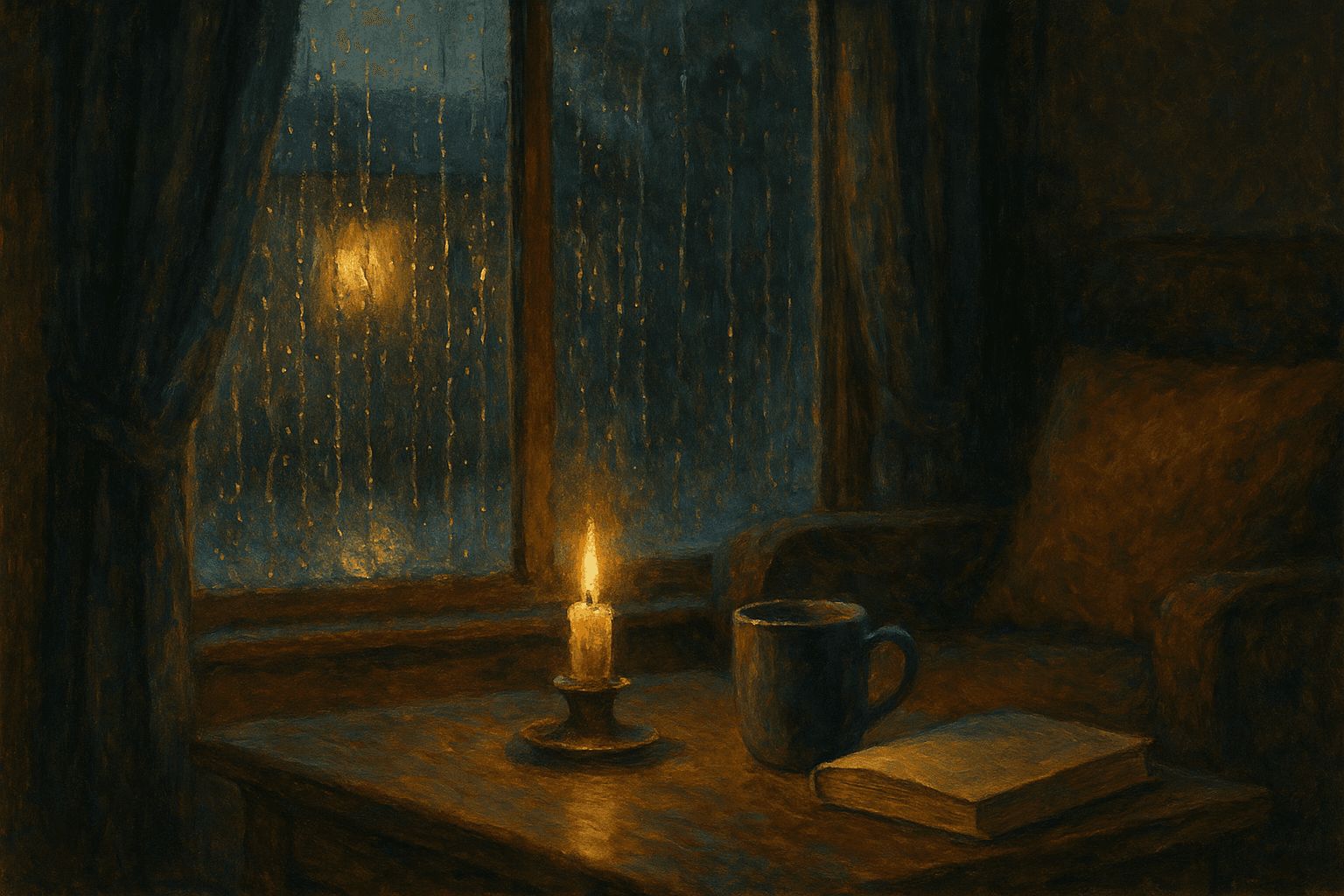
There’s a kind of evening when the world seems to sigh in relief. Rain drifts softly against the windows, the air smells faintly of earth, and the lights inside take on a golden glow. It’s a mood that wraps around you, quiet but alive. A rainy night has a way of smoothing the edges of the day. It tells you, without words, that it’s time to rest.
For reasons both scientific and emotional, rain has always been comforting. It’s not only about being dry indoors; it’s about being protected. There’s something ancient and familiar in the rhythm of falling water, as if the planet itself were humming a lullaby.
Why Rain Feels Like a Hug for the Nervous System
The calming effect of rain isn’t just in our imagination. The steady patter produces what’s called pink noise, a gentler cousin of white noise. It evens out sudden sounds and helps the brain settle. That’s why so many people drift off more easily when it’s raining. The pattern tells our nervous system that the world outside is stable and safe.
Long before smart homes and streaming playlists, our ancestors found the same comfort in a rainstorm. It meant they could rest. Animals were quieter, the air was cooler, and there was less to fear. That instinct remains in us, even if the campfire has been replaced by a reading lamp and a cup of tea.
When the world outside turns damp and gray, the interior world feels richer. Candlelight seems to glow with more purpose. The steam from a cup of cocoa rises like a small celebration. The ordinary suddenly becomes precious.
The Art of Doing Nothing
Rainy nights remind us that stillness isn’t a flaw in the schedule. The sound on the roof, the smell of wet pavement, the fog on the window—these are invitations to slow down. A culture that rewards constant motion rarely gives permission for rest, but the rain does. It falls without judgment, asking nothing in return.
Doing nothing well is its own quiet craft. You might light a candle, pull a blanket close, and simply listen. Maybe you cook something slow and fragrant, letting the scent fill the house. Or you sit with an open notebook, waiting for thoughts to drift through. The rain doesn’t demand activity; it offers space for reflection.
Creative people often find this time restorative. Artists, writers, and dreamers know that ideas sometimes arrive only when we stop chasing them. The gentle rhythm of the rain is a companion to imagination—a muse in liquid form.
Digital Rain and Modern Comfort
Technology has made it possible to bring that same atmosphere anywhere. A rainstorm playlist, a looping video of thunderclouds, or a smart lamp that mimics candlelight can recreate the feeling of a rainy night even in the desert. What once required weather now fits in your pocket.
There’s a subtle beauty in that. In a fast, digital world, our devices are learning how to help us slow down. AI-generated soundscapes and ambient art installations are helping people reconnect with something ancient. Maybe that’s what the meeting point of art and technology truly is: a way to remember what it means to be still.
When the screen glows softly and the rain sounds play through the speakers, you can almost forget that the weather outside is dry. It’s an illusion, but a healing one. It gives the mind the same permission the real thing does—to breathe.
Memory, Melancholy, and the Rain
Rain has a way of stirring emotion. It invites us to look inward, to remember, to feel. Nostalgia rises as easily as the scent of wet earth. Sometimes it brings a quiet sadness, but it’s the kind that soothes rather than stings. Like washing dust from a window, the rain clears the mind.
It also softens memories. You might think of someone you once knew, a house you once lived in, or a night that mattered for reasons you can’t quite explain. Under the sound of rain, even loss feels gentler. The melancholy becomes a kind of music—a reminder that feeling deeply is its own form of being alive.
Poets and filmmakers return to this again and again because rain is both metaphor and mood. It’s the sound of reflection, the light of memory, the silence between thoughts.
The Ritual of Comfort
Rain encourages ritual. A soft sweater, a warm drink, a pet curled nearby—these small gestures become ceremonies of peace. They remind us that comfort doesn’t depend on grand moments. It lives in ordinary things: a roof overhead, the scent of rain, a moment of gratitude for both.
You might put on a slow record, make soup from scratch, or simply sit by the window and watch. These are quiet rebellions against the noise of the day. They tell the body and mind that there is value in calm, that not every hour needs to be filled with achievement.
In the glow of lamplight, with the soft percussion outside, time changes shape. The hours stretch in a good way. You are no longer chasing the day; you are inhabiting it. That is the secret comfort of a rainy night—it draws you back into the present.
Letting the Rain In
So when the clouds gather and the drops begin to fall, don’t rush for the forecast or worry about plans delayed. Let the world slow down. Light the candle. Let the rain speak to the quiet parts of you that are too often ignored.
You are not wasting time when you pause to listen. You are syncing with the rhythm of something older than memory. The comfort of a rainy night comes not from the weather, but from the way it reminds us who we are: small, warm, and wonderfully alive.
by Patrix | Oct 13, 2025
It used to be easy to spot a crypto scam. The fake websites were clunky, the “support agents” barely coherent, and the grammar was a dead giveaway. But 2025 has ushered in a darker, more sophisticated era. Today’s scams don’t look fake; they sound and feel real. They speak in familiar tones, reference your past transactions, and even mimic the voices of people you trust.
Welcome to the world of AI-powered fraud, where deepfakes, cloned voices, and generative chatbots are turning digital deception into a scalable industry.
The New Breed of AI-Fueled Crypto Scams
A few years ago, most crypto scams came as poorly written emails promising free Bitcoin. Then came fake Telegram groups, phishing links, and imposter influencers. Now, the game has changed entirely.
Scammers have begun using large language models (LLMs) to generate realistic chat conversations and voice cloning software to call victims directly. One high-profile case involved a deepfake “Coinbase support agent” who convinced users to “verify” their wallet access, only to drain their funds. Another used an AI-generated video of a well-known crypto YouTuber promoting a non-existent “AI token.” The production quality was so convincing that even his long-time subscribers were fooled.
We’re witnessing the merging of two forces: AI’s ability to imitate human trust signals and crypto’s irreversible, high-stakes nature. Once your digital assets are gone, they’re gone.
Why These Scams Are So Convincing
Traditional scams relied on social engineering — getting someone to click a link or reveal a password. AI has made that manipulation feel eerily human.
- Voice cloning allows scammers to reproduce speech patterns, accent, and even laughter.
- LLM chatbots can carry on long, emotionally calibrated conversations.
- Generative images and video can create false “proof of identity” documents that pass basic KYC checks.
In essence, AI has turned the scammer’s toolkit into a full-fledged studio of deception. The irony isn’t lost on the creative community: the same tools that help artists generate realistic portraits or 3D textures are now being weaponized by criminals. It’s a powerful reminder that technology itself isn’t moral or immoral — it’s the human intent behind it that matters.
The Psychology Behind the Scam
Most of these new scams don’t rely on technical exploits; they exploit emotions. AI can identify your stress patterns, your FOMO triggers, even your patience level — and tailor its persuasion accordingly.
A deepfake “customer support” agent might sound empathetic when you express frustration or stern when you hesitate. The scam adjusts in real time, guided by emotion-detection algorithms. It’s digital manipulation at scale.
What’s chilling is how personal it feels. These bots don’t just sound real — they feel like they care. And when you’re dealing with something as volatile as crypto markets, that illusion of reassurance can be dangerously persuasive.
Artists and Creators: You’re Now Targets Too
For artists and digital creators, the risks go beyond stolen wallets. Scammers are increasingly targeting the creative community with fake “AI art contests,” gallery collaborations, or NFT showcases that require wallet connections or “submission fees.”
Others impersonate curators or influencers, offering partnership deals via email or DMs. Some even create AI-generated versions of real art dealers, complete with profile photos, bios, and recent posts — all scraped and synthesized from social media.
Another growing trend is the “AI feedback scam.” Artists receive messages claiming to offer “AI-powered portfolio reviews.” The link they share looks professional but leads to a credential-harvesting site.
Rule of thumb: if someone you don’t know offers to “collaborate,” “sponsor,” or “verify,” stop and verify them first through a known official channel — never via the link they send.
Practical Defense: Your AI Scam Survival Kit
There’s no silver bullet, but you can make yourself a hard target. Here’s a simple self-defense kit for creatives and investors alike:
- Use separate wallets — one for experiments, one for storage. Never connect your primary wallet to new projects.
- Enable multi-factor authentication on all crypto and email accounts.
- Don’t trust voice or video alone. Verify identity through written, platform-linked messages.
- Slow down. Scammers thrive on urgency. A pause is the best security feature you have.
- Bookmark official URLs. Never follow links from messages, even if they look familiar.
- Learn to read tone. AI-generated texts are often overly formal, polite, and “perfect.” Humans rarely sound like that.
And if you want an extra layer of vigilance, tools like Deepware Scanner and Hive Moderation can help detect AI-generated voices and images. It’s not foolproof, but it’s progress.
How AI Is Fighting Back
Fortunately, the same technology that enables scams is also being used to fight them.
Blockchain analytics firms like Chainalysis and Elliptic are training AI models to detect fraudulent transaction patterns faster than any human could. Exchanges are experimenting with voiceprint verification — using your unique vocal signature as a biometric key.
Meanwhile, projects like World ID and Civic are exploring “proof-of-personhood” systems, aiming to distinguish real humans from synthetic agents on the blockchain. These won’t eliminate scams entirely, but they could make it much harder to impersonate legitimate users.
According to Chainalysis, AI-enhanced crypto scams have grown by over 40% this year; but AI-based detection and auditing tools have improved nearly as fast. It’s a digital arms race, and awareness remains our best weapon.
The Human Element
The most powerful defense still isn’t a piece of software; it’s the person behind the screen. The scammers are counting on speed, fear, and confusion. What they can’t outsmart is patience, curiosity, and human intuition.
Before clicking a link, pause. Before responding to a “support call,” breathe. Before sharing your credentials, ask yourself: Would a real company ever ask for this?
The truth is, AI is neither hero nor villain. It’s a mirror. It reflects whatever intent we bring to it. As artists, investors, and creators, our best path forward isn’t paranoia — it’s awareness.
Maybe the most intelligent thing we can do in this new digital age is the simplest of all: slow down and think.