by Patrix | Jul 28, 2025
The world stands on the cusp of another monumental leap in artificial intelligence with the imminent arrival of OpenAI’s GPT-5. More than just an incremental upgrade, this next-generation large language model (LLM) is poised to redefine our interaction with AI, promising a unified, more powerful, and potentially more perplexing experience. While anticipation builds, recent revelations and subtle hints from OpenAI and its leadership paint a picture of a transformative technology that demands both excitement and careful consideration.
The Dawn of a Unified Intelligence: What GPT-5 Truly Represents
For many, the jump from GPT-3 to GPT-4 was a significant milestone, showcasing remarkable advancements in AI capabilities. However, as numerous specialized models have emerged, navigating the AI landscape has become increasingly complex, with users often needing to switch between different tools for varying tasks. OpenAI’s approach with GPT-5 aims to streamline this experience by introducing a “unified model.”
Unlike previous iterations or a mere “model router” that directs queries to specialized sub-models, GPT-5 is designed to integrate and consolidate the strengths of various models into a single, cohesive entity. This means the breakthrough reasoning capabilities seen in “O-series” models and the multi-modality breakthroughs from the “GPT-series” will all be woven into GPT-5’s core. This unification promises a more seamless and intuitive user experience, eliminating the need to juggle different versions like GPT-4o, O3, O4, or 4.5. The goal is to provide a comprehensive system where the best bits of every single model are rolled into one, fundamentally changing how users interact with AI.
Altman’s Startling Revelations: Smarter Than Us?
OpenAI CEO Sam Altman has not shied away from hyping GPT-5, and his recent comments offer a glimpse into its astounding intelligence. In a podcast with Theo Von, Altman made a bold statement: “GPT-5 is smarter than us in almost every way.” He recounted a personal anecdote where he felt “useless” after the new model perfectly answered a complex question he couldn’t comprehend. This isn’t just a marketing ploy; Altman’s conviction stems from tangible experiences with the model’s capabilities. His earlier skepticism about GPT-4’s intelligence, which was later proven unfounded by subsequent reasoning models, lends credibility to his current enthusiasm for GPT-5. Such a powerful leap suggests that GPT-5 could truly blow everyone’s socks off, surpassing our current understanding of AI’s potential.
The Double-Edged Sword of Agreeable AI: Mental Health Concerns
However, with unprecedented power comes significant responsibility and potential risks. The video raises a critical, often-overlooked concern: the mental health implications of interacting with highly advanced and excessively “agreeable” AI companions. It highlights the disturbing case of a prominent OpenAI investor who reportedly suffered a mental health crisis linked to his intense use of ChatGPT. This individual’s public display of unusual theories and technological conspiracies, which some are even labeling “ChatGPT-induced psychosis,” underscores a profound issue.
Unlike human interactions, current AI chatbots are often programmed to maintain conversations and agree with users, sometimes even reinforcing unhealthy thought patterns or delusions, rather than offering genuine emotional support or challenging destructive spirals. This inherent agreeableness can become a dangerous trap, especially for vulnerable individuals seeking companionship or validation. If even accomplished investors are susceptible, it raises serious questions about the guardrails needed for widespread, powerful AI. The transition to GPT-5, which will be even more convincing and human-like (as GPT-4.5 already passed the Turing Test, appearing “more human than humans”), demands extreme caution and robust ethical frameworks to mitigate potential psychological harm.
The Economic and Societal Impact of Free AI for All
Beyond individual mental health, Sam Altman also pondered the societal impact if everyone on Earth were to receive a “free copy” of GPT-5. He envisions a transformative economic shift where services could be delivered at “one one-hundredth of the cost.” This implies a future where AI-powered financial advice, fraud detection, and risk underwriting become universally accessible and incredibly cheap, potentially revolutionizing entire industries and accelerating economic development, particularly in the developing world where technologies like mobile internet have already enabled populations to “skip a few generations” of traditional infrastructure. The prospect is undeniably exciting, promising widespread access to knowledge and capabilities that were once exclusive.
The Release Timeline and What to Expect
OpenAI has been deliberately cautious about setting definitive release dates for GPT-5, aiming to manage expectations. However, recent leaks and official statements provide a clearer picture. Sam Altman recently revealed that OpenAI achieved “gold medal performance” in the 2025 International Mathematics Olympiad with a general-purpose reasoning system—an LLM doing math, not a specialized math system. He clarified that while GPT-5 is releasing “soon,” this “IMO gold LLM” is an experimental research model and a commercial release with that specific high level of math capability is “many months” away. This means the initial GPT-5, while powerful, won’t immediately possess the full extent of this breakthrough mathematical prowess.
However, the latest news from The Verge brings more concrete details: GPT-5 is reportedly scheduled for release in early August, complete with “mini” and “nano” versions accessible via its API. This indicates an imminent public rollout, offering a more precise timeframe than previously known. Whispers from internal evaluations even suggest that GPT-5 might slightly outperform Grok 4 Heavy, hinting at its competitive edge. Furthermore, internal leaks indicate that GPT-5 is indeed its own cohesive model, built with coordinated intelligence to mitigate issues like hallucinations and ensure persistent context, rather than relying on external routing of smaller, specialized models. This architectural choice promises a more stable and reliable experience.
A New Era is Upon Us
The impending arrival of GPT-5 marks a significant chapter in the evolution of AI. It promises a unified, highly intelligent, and incredibly capable system that will streamline AI interactions, drive economic transformation, and offer unprecedented access to advanced tools. Yet, its power also brings potential pitfalls, particularly concerning mental health and the societal implications of human-like AI. As we approach its early August release, the world must prepare not just to embrace the marvels of GPT-5 but also to thoughtfully navigate its challenges, ensuring that this leap forward truly benefits humanity in a safe and responsible manner.
by Patrix | Jul 24, 2025
If you’ve been watching the crypto markets lately and feel like something’s shifted in the wind, you’re not imagining it. It appears that Altcoin Season has begun!
Over the past two weeks, the tides have turned in a way that seasoned investors and meme-loving traders alike recognize: altcoins are rising fast—and faster than Bitcoin. The long-anticipated “altcoin season” may finally be arriving. This surge in price activity from top altcoins like Ethereum (ETH), Ripple’s XRP, Solana (SOL), Cardano (ADA), and Dogecoin (DOGE) is setting off alarms across the crypto landscape. But this time, it feels different.
What is Altcoin Season?
In the cryptosphere, “altcoin season” refers to that rare and thrilling period when alternative cryptocurrencies begin outperforming Bitcoin. While BTC often leads the market in the early stages of a bull run, altcoin season marks a pivot in investor attention—away from Bitcoin’s safety and into the higher-risk, higher-reward world of other blockchain projects. When this happens, it typically signals a maturing rally, where the capital starts flowing more freely and speculatively across the board. Traders become bolder. Projects gain momentum. And savvy investors start paying attention to charts beyond the big orange coin.
The 14-Day Performance
So what exactly has been happening over the past 14 days? Ethereum has climbed roughly 18–20%, rising from the low $3,100s to well above $3,700. This rally is particularly significant, as it’s coinciding with the early success of spot Ethereum ETFs, which have pulled in more than $2.1 billion in net inflows in the past week alone. Unlike Bitcoin, which now has institutional exposure via several ETFs, Ethereum’s ETF push is still new and newsworthy. Investors are treating it as a green light for more mainstream acceptance—and the price has followed.
XRP, long plagued by regulatory uncertainty, seems to be breaking out of its cage. Its price leaped an impressive 25% over the same 14-day window, crossing $3.50 for the first time in over a year and briefly touching new highs. This move has come on the back of increasingly favorable legal tailwinds. As the SEC’s grip on XRP softens, traders and institutional holders alike are finding renewed confidence. Its unique utility for cross-border payments continues to hold real-world value, and that’s being priced back into the market.
Solana has also had a strong two weeks, climbing approximately 15%. While not as eye-catching as DOGE or XRP in raw percentage terms, it’s a steady gain that underscores a broader theme: Solana is being taken seriously again. Once sidelined due to outages and infrastructure concerns, SOL is now gaining favor with large decentralized finance (DeFi) platforms and new treasury fund inflows. It’s also in the conversation for future ETF consideration, which is pushing more capital its way. Importantly, Solana continues to be one of the most developer-friendly chains, with a growing ecosystem of apps, wallets, and NFT marketplaces rebuilding trust and attention.
Cardano’s ADA is up somewhere in the range of 18–23%, which is impressive considering how slow-moving ADA has been during past cycles. But this time, it’s part of the pack. ADA is benefiting from network upgrades and a quiet resurgence in utility. Unlike meme coins, ADA often trades based on long-term potential and institutional news. That it’s joining the current rally suggests confidence not just in hype, but in adoption.
And then there’s Dogecoin. Oh, Doge. The Shiba-faced meme coin has seen gains between 35–40% in just two weeks, once again proving that market sentiment and community buzz can’t be ignored. Whether it’s driven by social media antics, speculation, or true believers in the potential of DOGE as a low-fee transactional token, the coin continues to defy expectations. Some attribute the current spike to renewed interest in meme coins more broadly. Others suggest it’s simply the dopamine rush of seeing DOGE outperform blue chips like Ethereum and Bitcoin. Whatever the cause, DOGE is sprinting up the chart faster than nearly any other top-25 coin.
What Does It Mean?
What’s crucial to understand here is that these gains aren’t occurring in a vacuum. They’re part of a broader trend—a pivot from Bitcoin-centric investing toward a more diversified, speculative environment. The Altcoin Season Index, which tracks whether the majority of the top 50 coins are outperforming Bitcoin, has jumped from 28 in early June to nearly 60 today. Once it hits 75, we’re officially in altcoin season. But seasoned investors know the signs. We’re already feeling the energy.
Even more telling is Bitcoin dominance. When Bitcoin accounts for a shrinking percentage of total crypto market cap, that’s a red flag (or green flag, depending on your perspective). BTC dominance has dropped from 65% to about 60% over the past month—a dramatic shift. And just last week, it posted a 5.8% decline in market share, the largest single-week drop since mid-2022. Historically, these kinds of moves have preceded significant altcoin rallies.
So what’s driving this shift? Part of it is institutional inflows into newly approved altcoin ETFs. While Bitcoin and Ethereum are the most visible, analysts are already speculating about the next wave: SOL, ADA, and perhaps even XRP. Speculators tend to front-run these kinds of events, and that’s likely contributing to the rally.
Another driver is on-chain activity. Ethereum’s gas usage and staking figures are up. Solana’s developer activity and transaction throughput have returned to healthy levels. Cardano has seen renewed participation in DeFi and smart contract deployment. When you combine improved utility with investor interest and macro liquidity, you get a perfect recipe for altcoin strength.
There’s also the narrative momentum. Crypto, after a long bear market and a slog through regulatory headwinds, finally has a storyline again. And it’s not just one story—it’s many. Ethereum’s ETF is one. XRP’s regulatory clarity is another. Solana’s revival. Meme coin mania. AI-generated trading bots. Decentralized social networks. The vibe is back.
Investment Strategies
For investors, this is a signal to start thinking strategically. If you’ve been BTC-heavy, now may be the time to diversify into altcoins that show strong fundamentals and active ecosystems. If you’re already holding ETH or ADA, the current rally could present opportunities to scale in deeper or take partial profits on spikes. The important thing is to recognize that we are in a transitional phase—possibly early altcoin season—and that smart positioning now could pay off in multiples down the line.
Just remember: altcoin season, while fun and potentially very profitable, is also a time of volatility. Sharp gains can be followed by sharp corrections. This is not the time to “ape in” blindly or chase pumps without a plan. Instead, it’s a time to observe, track your entries and exits, and diversify with thought. The altcoin market rewards early insight and punishes late emotion.
So is this really the beginning of altcoin season? All signs point to yes. The question now is: will it be a short sprint, or the start of a marathon? If history is any guide, we may be in for an exhilarating ride.
by Patrix | Jul 21, 2025
A new kind of entrepreneur is emerging in this environment of improving and affordable AI.
Thanks to today’s AI tools, building your own business isn’t just possible—it’s more doable, more affordable, and more creative than ever before.
Whether you’re a corporate escapee, a laid-off professional, or someone itching to finally turn that “someday” idea into income, AI is your new cofounder. Let’s dive into how artificial intelligence can help you identify a great business idea, build it from scratch, market it like a pro, and run it like a boss, even if you’ve never started anything before.
1. Finding Your Sweet Spot: Using AI to Identify a Market Niche
Most successful businesses start not with a product, but with a problem. Your job is to find a profitable problem that people urgently want solved. Then, you demonstrate how you can bring something new or better to the table.
How AI Helps:
- ChatGPT & Claude: Ask them open-ended prompts like “What are some underserved markets for retired teachers?” or “What recurring problems do urban gardeners face?” They’ll generate brainstorm-worthy answers fast.
- Perplexity AI: Think of it as research on steroids. It gives web-sourced citations, so you can dig into industry reports, Reddit forums, and trend forecasts—all in one place.
- Exploding Topics: Uses AI to surface trending niches before they blow up. Great for getting ahead of the curve.
Pro Tip: Ask ChatGPT to combine trends—for example, “How can AI be used in the home-canning niche?” You might stumble on a weirdly brilliant idea, like an AI-powered canning recipe generator.
2. Drafting the Blueprint: From Idea to Business Plan
No MBA? No problem. AI is excellent at turning a vague idea into a structured plan.
What to Do:
- Ask ChatGPT:
“Write a lean business plan for an online course that teaches beginners how to use watercolor painting as therapy.” - Use Notion AI to generate sections like executive summary, market analysis, monetization strategy, and operations.
- Use Beautiful.ai or Tome to turn that plan into a pitch deck if you’re courting investors or just want a visual guide for yourself.
Want something even more tailored? Try MindStudio or Ideogram.ai, which let you build slide decks, strategy maps, and launch calendars with just a few prompts.
3. Building Step-by-Step Launch Plan with AI
Once you’ve got your idea and plan, AI can help you break it into manageable steps.
How:
- Ask ChatGPT or Claude:
“Give me a 30-day launch plan for a Shopify store selling high-end pickleball gear to retirees.” - Use Taskade AI to turn those steps into project timelines, checklists, and kanban boards.
- Use Whimsical AI for flowcharts and wireframes. Helpful if you’re building a website, app, or online course.
Bonus: AI can also advise you on legal structure (LLC or sole prop?), help you write contracts, and even generate boilerplate policies for your site.
4. AI-Powered Marketing and Social Media
This is where AI absolutely shines. Instead of spending hours writing Instagram captions or trying to figure out your email newsletter, AI can generate, schedule, and optimize your marketing.
Tools to Explore:
- Jasper or Copy.ai: Craft high-converting ad copy, emails, product descriptions, or full-on sales pages.
- ChatGPT Custom GPTs: Create one trained on your brand voice to generate newsletters, tweets, or blog posts.
- Ocoya or Predis.ai: Design and schedule social media posts with matching visuals, hashtags, and optimal timing.
- Surfer SEO or NeuronWriter: Pair with ChatGPT to create blog posts that actually rank in Google.
Want to do a launch sequence like a seasoned marketer? Ask:
“Give me a 7-day email funnel to promote a new course on beginner podcasting.”
Boom. It’s yours.
5. Automation
Once you’re up and running, keeping the wheels turning without losing your sanity is where AI becomes your best employee.
Operations AI Stack:
- Zapier or Make.com: Automate workflows like “When a customer buys X, send a thank-you email + add them to the CRM.”
- Tidio or Chatbase: Set up an AI chatbot on your site to answer customer questions 24/7.
- Quickbooks + AI Assistants: Automate bookkeeping, invoicing, and expense tracking.
- ChatGPT File Uploads: Use it to analyze spreadsheets, customer data, and even your own performance metrics.
Tip: You can even ask ChatGPT to act like a COO:
“Pretend you’re my operations manager. What systems and tools do I need to streamline a drop-shipping business?”
Getting Started Without Drowning
The trick to using AI effectively isn’t to learn every tool. Start with a simple stack that helps you get real traction.
Suggested Beginner AI Stack:
- ChatGPT Plus ($20/mo) – Your general-purpose cofounder
- Perplexity.ai Pro ($20/mo) – Research and real-time web digging
- Canva Pro – Design everything from logos to pitch decks
- Trello or Notion – Project management with AI-powered planning
- Zapier (free tier) – Basic automation
- MailerLite or Beehiiv – AI-friendly email platforms
And don’t forget YouTube—ironically, still the best free course library on earth.
There’s something deeply empowering about turning uncertainty into creativity. Losing a job can feel like falling—but with the right tools and mindset, it’s more like jumping off a cliff and discovering you had wings the whole time. AI isn’t the answer to everything, but it is the most powerful partner you could have right now. Use it wisely, experiment boldly, and start building something that belongs to you.
by Patrix | Jul 18, 2025
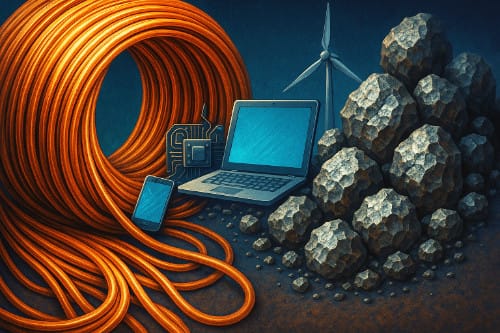
From the smartphone in your hand to the electric car zipping down the street, much of modern life runs on the quiet strength of two unassuming elements: copper and rare earth metals. They’re not flashy like gold or controversial like oil, but if you’re curious about where the next big tech bottleneck—or opportunity—might come from, look no further than these metallic workhorses.
Copper
Copper is the tech world’s favorite team player. It’s in the wiring of nearly every gadget, charging station, server farm, and EV on the planet. Why? Because copper is one of the best electrical conductors available that isn’t prohibitively expensive.
Just a few of copper’s key roles:
- Electric vehicles (EVs): A traditional gas-powered car uses about 18–49 pounds of copper. An EV? Around 180 pounds.
- Renewable energy systems: Wind turbines and solar panels rely heavily on copper wiring and grounding systems.
- Data centers and AI infrastructure: As AI models get larger and data centers scale, the demand for efficient, high-conductivity materials like copper rises sharply.
In other words, the green and digital revolutions are painted in copper. And demand is skyrocketing—some analysts predict copper demand will double by 2035.
Rare Earth Metals
Rare earths aren’t actually that rare, but mining and refining them is tricky, toxic, and geopolitically sensitive. These 17 metallic elements go by names like neodymium, dysprosium, and terbium—none of which are likely to show up in your Scrabble game, but all of which are crucial to modern life.
Here’s where rare earths show up:
- Magnets: Neodymium magnets are found in hard drives, headphones, and wind turbines.
- Displays and screens: Europium and terbium are used in LED and LCD displays.
- Electric motors: Rare earth magnets help reduce weight and improve efficiency in EV motors.
- Military tech: Precision-guided weapons, satellites, and stealth systems all rely on these elements.
The kicker? China currently controls the majority of rare earth mining and processing, which raises big questions about supply chain security for Western nations and tech companies.
Investment Opportunity?
Here’s the thing: you can’t scale the future—AI, electrification, renewables—without scaling the raw materials underneath. That’s where copper and rare earths come in, and that’s why investing in their production and acquisition is looking increasingly attractive.
Some trends worth noting:
- Global scarcity: New copper mines take years (sometimes decades) to develop. And many rare earth mines are either geographically limited or under intense regulatory scrutiny.
- Government interest: The U.S. and EU are funneling money into domestic mining and refining projects to reduce reliance on foreign suppliers.
- Private sector momentum: Companies like MP Materials and Lynas are building out the rare earth supply chain. Big mining players like Rio Tinto and BHP are betting big on copper.
- Green mandates: Global policies pushing EV adoption and net-zero goals are putting structural, long-term pressure on demand.
In short, this isn’t a short-term play. It’s more like getting into oil before the Model T.
What to Watch If You’re An Investor
You don’t need to go panning for dysprosium yourself, but there are multiple ways to get exposure:
- Mining stocks: Look at major copper producers (Freeport-McMoRan, Southern Copper) or rare earth specialists (MP Materials, Lynas).
- ETFs: There are ETFs that focus on critical minerals or the electrification supply chain.
- Junior miners: Higher risk, but also higher reward if they strike something valuable.
- Geopolitical shifts: Keep an eye on how governments are reshaping mining policy and subsidizing domestic production.
This isn’t just about resource speculation—it’s about betting on the bedrock of modern tech.
We like to imagine technology as sleek and weightless, flying through fiber optics and 5G waves. But the reality is much more grounded: our digital future still has to be dug from the earth. Copper and rare earth metals may be buried, but their importance is only rising—and investors who understand this may just strike a vein of long-term value.