by Patrix | Nov 5, 2025
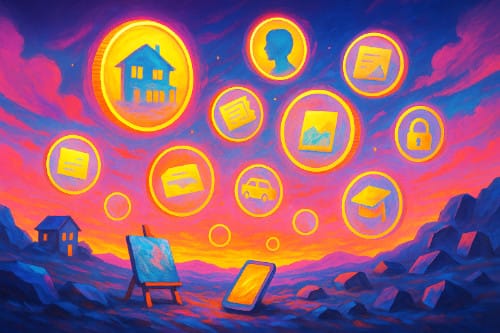
Imagine a world where everything you own, from your beach house to your concert ticket to the tiny watercolor you just painted, exists as a digital token—a unique, verifiable object on a global network. Not a copy, not a file on your computer, but a token that proves ownership, authenticity, and sometimes even emotion. That’s the tokenized world we’re heading toward, and whether we notice it or not, it’s already taking shape beneath our feet.
The New Language of Value
For most of history, ownership was physical. You held a deed, a coin, or a painting. The internet shattered that logic. Suddenly, value could move at light speed, but proof of ownership couldn’t. Blockchain technology fixed that gap. It introduced the idea of a token, which is a kind of digital certificate that says, “This belongs to me.”
Bitcoin was the first major example. It proved digital scarcity was possible. Then Ethereum showed we could tokenize just about anything: art, music, even tweets. And now, as the technology matures, we’re moving toward a world where every object, idea, or access point can be represented by a token.
Tokenization in Everyday Life
Think beyond crypto collectibles or meme coins. Imagine these scenarios:
- A musician releases a limited run of songs as collectible tokens. Fans can trade them or use them as keys to private shows.
- A photographer sells access to their entire portfolio as a fractionalized token, allowing patrons to share in its future value.
- Real estate gets tokenized, making it possible to invest in a slice of a vacation home rather than buying the whole thing.
- Even your reputation or social media presence could be tokenized, transforming online influence into tangible value.
In this sense, tokenization becomes a kind of digital fabric. It’s an invisible layer of ownership that threads through our economy and culture.
The Psychological Shift
When everything becomes tokenized, the way we think about value changes. Ownership is no longer about possession; it’s about participation. A digital artist might still “own” their original file, but the value of their token lies in its story and the network of people who believe in it.
We’re already seeing this with NFTs. A painting in your living room might have sentimental value, but a digital token can carry community value. It blurs the line between collector and creator. Everyone becomes part of the creative economy.
There’s something almost poetic about that. The world becomes a gallery, and each token a brushstroke in a collective artwork.
The Good, the Weird, and the Inevitable
Like any major shift, tokenization comes with tension. It’s not just about technology; it’s about human behavior.
On the good side, tokenization democratizes access. It opens doors for people who never had them—small creators, global investors, artists in remote towns. It makes the economy more liquid, more transparent, and potentially more fair.
On the weird side, it also risks commodifying everything. When even your digital identity has a token price, what happens to authenticity? Will art still feel sacred when it’s instantly tradeable? Will friendship or community lose something if loyalty points become financial assets?
And yet, this evolution feels inevitable. The internet has always pushed us toward abstraction. From gold to paper to pixels to tokens, we keep reimagining what “value” means.
Art in the Age of Tokens
For artists, tokenization is both liberation and labyrinth. It means direct connection with audiences, verifiable provenance, and income streams that don’t rely on middlemen. But it also means navigating marketplaces, smart contracts, and the psychological weight of constant monetization.
Still, artists have always been at the forefront of new mediums. From the first cave painter to the first crypto artist, creation and experimentation go hand in hand. In many ways, tokenization restores something ancient: the human need to prove, “I made this,” and to have that statement echo across time.
When the World Itself Becomes a Ledger
One day, we may wake up and realize that tokenization isn’t just a feature of the economy; it’s the economy. Your car’s maintenance record, your diploma, your medical data, your digital garden of AI-generated art—each tokenized, portable, and under your control.
It’s easy to see this as dystopian or utopian, depending on your mood. The truth, as usual, will probably be somewhere in between. The key question is not whether everything will be tokenized, but how we’ll behave once it is.
Will we treat tokens as mere assets, or as meaningful artifacts of human creativity? Will we use them to build trust and community, or to speculate and divide?
If we get it right, tokenization could become one of the most empowering technologies of our lifetime. It’s a bridge between art and math, between ownership and identity. A world where value is no longer confined to banks and galleries, but flows freely, beautifully, and verifiably among us.
And maybe, when everything becomes a token, we’ll finally see that the real value was never in the token itself, but in the human stories behind it.
by Patrix | Nov 3, 2025
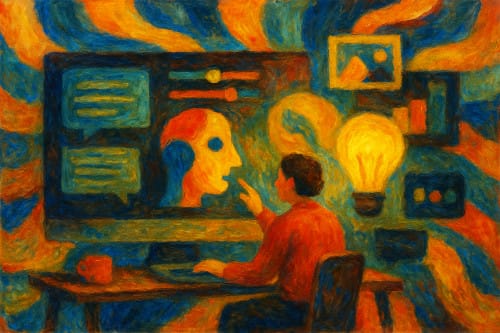
The first time you open Google AI Studio, it feels like walking into a modern art lab. There are buttons, sliders, and glowing boxes full of potential. It looks technical at first, but within minutes you realize it’s less like coding and more like sketching with light.
For creative people such as writers, painters, designers, retired tinkerers, or anyone curious about artificial intelligence, Google AI Studio might be one of the most quietly powerful creative tools of the year.
A Playground for AI Curiosity
Google AI Studio is Google’s free, browser-based interface for exploring its Gemini AI models. These are the same language models that power Gemini, formerly Bard, but here you can guide and shape their responses directly. It’s a conversational sandbox where you can build your own digital assistant, art muse, or idea generator.
There’s no software to install and no coding experience required. You sign in with your Google account and step into a workspace where you can type prompts, test responses, and adjust the “temperature” of the model. That setting controls how imaginative or precise the AI behaves. A lower temperature produces steady, factual answers. A higher one lets the AI wander creatively, like a jazz musician exploring a theme.
Turning Ideas Into Quick Prototypes
Imagine you’re brainstorming a new story concept. You can feed a short description into AI Studio and ask for possible character arcs, emotional tones, or even snippets of dialogue. A digital artist could use it to refine Midjourney prompts until the imagery matches what they see in their mind. A small business owner might experiment with product descriptions or short ad scripts.
Because you can adjust the AI’s settings on the fly, it feels like jamming with a creative partner. The tool doesn’t just answer questions; it helps you iterate. You can keep nudging the idea until it feels right.
The experience is less like programming and more like co-creating.
Build Something You Can Share
Once you’ve shaped an idea or prompt that works well, Google AI Studio lets you turn it into a shareable prototype. With just a few clicks, you can generate a public link or even an API endpoint that developers can connect to a website or app.
Even if you never plan to code, this means you can design experiences that others can use. Imagine creating a journaling assistant, a creative writing coach, or a generator that helps artists craft better image prompts. It’s possible to do all of this inside AI Studio without touching a single line of code.
In a sense, Google has made it easy for non-engineers to start thinking like toolmakers.
A Transparent Window Into AI Thinking
One of the most fascinating parts of AI Studio is how clearly it shows what the AI is doing. You can see how changes in your prompt structure affect responses. You can watch how adjusting one parameter alters the tone or level of detail.
It’s a friendly introduction to the new skill of prompt engineering. Understanding how AI responds to language is becoming as practical today as knowing how to use Photoshop was twenty years ago.
For creative people, this kind of visibility removes the mystery. It shows that AI is not an oracle but a mirror that reflects human patterns. Once you see that, you can use it more consciously and with more playfulness.
Seamless with the Google Ecosystem
If you already live inside Google’s world with Docs, Drive, and Gmail, AI Studio will feel familiar. It connects easily to Google Cloud Vertex AI if you decide to expand into more serious development. You can begin as a hobbyist and grow into a builder without switching platforms.
Collaboration is simple too. You can share a project with a friend, student, or teammate. They can run the same prompt, tweak it, and send feedback. It’s like passing your sketchbook across the digital table.
A Creative Bridge, Not a Technical Barrier
AI Studio represents a quiet but important shift. It takes something deeply technical and makes it human again. The interface invites exploration rather than intimidation.
For artists and writers, it’s a place to test what AI can do for your craft. For educators, it’s a playground for designing interactive lessons. For retirees or lifelong learners, it’s a relaxed way to understand the next big leap in technology.
The beauty of AI Studio is that it rewards curiosity. You don’t need to know how it all works under the hood. You just need a question, an idea, or a dream to start with.
The Joy of Experimenting
The more time you spend in AI Studio, the more it starts to feel like a sketchpad that responds. Some experiments fail, others surprise you. But every session leaves you with a deeper sense of what’s possible.
That’s what makes it special. It encourages play. It encourages curiosity. It helps you see that AI is not just a tool for tech companies. It’s a new kind of creative partner.
Next time you’re sipping coffee and wondering what to make next, open Google AI Studio. You might find yourself building something delightfully unexpected.
by Patrix | Oct 31, 2025
If 2025 was the year everyone started talking to machines, 2026 will be the year we learn to talk beautifully to computers.
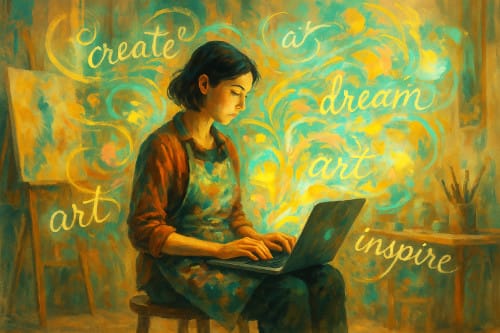
Across studios, coffee shops, and kitchen tables, artists and writers are discovering something quietly revolutionary: words are becoming brushstrokes. The way we describe an image to an AI model is starting to feel less like coding and more like painting. The prompt has evolved into a genuine art form, and how we craft it may soon define our creative era.
This isn’t about replacing artistry. It’s about extending it.
The Rise of the Prompt Era
There was a time when learning digital art meant memorizing software shortcuts. You knew your brushes in Photoshop or your layers in Procreate. But in 2026, the most powerful tool in the artist’s kit will language. It’s not what you click, it’s what you say.
Large language and diffusion models have matured. Tools like ChatGPT, Midjourney, DALL·E, and Google’s Gemini all interpret our phrases with nuance. Instead of telling a computer what to do, we tell it what to feel. A single sentence can now conjure entire worlds.
Why Prompts Are Like Brushstrokes
Think about how a painter works. A brushstroke can be gentle or bold, abstract or precise. The same goes for prompts. Every word carries a texture, a rhythm, a tone.
Try it.
Type this: “a cat in a garden.”
Now try this: “a sleepy Siamese cat lounging under pink bougainvillea, morning sunlight dappling its fur, watercolor style.”
Both describe a cat. Only one feels alive.
The difference isn’t in the AI; it’s in you. The artist’s voice has moved from the canvas to the sentence. The AI merely reflects it back.
We are discovering that the smallest change in phrasing—adding warmth, mystery, or mood—shifts everything. Like brush pressure or pigment density, language becomes the medium of emotion.
Finding Your Prompting Voice
Every artist has a signature. You can spot a Van Gogh sky or a Hopper shadow from a distance. The same individuality is emerging in prompt writing.
Your “prompting voice” is a mix of vocabulary, rhythm, and worldview. Some artists lean poetic. Others think in cinematic scenes or music-inspired imagery. The key is to write the way you see.
- Think in senses. Use texture, sound, and atmosphere. Instead of “a city,” say “a rain-washed city humming with neon reflections.”
- Reference artistic movements. “In the style of mid-century poster art” gives AI cultural context.
- Combine opposites. “Surreal yet minimalist” creates friction that often sparks originality.
Prompting is no longer about commanding a tool. It’s about conversing with one. The more personal your phrasing, the more the result feels yours.
Curation: The Hidden Art Form
Even the best prompts don’t always yield perfect images. That’s where curation steps in—the quiet act of choosing and refining.
Scrolling through a dozen AI outputs is like flipping through contact sheets from an old film shoot. Somewhere in that grid lies the soul of your idea. The trick is knowing which frame speaks to you.
Artists today are mixing worlds. They blend Midjourney generations with Procreate touch-ups or combine AI drafts with watercolor washes. The computer’s precision meets the human hand’s imperfection. The two together create something new and strangely honest.
Ethics, Originality, and Intention
Let’s be honest: AI art still walks a tricky line. These systems learn from vast pools of human-created work. So where does originality begin?
For me, it begins with intention.
If your goal is expression, exploration, and emotional truth, then the machine becomes a collaborator, not a thief. Artists have always borrowed from the past. Think of the way jazz riffs on older melodies or how painters reinterpret myths. The AI simply amplifies that process.
The key is transparency. Know what tools you’re using. Acknowledge influence. Mix in your own layers, words, or paint. Authenticity lives not in the medium but in the maker’s awareness.
A Simple Experiment
If you want to feel the magic firsthand, try this:
- Write one short, plain prompt: “a sunset over the ocean.”
- Then rewrite it with emotion and imagery: “the last glow of an orange sun dissolving into calm Pacific waters, a lone pelican gliding through the reflection.”
- Generate both, and compare.
Most people are stunned. The second image feels like it carries a soul. That’s not because the AI suddenly became smarter. It’s because you did.
The Future of Creative Language
By early 2026, new tools will make this collaboration even richer. We’re already seeing AI systems that merge text, sound, and movement. Type a scene and watch it unfold as animation. Speak a mood and hear music adapt in real time.
Soon, art students might study “prompt literacy” alongside color theory and composition. The brush and the pen are still here—they’ve just gained a digital cousin.
What excites me most is not what AI can do, but what it reveals: that creativity has never been about medium or tool. It’s about translation—turning the invisible inner world into something shareable. Whether through oil paint or text prompts, the mission is the same.
History Rhymes
We are the first generation to paint with words that machines can see. It feels a little like magic, and a little like history repeating itself.
Painters once feared photography. Writers feared the typewriter. Musicians feared the synthesizer. Each time, creativity adapted. And each time, art became more human, not less.
So yes, prompts are becoming the brushstrokes of our time. But they are still guided by the same hand, the same heart.
by Patrix | Oct 28, 2025
If you run a small business, this is your wake-up call. Artificial intelligence is not a futuristic luxury or a tool reserved for tech giants. It is the new electricity, quietly rewiring every industry, every process, and every assumption about what it means to run a company. And here’s the hard truth: small businesses that do not learn how to use AI soon risk being left behind in a world that moves at algorithmic speed.
We are entering an era where hesitation can cost not just efficiency but survival. The pace of change is breathtaking, but the opportunity is even greater.
The New Business Divide: Those Who Adapt, and Those Who Disappear
Think back to the early days of the internet. Some small businesses shrugged off websites as unnecessary. “We are a local shop,” they said. “Our customers already know where to find us.” Fast forward a decade, and many of those shops were gone. AI is that same moment all over again, only faster and bigger.
Today, AI is not just about automating a few tasks. It is about redesigning how business gets done. It covers customer service, marketing, bookkeeping, logistics, HR, and creative direction, all enhanced by intelligent automation. Tools such as ChatGPT, Claude, and Perplexity can draft proposals, generate social media content, respond to customers, and analyze data patterns that humans would never notice. Midjourney and Runway can produce visuals that once required full design teams. Even small-town bakeries can use predictive analytics to know exactly how many croissants to make tomorrow morning.
This is not just innovation. It is a survival strategy.
You Don’t Need a Tech Department. You Need Curiosity
One of the biggest misconceptions is that AI is complicated. It is not. What is complicated is clinging to old habits.
Small businesses do not need data scientists or custom-built algorithms to begin. What they need are owners and managers who are willing to experiment. A solo entrepreneur can now access the kind of analytical power that once belonged only to corporations with large research budgets. Most AI tools are plug-and-play, cloud-based, and surprisingly affordable.
If you can type, you can prompt. If you can explain a task to an employee, you can explain it to an AI assistant. The real skill is learning how to ask the right questions, how to translate your goals into clear instructions. That is not a technical ability; it is a creative one.
The Real Urgency: The AI Advantage Compounds
Here is the part most people do not see. The AI learning curve has compounding returns. Businesses that start early do not just save time; they build data, refine workflows, and develop experience that keeps improving over time. Every week you wait is a week your competitors are teaching their AIs to serve their customers better, faster, and cheaper.
Picture two graphic design studios today. One experiments with generative design tools, AI upscaling, and automated proposal writing. The other decides to “wait and see.” In a year, the first studio’s productivity doubles while its costs drop. In two years, its client experience feels effortless and almost magical. The second studio is still wondering what happened.
Small Businesses Have a Superpower: Agility
Large corporations move like cruise ships. They take forever to turn. Small businesses are speedboats, quick to maneuver and capable of changing direction in a single day.
You do not need a committee to approve a new process. You can test an AI tool on Monday, refine it on Tuesday, and see results before the week is over. The smaller your team, the easier it is to adapt workflows, experiment with automation, and find the right balance between human creativity and machine efficiency.
Many small business owners still assume AI is a threat. In reality, it is their best equalizer. The same technology that makes billion-dollar companies more efficient can make your one-person operation feel ten times larger.
The Human Touch Still Matters, Even More So
AI does not replace human authenticity; it enhances it. The businesses that thrive in this new era will be the ones that blend automation with warmth. Imagine AI handling your scheduling, bookkeeping, or marketing drafts so that you can focus on what only you can do: personal connection, local storytelling, and exceptional service.
People crave realness, especially as more interactions move online. Use AI to streamline, not sterilize. Let it handle the heavy lifting so your humanity shines brighter.
Where to Begin (Today, Not Tomorrow)
Start small, but start now.
Use AI chat tools to draft emails or customer responses. Try an image generator for product photos or marketing visuals. Use AI bookkeeping assistants to track expenses. Experiment with automated analytics to understand sales patterns.
The goal is to build habits, small daily integrations that add up to major transformations. Once you see what is possible, you will never want to go back to doing everything manually.
The Bottom Line
The AI revolution is not on the horizon; it is already here, reshaping the foundation of modern commerce. For small businesses, this is not the time to hesitate or debate the meaning of change. It is the time to act, to learn, and to explore.
You do not need to become an expert. You just need to stay curious and nimble. The future will not wait for you to catch up, but if you start now, you may find that it is the most exciting and empowering era small business has ever seen.
by Patrix | Oct 24, 2025
There is a quiet revolution happening in garages, spare rooms, and coffee shops around the world. It is not funded by venture capital or directed by tech giants. It is powered by curiosity, caffeine, and a handful of astonishingly capable AI tools. The people leading it are not CEOs or professional developers. They are artists, retirees, designers, and tinkerers. What they share is not scale or money but an inventive spirit.
This is the age of the AI Entrepreneur..
From Industrial Tech to Personal Tech
For the past two decades, technology has grown by getting bigger. Bigger models, bigger datasets, bigger budgets. The next decade may be defined by the opposite trend: shrinking the distance between a single human imagination and world-class capability.
AI has become the ultimate amplifier. A single person with a laptop can now prototype products, compose film scores, design buildings, and model markets. What once required a team of specialists now fits in a conversation window.
This does not mean collaboration is over. It means individuals can move at the speed of thought, guided by their own obsessions instead of corporate roadmaps. That is the real creative frontier.
The One-Person Studio
Imagine a retired architect using AI to design solar-powered beach cabins in 3D and selling the plans online. Or a poet training a small language model on her own writing so she can co-create new verses that feel like a dialogue with her younger self.
These are not fantasies. They are emerging realities. Tools such as Runway, ChatGPT, and Midjourney are dissolving the line between idea and execution. They let a person follow a spark of curiosity without needing to master every technical detail.
The result is a wave of new micro-studios: one-person creative engines that make, publish, and refine their work faster than most companies can organize a meeting.
Some call this “solopreneurship,” but that term feels too businesslike. What is really happening is a return to the workshop. It is a modern echo of the Renaissance artisan, only this time the apprentices are digital models, always available, endlessly patient, and surprisingly insightful.
The Rise of Intentional Obsession
Small-scale genius is not about doing everything. It is about focusing deeply on something that matters. AI provides leverage, but the direction still comes from human intention.
A photographer can use diffusion models to extend a visual style into motion. A gardener can train a simple plant-recognition model to understand what thrives in coastal soil. A musician can merge field recordings with generative harmonies to create soundscapes that feel alive.
The tools do not make the work meaningful. The curiosity of the creator does. The real genius lies in that pairing: a mind that notices something special and a machine that helps bring it into focus.
Why Big Companies Cannot Replicate This
Large companies are built for predictability. They need certainty, efficiency, and scale. Small-scale creators, on the other hand, can follow hunches. They can explore half-formed ideas, chase beauty, or build something just to see if it works.
That freedom is invaluable. It is why so many breakthroughs, from open-source software to indie games to early crypto projects, began as experiments by individuals rather than committees.
AI magnifies that effect. It allows one person to work at a scale that once required an organization while staying independent and agile. The creative economy of the future may look less like Silicon Valley and more like a constellation of small studios, each orbiting its own curiosity.
The Tools of Modern Genius
- ChatGPT or Claude: your thinking partner and idea refiner.
- Midjourney, Ideogram, or Leonardo AI: visual design studios in a browser tab.
- Runway, Pika, or Sora (when available): cinematic imagination engines.
- Canva, Notion, or Descript: finishing tools that make publishing effortless.
But the most powerful tool is not digital. It is the mindset that these tools encourage. They promote experimentation, speed, and reflection. You can fail quietly, learn fast, and share the results when ready. That is how real craft develops.
Rethinking Success
Small-scale genius does not need to go viral. It does not need millions of followers. Its measure of success is depth, not reach. Did you make something meaningful? Did you learn something new? Did your curiosity grow stronger?
This approach to creation feels almost rebellious in a culture obsessed with scale. But it is precisely that intimacy—the sense that a single person made this out of genuine fascination—that gives the work its power.
In a way, AI is restoring something ancient. It is making the individual workshop viable again. The world’s most advanced tools have become personal instruments. The future may not belong to whoever has the biggest model or the most GPUs, but to whoever has the clearest vision and the patience to refine it.
The Beauty of Staying Small
It is easy to confuse progress with expansion. Yet every ecosystem needs small, adaptive organisms that can thrive where giants cannot.
The small-scale creator can change direction overnight, follow inspiration instantly, and keep their work personal and distinctive. In that space, between curiosity and capability, innovation flourishes.
The genius of tomorrow will not be measured in patents or IPOs. It will live in quiet workshops, on handmade websites, in local galleries, and perhaps on a porch overlooking the Central Coast, where one person and a laptop are turning an idea into something that did not exist yesterday.
by Patrix | Oct 17, 2025
Every once in a while, a new technology feels less like an upgrade and more like an awakening. OpenAI’s Sora 2 is one of those moments. It doesn’t just generate video; it thinks in motion. Watching what it creates feels a bit like watching imagination learn how to use a camera.
When the first Sora appeared, it impressed people by turning short text prompts into moving images. But those clips felt like experiments: flashes of brilliance without continuity. Sora 2 is different. It connects scenes, sustains emotion, and follows light and logic the way a cinematographer would. For artists and filmmakers, it’s thrilling and unsettling all at once.
What Sora 2 Really Does
Sora 2 takes ordinary language and builds living, breathing video from it. You describe what you want — “a child chasing a red balloon through a rainy Paris street” — and Sora 2 delivers it in cinematic realism. Shadows stretch naturally. The camera tracks smoothly. The emotion holds.
What sets it apart is continuity. Earlier AI models could create five-second wonders but stumbled on sequences that needed flow. Now, Sora 2 handles longer scenes with believable transitions and consistent characters. It’s the difference between a flipbook and a film.
There’s also a new sense of interpretation. The model doesn’t just render what you type; it infers intent. It knows the tone behind the words and applies it to movement, light, and pacing. It’s like working with a gifted assistant who understands not just what you asked for, but what you meant.
From Tools to Creative Partners
Sora 2 changes our relationship with technology. For the first time, we’re not operating a machine; we’re directing it. You give guidance; it composes. That’s a quiet revolution in creativity.
When digital music first appeared, purists said it wasn’t “real” composition. Sampling, looping, and digital mixing felt like shortcuts. Yet those tools ended up expanding music itself. Sora 2 is the same kind of inflection point. It doesn’t eliminate artistry; it amplifies it. The keyboard becomes the director’s notebook, and language becomes the new lens.
Still, there’s a question that lingers: when an AI captures the rhythm of emotion, who’s the artist? That question isn’t a flaw. It’s the beginning of a new kind of authorship.
A Shift in Creative Work
For solo creators and small studios, Sora 2 is a windfall. You no longer need expensive cameras or editing suites to make compelling visuals. Storyboard, prompt, refine; that’s your workflow.
Educators can illustrate lessons instantly. Small brands can craft professional ads in an afternoon. Artists can test entire visual ideas without ever renting a light or scouting a location.
For larger studios, the news is more complicated. Routine work will likely move to AI generation. But that doesn’t mean the creative industry disappears. It evolves. The focus shifts from producing what everyone can make to telling what only you can.
Creativity, in other words, moves up the ladder. The new scarcity isn’t content; it’s perspective.
The End of Stock Footage
The stock video industry is quietly trembling. If anyone can generate a perfect “sunset surfer” clip in five seconds, who’s paying $300 for the licensed version? AI footage will outcompete traditional stock for speed, cost, and flexibility.
But something valuable may emerge in its place: authenticity. As synthetic media floods the web, “real” imagery will carry cultural weight again. Stock libraries could evolve into curators of truth, certifying what’s human-made, not machine-made. It’s ironic, but authenticity might soon become the new luxury.
Meanwhile, creators everywhere gain access to visual power once reserved for film studios. A travel vlogger could pre-visualize destinations. A journalist could reconstruct events for clarity. A teacher could animate an ancient civilization for tomorrow’s class. The visual language of the internet is about to grow richer — and noisier.
Learning to Watch Critically
As visuals become indistinguishable from reality, we’ll need to rethink trust. “Seeing is believing” no longer works. The realism of Sora 2 makes the term deepfake feel outdated.
The answer isn’t panic; it’s literacy. We’ll learn to watch the way we learned to read critically online. We’ll judge sources, not pixels. Truth will depend on credibility, not appearance. Over time, society adapts and this generation will develop sharper eyes and better instincts about what to believe.
Technology challenges perception, but it also refines it. In that sense, Sora 2 might be as much a teacher as a tool.
Blending the Creative Ecosystem
Sora 2 doesn’t stand alone. It fits into a growing ecosystem where AI and traditional software cooperate. You can imagine writing your story outline in ChatGPT, creating scenes in Sora, and finishing the cut in DaVinci Resolve.
This is where it gets exciting. The act of filmmaking becomes more like sketching with light. You draft ideas, see them unfold, and adjust. The process feels intuitive, almost playful. In that shift lies a profound truth: creativity is returning to spontaneity. Tools that once slowed us down are starting to disappear into the background.
Language is becoming the universal interface. You don’t have to master complex software; you just have to imagine clearly and describe it well.
Beyond Art and Film
It’s tempting to think of Sora 2 as just an art tool, but its implications go further. Teachers could generate immersive lessons in seconds. Therapists might use personalized visuals to help clients process memories. Historians could recreate events lost to time. Scientists could visualize complex processes instead of describing them abstractly.
When visualization becomes effortless, understanding expands. Sora 2 may quietly become one of the most educational tools of the decade; not because it entertains, but because it helps us see ideas come alive.
The Weight of Infinite Choice
All creative revolutions bring new responsibilities. When anyone can generate anything, the measure of creativity becomes intent. The power is no longer in the making, but in the meaning.
The best artists will be those who choose carefully, who use the infinite canvas to tell something true. In the coming years, originality will depend less on novelty and more on discernment.
Sora 2 doesn’t just extend what technology can do. It expands what we imagine possible. Watching it work feels a little like watching the future assemble itself, frame by frame.
The tool is here. The imagination is infinite. What we do with it will say everything about us.