by Patrix | May 24, 2025
What if the future of art isn’t about machines replacing humans — but machines whispering strange, beautiful ideas into our ears? Yeah, that sounds a little creepy, but hear me out.
This is the path more artists are exploring as they embrace AI, not as a crutch, but as a muse. Amidst the controversy over AI-generated images that mimic living artists’ styles, a quieter revolution is happening. Creatives are using tools like ChatGPT, Sora, and Claude to provoke their own imagination, not outsource it.
Welcome to the new studio: part sketchpad, part silicon oracle.
The AI as Collaborator
Let’s be honest: it’s easy to feel threatened by AI’s ability to crank out music, images, and prose with disturbing speed. But what’s getting lost in the noise is how many artists are using these tools in a slower, more intimate way.
Think of ChatGPT not as an artist, but as a really intense, slightly surreal conversation partner. One who throws out wild metaphors, strange titles, unexpected color palettes, and story ideas that feel half-dreamed.
I once asked ChatGPT to give me names for imaginary art shows based on the theme “silence.” It came back with:
- The Geometry of Quiet
- Whispers of Secret Dreams
- Poetry of Butterflies
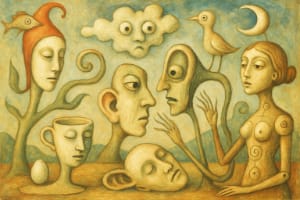
I then put “Whispers of Secret Dreams” into ChatGPT to create an image. This is what it created:

“Whispers of Secret Dreams”
Prompting as a Creative Ritual
Prompting a language model is part creative writing, part séance. Here are a few ways artists are using prompts as part of their daily practice:
For Writers:
- Ask for unusual metaphors for grief, joy, aging, or time.
- Request a dialogue between two imaginary creatures who live inside your closet.
- Generate random titles or first lines, then riff off them manually.
For Visual Artists:
- Feed it your own artist statement and ask it to give you surreal painting concepts based on your themes.
- Ask it to describe a dream landscape based on three emotions.
- Use it to “translate” music or poems into visual prompts.
For Musicians or Composers:
- Generate imaginary genres (“Ambient Baroque Punk” anyone?)
- Ask for a story or myth to base a suite or album around.
- Explore descriptions of unheard sounds, then try to recreate them.
In all cases, you’re not just accepting what the model spits out — you’re reacting to it, arguing with it, riffing off of it. Like jazz.
Real Artists Doing It Right
Some of my favorite examples of AI-as-muse come from creatives who treat it like a very peculiar studio assistant:
- A collage artist in Oregon who uses GPT to write poetic titles for their otherwise abstract pieces.
- A songwriter who brainstorms lyrics with Claude, then rewrites every single line to make it more personal.
- A digital painter who asks ChatGPT for “folk tales from a forgotten planet,” then illustrates them as storybook scenes.
None of them are blindly accepting the output. They’re wrestling with it. Which, honestly, is kind of the point.
The Soul Is in the Editing
If you’re worried about losing your creative identity to the machine — good. That worry means you care. It also probably means you won’t.
Because here’s the thing: real creativity doesn’t come from prompts. It comes from your response to the prompts. Your taste. Your weird inner logic. Your delight in breaking your own rules.
AI can offer the spark, but the fire? That’s yours.
Use the Machine For Your Art
If you’re an artist, you don’t have to reject AI outright. But you also don’t have to let it steal your spotlight. Use it like a mirror, a provocateur, a riddler.
Let it surprise you. Let it weird you out. Let it help you see something old in a new way.
But always remember: AI is not the artist. You are.
by Patrix | May 21, 2025
Back in the day, the invention of the paint tube changed everything. Suddenly, artists didn’t need to grind their own pigments or stay indoors—they could take their easels outside and paint the world as they saw it. It was a small shift in materials, but a massive leap in creative possibility.
Oil paints were once controversial.
When photography first came on the scene, some folks speculated it would be the end of painting..
Today, we’re facing something similar with AI art. Tools like Midjourney, DALL·E, and Stable Diffusion have arrived on the scene, stirring up both excitement and concern. Some see these tools as threats to traditional artistry. Others see them as toys or shortcuts. But for many of us—especially those curious about the intersection of creativity and technology—they offer something far more nuanced: a new way to explore our imagination.
A Brush That Listens
At its core, AI art is collaborative. You don’t just click a button and get a masterpiece. You describe what you see in your mind’s eye. You experiment, revise, and refine. You coax the image into existence through prompts, much like a sculptor chips away at marble. The results often surprise you. Sometimes, they’re flat-out wrong. But that back-and-forth, that act of shaping and reacting, is the creative process.
It’s easy to underestimate the skill involved until you try it for yourself. Crafting the right prompt takes intuition, clarity, and persistence. It’s not unlike directing a team—except your “team” happens to be a statistical model trained on billions of images.
Standing on the Shoulders of Giants (and Algorithms)
It helps to remember that artists have always used the tools available to them. The camera obscura once seemed like a trick. Photoshop was once debated in the world of photography. Even the idea of digital painting was initially met with skepticism. And yet, each of these innovations opened up new forms of expression.
AI might feel different because it seems to “create” on its own. But it doesn’t. It mirrors patterns and reflects inputs—it needs a human guide. If anything, it holds up a mirror to your own imagination and asks, “Is this what you meant?” Often, the answer is no. So you adjust. Try again. And somewhere in that process, art happens.
Personal Notes from the Prompt Trenches
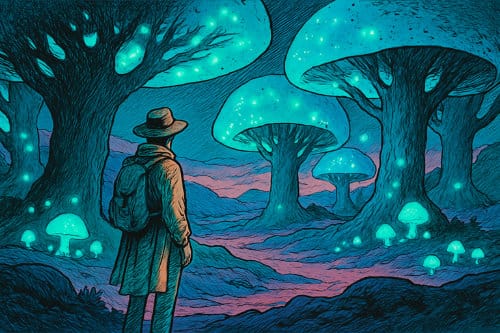
When I first started using Midjourney, I wasn’t trying to replace anything. I was just curious. I’d type in a phrase—something like “a lone figure under bioluminescent trees, painted in the style of Moebius”—and see what came back. Most of the time, the results weren’t quite right. But every so often, I’d get something that made me stop and stare. Not because it was perfect, but because it hinted at a story I hadn’t told yet. That moment of surprise—that’s the part that felt like art to me.
Over time, I began using AI not to finish work, but to start it. It became a sketchbook, a reference generator, a source of inspiration when I was stuck. It nudged me into new color palettes, strange compositions, and ideas I wouldn’t have thought of on my own.
A Tool, Not a Threat
None of this is to say that AI tools don’t raise serious questions—about authorship, copyright, originality. These are valid concerns, and we’ll need to grapple with them honestly. But dismissing AI outright, as if it’s cheating or lazy, misses the deeper truth: creativity has always been about making meaning with the tools we have. The brush changes, but the impulse to create, to express, to share—that doesn’t.
So maybe the real question isn’t whether AI art “counts.” Maybe it’s how we, as artists and humans, choose to use it.
Curious to try it for yourself?
Next time you feel a creative itch, try describing something impossible to an AI art generator. Not to show off or make a finished product—but to see what comes back. Treat it like a sketch, not a statement. You might just discover a new direction you hadn’t considered.
And if it feels weird or uncertain at first—that’s okay. Most good art does.
by Patrix | Apr 21, 2025
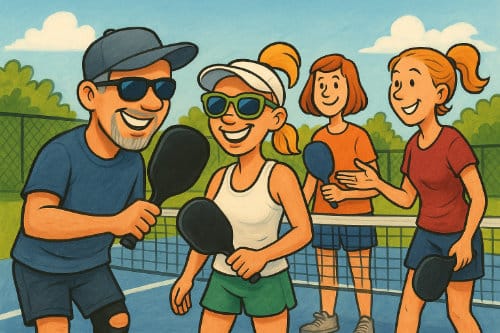
It started with a missed shot. Someone blamed the wind. Someone else blamed the paddle. And someone else blamed the cracks on the court. Then someone (let’s call him Patrick) said “Well, sometimes I am for the cracks.” Then the lady with the green glasses made one simple gesture: with an exaggerated surprised look on her face, she covered her butt with her paddle.
They laughed for minutes.
It’s not just a sport—it’s a stage. A recurring ensemble of characters shows up, paddles in hand, ready to rally and razz. And now, thanks to artificial intelligence, you can capture the drama, comedy, and chaos of your pickleball life in the form of a cartoon strip. No drawing skills required; just your imagination.
AI as Your New Comic Artist
I’ll admit, I was skeptical at first. Turning real-life moments into a cartoon seemed like something that required either years of practice or a teenager with Procreate. But AI image generators—like DALL·E, Bing Image Creator, Midjourney, and even ChatGPT—have gotten weirdly good at turning text descriptions into colorful, expressive visuals. Especially when you give them something playful to work with.
Pickleball, it turns out, is a perfect subject.
What Makes a Good Comic?
You don’t need much. Four or five panels is enough to tell a small story—something silly, familiar, and just exaggerated enough to make your friends laugh out loud (or groan).
The Characters
It helps to exaggerate a little. That quiet guy who’s secretly competitive? Turn him into a shadowy figure practicing dinks by moonlight. The friend who always shows up in matching visors and wristbands? She becomes the team fashion icon, complete with sparkles and a signature smirk.
To keep the AI from getting confused, I learned to describe characters consistently in every prompt. “Slim man with grey cap and right knee brace, cartoon style” became shorthand for Patrick. Cari? “Petite woman with green sunglasses and a white visor, energetic expression.” AI doesn’t remember from panel to panel, so you have to guide it carefully. But once you get the hang of it, it becomes a fun little collaboration—part art project, part improv comedy.
The Joy of Seeing It on the Screen
I think what surprised me most was how satisfying it was to see these ridiculous court moments frozen in cartoon form. Not polished. Not perfect. But funny in a way that felt both personal and sharable.
And the process—assembling the panels, adding text bubbles, tweaking expressions—reminded me that storytelling doesn’t have to be high art. Sometimes it’s just four friends on a pickleball court, trying to figure out which paddle is which, or which cracks are which.
It’s Not About the Art. It’s About the Memory.
AI can’t replace the warmth of real-life friendships, or the squeak of shoes on the court, or the quiet satisfaction of a well-placed drop shot. But it can help you capture those fleeting moments in a form that’s easy to share and impossible not to smile at.
You don’t need to be a tech expert. You don’t need to understand how neural networks work. All you need is a story—and a willingness to play with it.
Pickleball already gives you the characters, the drama, and the punchlines. All AI does is draw the panels.