by Patrix | Nov 17, 2025
There is a quiet shift happening in small business offices, garages, studios, and spare bedrooms everywhere. Owners are discovering that generic AI use is helpful, but strategic AI use is transformative. The key is pairing the right model with the right task instead of treating every problem as something a single chatbot should solve. That approach wastes time, produces mediocre results, and hides the true power of these tools.
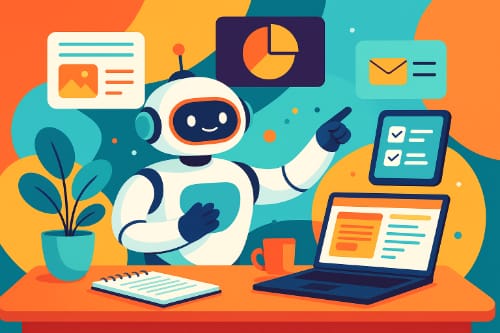
Choosing the right AI model for each job is similar to building a reliable toolbox. A socket wrench, a Phillips screwdriver, and a hammer all sit under the same lid, but nobody expects them to do the same thing. Models differ the same way. Some are built for writing, some for vision, some for coding, some for speech, some for data analysis, and some for workflow automation. Organizing them intentionally can simplify daily operations for any small business owner.
What follows is a practical and creative look at how specific AI models fit into specific functions of small business life. None of this replaces real judgment or real craftsmanship. It simply makes room for more of it.
Content Creation with Language Models
The most obvious use of AI in small business is writing. Marketing copy, newsletters, proposals, product descriptions, and internal documentation all eat time. General chat models can handle these tasks, but targeted language models make them smoother and more accurate.
Modern text generation models excel when you give them clear roles. Instead of asking a generic model to write everything, choose specialized versions or specialized prompt structures tuned for tone, length, and consistency. Use them to generate drafts, refine messages, or rewrite material into a house voice that feels natural to customers. Language models are also ideal for repurposing content across platforms so one idea can serve Instagram, a blog post, an email, and a short video script.
Small businesses benefit most when they treat writing models as partners, not printers. They help clarify ideas, break creative blocks, document processes, and keep communications steady even when schedules get chaotic.
Vision Models for Product, Branding, and Operations
Image generation and vision analysis models open a second arena of opportunity. They are useful far beyond creating pretty pictures. Vision models help develop product prototypes, test packaging ideas, explore branding directions, and even analyze photos from real environments.
Small retailers use vision tools to stage products in hypothetical rooms without paying for studio time. Local restaurants use them to explore menu display ideas or experiment with digital signage looks. Artists or makers use them to visualize variations of a piece before committing materials. Service businesses use them for brand moodboards or social media assets that match a unified style.
Vision models also help with practical tasks. They can interpret images from a job site, identify materials, compare before and after results, and speed up quality control. They do not replace the human eye, but they save time and reduce uncertainty.
Speech Models for Calls, Voice Notes, and Transcription
Many small business owners run companies through conversations. Calls with clients, voice memos after appointments, quick walkthroughs of ideas, and fast notes between meetings all contain valuable information. The trouble is getting that information into a usable form.
Speech models solve this. They transcribe, summarize, and extract action items from phone calls, meetings, field recordings, and brainstorming sessions. They turn days of scattered notes into structured plans. They can even translate or clean up audio for clear communication with clients who prefer verbal updates.
When used consistently, speech models create a living record of daily operations. That record supports continuity, training, onboarding, and future planning.
Data Models for Analysis and Forecasting
Small businesses generate data without realizing it. Sales, appointments, website traffic, customer feedback, inventory cycles, and marketing performance all point to patterns worth understanding. Data analysis models take these raw numbers and reveal practical insights.
These tools help answer real operational questions. Which items sell together. Which days will likely be busy. Which marketing channels actually convert. How long new customers tend to stay engaged. Where waste happens in production. Which tasks slow down growth.
Data models are not there to replace accountants or financial professionals. They provide a clear picture so owners can walk into those meetings prepared. They give clarity without requiring a degree in statistics.
Automation Models for Workflow and Integration
The true efficiency of AI shows up when models are connected. Workflow engines and automation models coordinate multiple steps so tasks run in the background instead of eating up the business owner’s time.
Imagine this chain happening automatically:
- A customer fills out a form.
- A structured summary is created by a language model.
- A vision model processes any images attached.
- A data tool updates the CRM.
- A writing model drafts a follow up email.
- A workflow runner sends the email.
- A speech model generates a voicemail script.
This is normal now. Small businesses can run sophisticated systems without hiring teams. When each model does what it does best, workflows become smooth instead of fragile.
Choosing the Right Model for Each Job
There is no universal chart that works for everyone. Each business has its own rhythm, its own pressure points, and its own creative style. The most effective approach is to start by identifying where time disappears.
Look at weekly patterns. Identify repetitive tasks. Examine where bottlenecks happen. Notice what work gets dropped when the schedule fills up. Then assign the right model to take pressure off that region. Use writing models for content, vision models for branding and review, speech models for knowledge capture, data models for clarity, and workflow tools to tie everything together.
The value is cumulative. Each improvement frees the owner to think, create, and lead rather than chase small tasks.
The Creative Advantage
Every small business is ultimately a creative act. AI models, when used with intention, protect that creative energy. They allow owners to shift from constant reaction to thoughtful direction. They help transform scattered effort into focused momentum.
The point is not automation. The point is space. Space for ideas. Space for listening. Space for customers. Space for building something that reflects its founder.
Small businesses that choose models intentionally do not work more. They work better.
by Patrix | Nov 5, 2025
Imagine a world where everything you own, from your beach house to your concert ticket to the tiny watercolor you just painted, exists as a digital token—a unique, verifiable object on a global network. Not a copy, not a file on your computer, but a token that proves ownership, authenticity, and sometimes even emotion. That’s the tokenized world we’re heading toward, and whether we notice it or not, it’s already taking shape beneath our feet.
The New Language of Value
For most of history, ownership was physical. You held a deed, a coin, or a painting. The internet shattered that logic. Suddenly, value could move at light speed, but proof of ownership couldn’t. Blockchain technology fixed that gap. It introduced the idea of a token, which is a kind of digital certificate that says, “This belongs to me.”
Bitcoin was the first major example. It proved digital scarcity was possible. Then Ethereum showed we could tokenize just about anything: art, music, even tweets. And now, as the technology matures, we’re moving toward a world where every object, idea, or access point can be represented by a token.
Tokenization in Everyday Life
Think beyond crypto collectibles or meme coins. Imagine these scenarios:
- A musician releases a limited run of songs as collectible tokens. Fans can trade them or use them as keys to private shows.
- A photographer sells access to their entire portfolio as a fractionalized token, allowing patrons to share in its future value.
- Real estate gets tokenized, making it possible to invest in a slice of a vacation home rather than buying the whole thing.
- Even your reputation or social media presence could be tokenized, transforming online influence into tangible value.
In this sense, tokenization becomes a kind of digital fabric. It’s an invisible layer of ownership that threads through our economy and culture.
The Psychological Shift
When everything becomes tokenized, the way we think about value changes. Ownership is no longer about possession; it’s about participation. A digital artist might still “own” their original file, but the value of their token lies in its story and the network of people who believe in it.
We’re already seeing this with NFTs. A painting in your living room might have sentimental value, but a digital token can carry community value. It blurs the line between collector and creator. Everyone becomes part of the creative economy.
There’s something almost poetic about that. The world becomes a gallery, and each token a brushstroke in a collective artwork.
The Good, the Weird, and the Inevitable
Like any major shift, tokenization comes with tension. It’s not just about technology; it’s about human behavior.
On the good side, tokenization democratizes access. It opens doors for people who never had them—small creators, global investors, artists in remote towns. It makes the economy more liquid, more transparent, and potentially more fair.
On the weird side, it also risks commodifying everything. When even your digital identity has a token price, what happens to authenticity? Will art still feel sacred when it’s instantly tradeable? Will friendship or community lose something if loyalty points become financial assets?
And yet, this evolution feels inevitable. The internet has always pushed us toward abstraction. From gold to paper to pixels to tokens, we keep reimagining what “value” means.
Art in the Age of Tokens
For artists, tokenization is both liberation and labyrinth. It means direct connection with audiences, verifiable provenance, and income streams that don’t rely on middlemen. But it also means navigating marketplaces, smart contracts, and the psychological weight of constant monetization.
Still, artists have always been at the forefront of new mediums. From the first cave painter to the first crypto artist, creation and experimentation go hand in hand. In many ways, tokenization restores something ancient: the human need to prove, “I made this,” and to have that statement echo across time.
When the World Itself Becomes a Ledger
One day, we may wake up and realize that tokenization isn’t just a feature of the economy; it’s the economy. Your car’s maintenance record, your diploma, your medical data, your digital garden of AI-generated art—each tokenized, portable, and under your control.
It’s easy to see this as dystopian or utopian, depending on your mood. The truth, as usual, will probably be somewhere in between. The key question is not whether everything will be tokenized, but how we’ll behave once it is.
Will we treat tokens as mere assets, or as meaningful artifacts of human creativity? Will we use them to build trust and community, or to speculate and divide?
If we get it right, tokenization could become one of the most empowering technologies of our lifetime. It’s a bridge between art and math, between ownership and identity. A world where value is no longer confined to banks and galleries, but flows freely, beautifully, and verifiably among us.
And maybe, when everything becomes a token, we’ll finally see that the real value was never in the token itself, but in the human stories behind it.
by Patrix | Oct 28, 2025
If you run a small business, this is your wake-up call. Artificial intelligence is not a futuristic luxury or a tool reserved for tech giants. It is the new electricity, quietly rewiring every industry, every process, and every assumption about what it means to run a company. And here’s the hard truth: small businesses that do not learn how to use AI soon risk being left behind in a world that moves at algorithmic speed.
We are entering an era where hesitation can cost not just efficiency but survival. The pace of change is breathtaking, but the opportunity is even greater.
The New Business Divide: Those Who Adapt, and Those Who Disappear
Think back to the early days of the internet. Some small businesses shrugged off websites as unnecessary. “We are a local shop,” they said. “Our customers already know where to find us.” Fast forward a decade, and many of those shops were gone. AI is that same moment all over again, only faster and bigger.
Today, AI is not just about automating a few tasks. It is about redesigning how business gets done. It covers customer service, marketing, bookkeeping, logistics, HR, and creative direction, all enhanced by intelligent automation. Tools such as ChatGPT, Claude, and Perplexity can draft proposals, generate social media content, respond to customers, and analyze data patterns that humans would never notice. Midjourney and Runway can produce visuals that once required full design teams. Even small-town bakeries can use predictive analytics to know exactly how many croissants to make tomorrow morning.
This is not just innovation. It is a survival strategy.
You Don’t Need a Tech Department. You Need Curiosity
One of the biggest misconceptions is that AI is complicated. It is not. What is complicated is clinging to old habits.
Small businesses do not need data scientists or custom-built algorithms to begin. What they need are owners and managers who are willing to experiment. A solo entrepreneur can now access the kind of analytical power that once belonged only to corporations with large research budgets. Most AI tools are plug-and-play, cloud-based, and surprisingly affordable.
If you can type, you can prompt. If you can explain a task to an employee, you can explain it to an AI assistant. The real skill is learning how to ask the right questions, how to translate your goals into clear instructions. That is not a technical ability; it is a creative one.
The Real Urgency: The AI Advantage Compounds
Here is the part most people do not see. The AI learning curve has compounding returns. Businesses that start early do not just save time; they build data, refine workflows, and develop experience that keeps improving over time. Every week you wait is a week your competitors are teaching their AIs to serve their customers better, faster, and cheaper.
Picture two graphic design studios today. One experiments with generative design tools, AI upscaling, and automated proposal writing. The other decides to “wait and see.” In a year, the first studio’s productivity doubles while its costs drop. In two years, its client experience feels effortless and almost magical. The second studio is still wondering what happened.
Small Businesses Have a Superpower: Agility
Large corporations move like cruise ships. They take forever to turn. Small businesses are speedboats, quick to maneuver and capable of changing direction in a single day.
You do not need a committee to approve a new process. You can test an AI tool on Monday, refine it on Tuesday, and see results before the week is over. The smaller your team, the easier it is to adapt workflows, experiment with automation, and find the right balance between human creativity and machine efficiency.
Many small business owners still assume AI is a threat. In reality, it is their best equalizer. The same technology that makes billion-dollar companies more efficient can make your one-person operation feel ten times larger.
The Human Touch Still Matters, Even More So
AI does not replace human authenticity; it enhances it. The businesses that thrive in this new era will be the ones that blend automation with warmth. Imagine AI handling your scheduling, bookkeeping, or marketing drafts so that you can focus on what only you can do: personal connection, local storytelling, and exceptional service.
People crave realness, especially as more interactions move online. Use AI to streamline, not sterilize. Let it handle the heavy lifting so your humanity shines brighter.
Where to Begin (Today, Not Tomorrow)
Start small, but start now.
Use AI chat tools to draft emails or customer responses. Try an image generator for product photos or marketing visuals. Use AI bookkeeping assistants to track expenses. Experiment with automated analytics to understand sales patterns.
The goal is to build habits, small daily integrations that add up to major transformations. Once you see what is possible, you will never want to go back to doing everything manually.
The Bottom Line
The AI revolution is not on the horizon; it is already here, reshaping the foundation of modern commerce. For small businesses, this is not the time to hesitate or debate the meaning of change. It is the time to act, to learn, and to explore.
You do not need to become an expert. You just need to stay curious and nimble. The future will not wait for you to catch up, but if you start now, you may find that it is the most exciting and empowering era small business has ever seen.
by Patrix | Oct 24, 2025
There is a quiet revolution happening in garages, spare rooms, and coffee shops around the world. It is not funded by venture capital or directed by tech giants. It is powered by curiosity, caffeine, and a handful of astonishingly capable AI tools. The people leading it are not CEOs or professional developers. They are artists, retirees, designers, and tinkerers. What they share is not scale or money but an inventive spirit.
This is the age of the AI Entrepreneur..
From Industrial Tech to Personal Tech
For the past two decades, technology has grown by getting bigger. Bigger models, bigger datasets, bigger budgets. The next decade may be defined by the opposite trend: shrinking the distance between a single human imagination and world-class capability.
AI has become the ultimate amplifier. A single person with a laptop can now prototype products, compose film scores, design buildings, and model markets. What once required a team of specialists now fits in a conversation window.
This does not mean collaboration is over. It means individuals can move at the speed of thought, guided by their own obsessions instead of corporate roadmaps. That is the real creative frontier.
The One-Person Studio
Imagine a retired architect using AI to design solar-powered beach cabins in 3D and selling the plans online. Or a poet training a small language model on her own writing so she can co-create new verses that feel like a dialogue with her younger self.
These are not fantasies. They are emerging realities. Tools such as Runway, ChatGPT, and Midjourney are dissolving the line between idea and execution. They let a person follow a spark of curiosity without needing to master every technical detail.
The result is a wave of new micro-studios: one-person creative engines that make, publish, and refine their work faster than most companies can organize a meeting.
Some call this “solopreneurship,” but that term feels too businesslike. What is really happening is a return to the workshop. It is a modern echo of the Renaissance artisan, only this time the apprentices are digital models, always available, endlessly patient, and surprisingly insightful.
The Rise of Intentional Obsession
Small-scale genius is not about doing everything. It is about focusing deeply on something that matters. AI provides leverage, but the direction still comes from human intention.
A photographer can use diffusion models to extend a visual style into motion. A gardener can train a simple plant-recognition model to understand what thrives in coastal soil. A musician can merge field recordings with generative harmonies to create soundscapes that feel alive.
The tools do not make the work meaningful. The curiosity of the creator does. The real genius lies in that pairing: a mind that notices something special and a machine that helps bring it into focus.
Why Big Companies Cannot Replicate This
Large companies are built for predictability. They need certainty, efficiency, and scale. Small-scale creators, on the other hand, can follow hunches. They can explore half-formed ideas, chase beauty, or build something just to see if it works.
That freedom is invaluable. It is why so many breakthroughs, from open-source software to indie games to early crypto projects, began as experiments by individuals rather than committees.
AI magnifies that effect. It allows one person to work at a scale that once required an organization while staying independent and agile. The creative economy of the future may look less like Silicon Valley and more like a constellation of small studios, each orbiting its own curiosity.
The Tools of Modern Genius
- ChatGPT or Claude: your thinking partner and idea refiner.
- Midjourney, Ideogram, or Leonardo AI: visual design studios in a browser tab.
- Runway, Pika, or Sora (when available): cinematic imagination engines.
- Canva, Notion, or Descript: finishing tools that make publishing effortless.
But the most powerful tool is not digital. It is the mindset that these tools encourage. They promote experimentation, speed, and reflection. You can fail quietly, learn fast, and share the results when ready. That is how real craft develops.
Rethinking Success
Small-scale genius does not need to go viral. It does not need millions of followers. Its measure of success is depth, not reach. Did you make something meaningful? Did you learn something new? Did your curiosity grow stronger?
This approach to creation feels almost rebellious in a culture obsessed with scale. But it is precisely that intimacy—the sense that a single person made this out of genuine fascination—that gives the work its power.
In a way, AI is restoring something ancient. It is making the individual workshop viable again. The world’s most advanced tools have become personal instruments. The future may not belong to whoever has the biggest model or the most GPUs, but to whoever has the clearest vision and the patience to refine it.
The Beauty of Staying Small
It is easy to confuse progress with expansion. Yet every ecosystem needs small, adaptive organisms that can thrive where giants cannot.
The small-scale creator can change direction overnight, follow inspiration instantly, and keep their work personal and distinctive. In that space, between curiosity and capability, innovation flourishes.
The genius of tomorrow will not be measured in patents or IPOs. It will live in quiet workshops, on handmade websites, in local galleries, and perhaps on a porch overlooking the Central Coast, where one person and a laptop are turning an idea into something that did not exist yesterday.
by Patrix | Sep 30, 2025
Artificial intelligence has already written our emails, helped us cook dinner, and made our vacation photos look like Van Gogh paintings. But the next stage isn’t about better suggestions — it’s about AI that actually does things on your behalf. This is the promise of agentic AI: not just a clever advisor, but a reliable junior associate who takes action.
Let’s explore what agentic AI is, how Manus.im is positioning itself as a practical tool for small businesses, and how it compares to alternatives like OpenManus and other open frameworks.
What Is Agentic AI?
Think of today’s large language models like ChatGPT, Claude, or Gemini as brilliant consultants. They answer questions, draft copy, and analyze data — but you still have to push the buttons. Agentic AI goes a step further. It doesn’t just recommend, it acts.
An agentic AI can plan, execute, and adapt across multiple steps. A generative model might give you a marketing slogan. An agentic model could draft the slogan, design a landing page, post it on your website, send it out to your mailing list, and schedule a reminder to check how many people clicked.
The essential qualities of agentic AI are autonomy, planning, adaptability, and integration with tools. It’s the difference between hiring a consultant and hiring an assistant who rolls up their sleeves and actually does the work.
Manus.im: The Polished Assistant
Manus.im bills itself as an “AI action engine.” The company behind it, Butterfly Effect Pte. Ltd. in Singapore, has designed Manus to be more than a chatbot. The platform is intended to let you delegate multi-step tasks that normally require juggling apps, spreadsheets, and browser tabs.
For small businesses, the appeal is clear. Manus promises workflow automation without coding. You could ask it to post updates, send emails, or sync data between Google Sheets and Mailchimp without writing a line of code. It integrates across multiple tools, which is especially valuable for small businesses running on a patchwork of Shopify stores, CRMs, and marketing platforms. Once a process is defined, Manus can repeat it consistently, offering a kind of scalability that normally requires adding staff. It also extends into creative execution, with demos showing Manus building websites, generating dashboards, and even handling some content creation.
If you are a solo entrepreneur or part of a lean team, Manus offers the fantasy of having a digital operations assistant — minus the payroll. But, like most new platforms, the reality is a bit more cautious. Some of the demos are aspirational, and the system is still new enough that errors are possible. It is wise for small businesses to begin with low-risk tasks such as reminders or content posting before turning the AI loose on more critical work like invoices or direct customer outreach.
OpenManus: The Community-Driven Counterpart
If Manus.im is the polished, commercial product, OpenManus is its open-source cousin. Built by a community of developers and hosted on GitHub, OpenManus attempts to replicate the agentic features of Manus, such as multi-agent coordination, web scraping, and tool integration.
The trade-offs are familiar to anyone who has chosen between commercial software and open-source alternatives. Manus is more stable and polished, while OpenManus can be buggy and experimental. Manus hides its inner workings, while OpenManus lets you see and even modify the code. Manus requires a subscription or usage fees, while OpenManus can often be used at little or no cost. Vendor support backs Manus, while OpenManus relies on volunteer effort and community contributions.
For tech-savvy users who like to tinker, OpenManus offers flexibility and transparency. For small business owners who simply need reliable execution, Manus is likely the safer choice.
Other Alternatives Emerging
Manus and OpenManus are not alone. Developers are experimenting with frameworks like LangChain, CrewAI, and AutoGen, which allow you to build your own agentic systems from scratch. Meanwhile, major AI vendors such as OpenAI and Anthropic are slowly weaving agent-like features into their platforms.
These options reflect the broader spectrum of choice: a polished turnkey assistant like Manus, a flexible open-source playground like OpenManus, or the do-it-yourself frameworks that require technical expertise. Which path you take depends on whether you want convenience, control, or customizability.
Should Small Businesses Dive In?
The pragmatic view is that agentic AI is still young but promising. For small businesses, the potential payoff is significant: time saved, more consistent execution, and the ability to scale without adding headcount. But the risks are equally real: mistakes, misfires, and unintended behaviors.
The smart move is to start small. Use agentic AI for marketing tasks, posting schedules, or simple report generation. Keep humans in the loop when communicating with customers. Watch carefully to see whether the time saved is worth the cost.
Agentic AI moves us from AI as an advisor to AI as a team member. Whether you choose Manus, OpenManus, or another route, the best way to think about these systems today is as bright but inexperienced interns. They are eager, fast-learning, and useful — but still in need of supervision.
by Patrix | Sep 20, 2025
For seasoned crypto followers, September has long been considered the worst month on the calendar. Traders even coined phrases like “Red September” because, historically, Bitcoin almost always lost value during this stretch. Since 2013, only a couple of Septembers finished green, and the average return was deeply negative. This made September a month of dread, especially for short-term traders who set their strategies around seasonality.
Yet here we are in September 2025, watching Bitcoin climb more than 8% mid-month — and if the trend holds, it will be Bitcoin’s best September in 13 years. That’s not just a minor blip in a price chart. It’s a signal that the old patterns may be changing, and that the crypto market is evolving in ways that go beyond the usual narratives.
Let’s unpack what’s driving this unexpected September surge, why it matters for the broader financial landscape, and what everyday investors and curious onlookers should take away from it.
The Weight of History: Why September Was Always Bad
Before we look at the current rally, it helps to understand the baggage. Historically, September was a weak month for risk assets in general, not just Bitcoin. Stocks also tend to underperform in September — analysts blame factors like end-of-summer trading slumps, tax-loss harvesting, and portfolio rebalancing by institutional investors.
Bitcoin inherited much of this seasonal weakness, but it often magnified it. Since Bitcoin is more volatile than most assets, September’s market drags frequently turned into sharp drops. Traders would often “front run” this expectation, shorting Bitcoin simply because September had such a bad reputation. In markets, self-fulfilling prophecies are a powerful force.
So when September 2025 began with Bitcoin around $56,000, few expected anything other than another dip. Instead, the market turned upward — and quickly.
The Rally So Far
By the third week of September, Bitcoin had gained roughly 8%. That might not sound earth-shattering compared to the 20% leaps the asset sometimes delivers in bull runs, but context matters. In September, positive numbers of any size are rare. This year’s rally is already on pace to be the best September since 2012, when Bitcoin was still trading under $15.
Equally important, the price strength has come during a period of relative calm. There hasn’t been a single high-profile regulatory announcement or sudden corporate adoption headline that can explain away the gains. Instead, the drivers are subtler but potentially more significant.
What’s Driving the Comeback?
1. Anticipation of Interest Rate Cuts
The U.S. Federal Reserve has been signaling that rate cuts could come as soon as early 2026. Even the mere expectation of looser monetary policy tends to lift risk assets. Bitcoin, often described as “digital gold,” benefits in two ways: as a hedge against future inflation and as a high-beta asset that thrives when money gets cheaper.
2. Institutional Steadiness
Unlike earlier cycles, institutions are now holding rather than fleeing. ETFs holding Bitcoin have seen consistent inflows this year. Pension funds and family offices that once avoided crypto are dipping their toes in, while the so-called “tourist money” (short-term speculators) has been less dominant. This suggests a maturing market that reacts less dramatically to seasonal quirks.
3. Market Structure and Supply Dynamics
Bitcoin’s supply schedule doesn’t change, but the halving earlier this year tightened the flow of new coins. Mining rewards dropped from 6.25 BTC to 3.125 BTC per block, and history shows that halvings often set the stage for multi-month uptrends. The September rally may simply be one chapter in this larger story.
4. Global Macro Tensions
Geopolitical uncertainty — from trade disputes to currency instability in emerging markets — is reinforcing Bitcoin’s appeal as a borderless, non-sovereign store of value. Countries experiencing inflationary pressures (like Argentina and Turkey) continue to drive grassroots demand.
5. A Shift in Narrative
Finally, there’s psychology. For more than a decade, September has been seen as doomed for Bitcoin. This year, breaking that streak creates a fresh story: that Bitcoin is decoupling from its past cycles and maturing into a more stable, mainstream asset. In markets, stories are as important as statistics.
What This Means for Investors
For long-term Bitcoin holders, the September rally doesn’t mean much in the grand scheme. If you’ve held since $20,000 or lower, an 8% bump is just another squiggle in the long-term chart. But psychologically, it may matter more than the raw numbers suggest.
Breaking the September curse could shift trader behavior for years to come. If people stop shorting Bitcoin reflexively every September, the market could see reduced volatility and healthier price action.
For newcomers, the lesson is clear: past patterns are useful guides but not guarantees. Seasonal trends, technical charts, and even famous “rules of thumb” in markets always bend when fundamentals shift. The key is to stay curious and flexible rather than betting on history repeating itself forever.
What About Altcoins?
Whenever Bitcoin rallies, the natural question is: what about Ethereum, Solana, or smaller tokens? Historically, Bitcoin strength has a mixed impact. Sometimes it sucks liquidity away from altcoins, as traders pile into the safer big name. Other times, Bitcoin rallies act like a green light for altcoin speculation.
So far in September, altcoins have underperformed relative to Bitcoin, which is typical in the early stages of a new narrative. If Bitcoin keeps climbing into October, expect money to spill into other projects. But right now, Bitcoin is clearly setting the tone.
Is This the Start of a Bigger Bull Run?
Every time Bitcoin rises, someone asks whether a new all-time high is imminent. With the halving behind us, institutional money flowing in, and macro tailwinds ahead, the case is strong. But calling the timing of a bull run is always dangerous.
Still, this September feels different. It’s not driven by meme mania or a single Elon Musk tweet. It’s a quieter, steadier move upward. That suggests durability — the kind of rally that builds foundations rather than castles in the air.
What to Watch in the Coming Weeks
- ETF Flows: Continued inflows into Bitcoin ETFs suggest sustained institutional interest.
- Federal Reserve Meetings: Any change in tone on interest rates could fuel momentum.
- Global Currency Volatility: Watch places like Argentina, Turkey, and Japan — their monetary struggles often spark Bitcoin demand.
- Altcoin Rotation: If Ethereum or Solana start catching up, it could signal broader risk appetite.
- Technical Resistance: Bitcoin’s next big psychological test will be around $60,000. If it breaks that level in October, the conversation could shift toward retesting all-time highs.
As someone who’s watched Bitcoin since its scrappy early days, I find this September rally fascinating not just for the price action, but for what it says about crypto’s cultural maturity. A decade ago, Bitcoin lived or died by retail traders chasing headlines. Today, it’s increasingly shaped by institutions, macro trends, and global demand for alternatives to fiat currency.