by Patrix | Oct 10, 2025
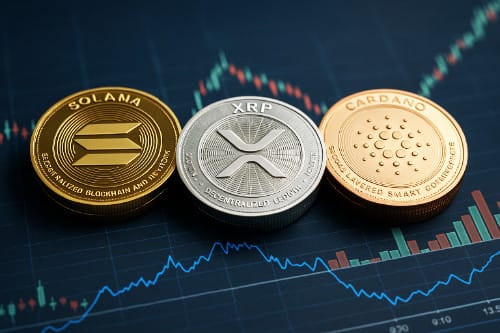
For years, the cryptocurrency market has danced to the rhythm of Bitcoin and Ethereum, with everyone else trying to keep up. But something new is stirring. The U.S. Securities and Exchange Commission (SEC) appears to be softening its stance on digital assets, hinting at potential approval for a wave of exchange-traded funds tied to other cryptocurrencies. Among the contenders, three names keep coming up: Solana (SOL), Ripple’s XRP, and Cardano (ADA). If these coins receive ETF approval, it could mark a defining moment for the broader crypto ecosystem.
The new regulatory opening
In late 2025, the SEC introduced generic listing standards for commodity-based exchange-traded products. That might sound like paperwork, but it’s a quiet revolution. Until now, every crypto ETF crawled through a lengthy and highly public approval process. The new framework streamlines that ordeal, allowing issuers to list ETFs tracking eligible digital assets as long as they meet defined requirements.
This shift also prompted applicants to withdraw and resubmit ETF filings for coins like Solana, XRP, Cardano, and others under the new rules. The message is straightforward: resubmit on the new rails and the timeline shortens. Windows that once stretched across half a year could compress to a couple of months. For investors, that change isn’t just procedural; it’s a signal that crypto is getting a clearer regulatory on-ramp.
A second back-office update also matters. “In-kind” creation and redemption — the ability for ETFs to transact in the underlying crypto rather than cash — reduces frictions and costs. Most people never see that machinery, yet it is the kind of infrastructure improvement that invites larger pools of capital to participate without operational headaches.
Why Solana, XRP, and ADA lead the pack
Solana (SOL) is the high-performance chain that developers lean on when speed and cost matter. With fast block times and low fees, it has become home base for a wide range of decentralized apps, from DeFi to consumer-facing experiments. Institutions like SOL because it behaves more like a modern tech platform than a speculative meme. If a Solana ETF gains approval, expect liquidity to deepen and spreads to tighten. That combination often attracts additional flows, which can snowball into momentum. Solana’s critics point to historic network outages and congestion. Those are real concerns, yet the recent trend has been toward better stability. If the chain continues to hold up under heavy load, SOL could become the “Apple-like” infrastructure layer of crypto — streamlined, efficient, and ready for mainstream adoption.
XRP brings something different. Its central story is payments. Ripple’s technology aims to move value across borders quickly and at low cost, and that makes XRP less of a casino chip and more of a bridge asset. After a long legal slugfest, XRP has clearer precedent than most altcoins. That doesn’t erase risk, but it reduces the fog. If an XRP ETF hits the market, it is easy to imagine conservative institutions warming to it as part of their “plumbing” allocation — an asset that helps them express a view on the future of settlement and tokenized value transfer. The potential upside is meaningful if a wave of cautious capital decides XRP is the safest way to gain altcoin exposure inside a traditional wrapper.
Cardano (ADA) takes the methodical route. It is built on peer-reviewed research and emphasizes security, sustainability, and energy efficiency. That slower, academic cadence has earned ADA a reputation for reliability rather than flash. If ADA secures ETF status, the initial surge might be gentler than SOL or XRP, yet it could prove more durable. ESG-minded allocators who want long-term exposure to a utility-first blockchain may find it appealing. Patience is the keyword: if approvals for ADA arrive after SOL or XRP, the delayed timeline could still work in Cardano’s favor by aligning with its steady-build narrative.
How ETF approval could reshape the market
ETF approval for these coins would do more than stir prices. It would change how money flows in the crypto economy. When capital enters through regulated ETFs, it often stays longer. Institutional investors prefer compliance, liquidity, and transparency, and ETFs deliver exactly that.
If ETFs for SOL, XRP, and ADA become available, traders will finally have familiar, regulated vehicles to gain exposure without the operational burden of custody and direct token handling. That invites pension funds, endowments, insurance companies, and large family offices to participate with clearer guardrails. A likely outcome is the gradual erosion of the Bitcoin-and-Ether near-monopoly on institutional attention. Capital that once concentrated in those two giants may begin to diversify into a compact set of “infrastructure” altcoins.
Diversification can also affect volatility. Deeper liquidity and tighter spreads generally tame wild swings. Expect the beta of SOL, XRP, and ADA to adjust if ETF volumes are significant. That doesn’t mean prices will move in a straight line. In the short term, regulation tends to spark speculation. Solana has a history of overreacting to hype, and XRP holders are famous for conviction. Short-term rallies and sharp corrections are likely. Cardano’s reaction may be smoother but still positive, especially if it benefits from slow-and-steady institutional accumulation.
What could go wrong
The biggest risk is political. A change in regulatory tone or a new round of enforcement could delay or even unwind progress. Even mundane issues, such as a government funding lapse, can slow reviews. If timelines slip, traders may rotate back into Bitcoin and Ether as safer holdings.
Another risk is fragmentation. If only one or two ETFs are approved initially, capital could rush into those while others languish. That can create choppy relative performance. Once ETFs exist, derivatives will proliferate. Options and futures on these funds can amplify both optimism and fear, raising the stakes for risk management.
What to watch and how to navigate
Investors should track the SEC announcement cadence and watch how issuers amend filings. On-chain activity is also a useful compass: developer traction, total value locked, and user adoption often foreshadow how resilient any post-approval rally will be.
Position sizing is more important than prediction. Regulatory momentum can move prices faster than fundamentals justify. If you catch a pop, it may be wise to realize gains methodically and leave room for consolidation. The market rewards those who plan exits as carefully as entries.
A quiet revolution
The SEC’s evolving approach to altcoin ETFs could turn out to be one of the decade’s most consequential financial shifts. Once institutional capital can flow freely into multiple regulated crypto funds, digital assets will no longer sit at the edge of the capital markets. They will live beside gold, oil, and equities in diversified portfolios.
Solana could mature into the chain of choice for speed and consumer apps. XRP might take root as the bridge for fast settlement and tokenized value. Cardano could become the patient investor’s pick for sustainable, research-driven infrastructure. Together, they offer a picture of a crypto market that looks less like a speculative carnival and more like a structured opportunity set for long-term builders and savers.
I think of it like switching from a gravel road to a paved highway. The destination doesn’t change — a digital, programmable financial system — but the ride becomes smoother, safer, and more accessible. With ETFs opening the on-ramps, the next stretch could be where crypto finally drives like a mainstream asset class.
by Patrix | Sep 30, 2025
Artificial intelligence has already written our emails, helped us cook dinner, and made our vacation photos look like Van Gogh paintings. But the next stage isn’t about better suggestions — it’s about AI that actually does things on your behalf. This is the promise of agentic AI: not just a clever advisor, but a reliable junior associate who takes action.
Let’s explore what agentic AI is, how Manus.im is positioning itself as a practical tool for small businesses, and how it compares to alternatives like OpenManus and other open frameworks.
What Is Agentic AI?
Think of today’s large language models like ChatGPT, Claude, or Gemini as brilliant consultants. They answer questions, draft copy, and analyze data — but you still have to push the buttons. Agentic AI goes a step further. It doesn’t just recommend, it acts.
An agentic AI can plan, execute, and adapt across multiple steps. A generative model might give you a marketing slogan. An agentic model could draft the slogan, design a landing page, post it on your website, send it out to your mailing list, and schedule a reminder to check how many people clicked.
The essential qualities of agentic AI are autonomy, planning, adaptability, and integration with tools. It’s the difference between hiring a consultant and hiring an assistant who rolls up their sleeves and actually does the work.
Manus.im: The Polished Assistant
Manus.im bills itself as an “AI action engine.” The company behind it, Butterfly Effect Pte. Ltd. in Singapore, has designed Manus to be more than a chatbot. The platform is intended to let you delegate multi-step tasks that normally require juggling apps, spreadsheets, and browser tabs.
For small businesses, the appeal is clear. Manus promises workflow automation without coding. You could ask it to post updates, send emails, or sync data between Google Sheets and Mailchimp without writing a line of code. It integrates across multiple tools, which is especially valuable for small businesses running on a patchwork of Shopify stores, CRMs, and marketing platforms. Once a process is defined, Manus can repeat it consistently, offering a kind of scalability that normally requires adding staff. It also extends into creative execution, with demos showing Manus building websites, generating dashboards, and even handling some content creation.
If you are a solo entrepreneur or part of a lean team, Manus offers the fantasy of having a digital operations assistant — minus the payroll. But, like most new platforms, the reality is a bit more cautious. Some of the demos are aspirational, and the system is still new enough that errors are possible. It is wise for small businesses to begin with low-risk tasks such as reminders or content posting before turning the AI loose on more critical work like invoices or direct customer outreach.
OpenManus: The Community-Driven Counterpart
If Manus.im is the polished, commercial product, OpenManus is its open-source cousin. Built by a community of developers and hosted on GitHub, OpenManus attempts to replicate the agentic features of Manus, such as multi-agent coordination, web scraping, and tool integration.
The trade-offs are familiar to anyone who has chosen between commercial software and open-source alternatives. Manus is more stable and polished, while OpenManus can be buggy and experimental. Manus hides its inner workings, while OpenManus lets you see and even modify the code. Manus requires a subscription or usage fees, while OpenManus can often be used at little or no cost. Vendor support backs Manus, while OpenManus relies on volunteer effort and community contributions.
For tech-savvy users who like to tinker, OpenManus offers flexibility and transparency. For small business owners who simply need reliable execution, Manus is likely the safer choice.
Other Alternatives Emerging
Manus and OpenManus are not alone. Developers are experimenting with frameworks like LangChain, CrewAI, and AutoGen, which allow you to build your own agentic systems from scratch. Meanwhile, major AI vendors such as OpenAI and Anthropic are slowly weaving agent-like features into their platforms.
These options reflect the broader spectrum of choice: a polished turnkey assistant like Manus, a flexible open-source playground like OpenManus, or the do-it-yourself frameworks that require technical expertise. Which path you take depends on whether you want convenience, control, or customizability.
Should Small Businesses Dive In?
The pragmatic view is that agentic AI is still young but promising. For small businesses, the potential payoff is significant: time saved, more consistent execution, and the ability to scale without adding headcount. But the risks are equally real: mistakes, misfires, and unintended behaviors.
The smart move is to start small. Use agentic AI for marketing tasks, posting schedules, or simple report generation. Keep humans in the loop when communicating with customers. Watch carefully to see whether the time saved is worth the cost.
Agentic AI moves us from AI as an advisor to AI as a team member. Whether you choose Manus, OpenManus, or another route, the best way to think about these systems today is as bright but inexperienced interns. They are eager, fast-learning, and useful — but still in need of supervision.
by Patrix | Sep 20, 2025
For seasoned crypto followers, September has long been considered the worst month on the calendar. Traders even coined phrases like “Red September” because, historically, Bitcoin almost always lost value during this stretch. Since 2013, only a couple of Septembers finished green, and the average return was deeply negative. This made September a month of dread, especially for short-term traders who set their strategies around seasonality.
Yet here we are in September 2025, watching Bitcoin climb more than 8% mid-month — and if the trend holds, it will be Bitcoin’s best September in 13 years. That’s not just a minor blip in a price chart. It’s a signal that the old patterns may be changing, and that the crypto market is evolving in ways that go beyond the usual narratives.
Let’s unpack what’s driving this unexpected September surge, why it matters for the broader financial landscape, and what everyday investors and curious onlookers should take away from it.
The Weight of History: Why September Was Always Bad
Before we look at the current rally, it helps to understand the baggage. Historically, September was a weak month for risk assets in general, not just Bitcoin. Stocks also tend to underperform in September — analysts blame factors like end-of-summer trading slumps, tax-loss harvesting, and portfolio rebalancing by institutional investors.
Bitcoin inherited much of this seasonal weakness, but it often magnified it. Since Bitcoin is more volatile than most assets, September’s market drags frequently turned into sharp drops. Traders would often “front run” this expectation, shorting Bitcoin simply because September had such a bad reputation. In markets, self-fulfilling prophecies are a powerful force.
So when September 2025 began with Bitcoin around $56,000, few expected anything other than another dip. Instead, the market turned upward — and quickly.
The Rally So Far
By the third week of September, Bitcoin had gained roughly 8%. That might not sound earth-shattering compared to the 20% leaps the asset sometimes delivers in bull runs, but context matters. In September, positive numbers of any size are rare. This year’s rally is already on pace to be the best September since 2012, when Bitcoin was still trading under $15.
Equally important, the price strength has come during a period of relative calm. There hasn’t been a single high-profile regulatory announcement or sudden corporate adoption headline that can explain away the gains. Instead, the drivers are subtler but potentially more significant.
What’s Driving the Comeback?
1. Anticipation of Interest Rate Cuts
The U.S. Federal Reserve has been signaling that rate cuts could come as soon as early 2026. Even the mere expectation of looser monetary policy tends to lift risk assets. Bitcoin, often described as “digital gold,” benefits in two ways: as a hedge against future inflation and as a high-beta asset that thrives when money gets cheaper.
2. Institutional Steadiness
Unlike earlier cycles, institutions are now holding rather than fleeing. ETFs holding Bitcoin have seen consistent inflows this year. Pension funds and family offices that once avoided crypto are dipping their toes in, while the so-called “tourist money” (short-term speculators) has been less dominant. This suggests a maturing market that reacts less dramatically to seasonal quirks.
3. Market Structure and Supply Dynamics
Bitcoin’s supply schedule doesn’t change, but the halving earlier this year tightened the flow of new coins. Mining rewards dropped from 6.25 BTC to 3.125 BTC per block, and history shows that halvings often set the stage for multi-month uptrends. The September rally may simply be one chapter in this larger story.
4. Global Macro Tensions
Geopolitical uncertainty — from trade disputes to currency instability in emerging markets — is reinforcing Bitcoin’s appeal as a borderless, non-sovereign store of value. Countries experiencing inflationary pressures (like Argentina and Turkey) continue to drive grassroots demand.
5. A Shift in Narrative
Finally, there’s psychology. For more than a decade, September has been seen as doomed for Bitcoin. This year, breaking that streak creates a fresh story: that Bitcoin is decoupling from its past cycles and maturing into a more stable, mainstream asset. In markets, stories are as important as statistics.
What This Means for Investors
For long-term Bitcoin holders, the September rally doesn’t mean much in the grand scheme. If you’ve held since $20,000 or lower, an 8% bump is just another squiggle in the long-term chart. But psychologically, it may matter more than the raw numbers suggest.
Breaking the September curse could shift trader behavior for years to come. If people stop shorting Bitcoin reflexively every September, the market could see reduced volatility and healthier price action.
For newcomers, the lesson is clear: past patterns are useful guides but not guarantees. Seasonal trends, technical charts, and even famous “rules of thumb” in markets always bend when fundamentals shift. The key is to stay curious and flexible rather than betting on history repeating itself forever.
What About Altcoins?
Whenever Bitcoin rallies, the natural question is: what about Ethereum, Solana, or smaller tokens? Historically, Bitcoin strength has a mixed impact. Sometimes it sucks liquidity away from altcoins, as traders pile into the safer big name. Other times, Bitcoin rallies act like a green light for altcoin speculation.
So far in September, altcoins have underperformed relative to Bitcoin, which is typical in the early stages of a new narrative. If Bitcoin keeps climbing into October, expect money to spill into other projects. But right now, Bitcoin is clearly setting the tone.
Is This the Start of a Bigger Bull Run?
Every time Bitcoin rises, someone asks whether a new all-time high is imminent. With the halving behind us, institutional money flowing in, and macro tailwinds ahead, the case is strong. But calling the timing of a bull run is always dangerous.
Still, this September feels different. It’s not driven by meme mania or a single Elon Musk tweet. It’s a quieter, steadier move upward. That suggests durability — the kind of rally that builds foundations rather than castles in the air.
What to Watch in the Coming Weeks
- ETF Flows: Continued inflows into Bitcoin ETFs suggest sustained institutional interest.
- Federal Reserve Meetings: Any change in tone on interest rates could fuel momentum.
- Global Currency Volatility: Watch places like Argentina, Turkey, and Japan — their monetary struggles often spark Bitcoin demand.
- Altcoin Rotation: If Ethereum or Solana start catching up, it could signal broader risk appetite.
- Technical Resistance: Bitcoin’s next big psychological test will be around $60,000. If it breaks that level in October, the conversation could shift toward retesting all-time highs.
As someone who’s watched Bitcoin since its scrappy early days, I find this September rally fascinating not just for the price action, but for what it says about crypto’s cultural maturity. A decade ago, Bitcoin lived or died by retail traders chasing headlines. Today, it’s increasingly shaped by institutions, macro trends, and global demand for alternatives to fiat currency.
by Patrix | Jul 12, 2025
It’s not every year that two technological revolutions collide – or at least emerge at the same time. But here we are: 2025, with Bitcoin maturing into a global alternative asset and AI becoming the engine behind nearly every digital decision. The question on many minds—especially among crypto-savvy technophiles is: what will AI do to the price of Bitcoin?
There are a few ways AI could affect Bitcoin’s price over the next 12 months. Some are direct. Others are more subtle but possibly more powerful.
1. AI Trading Bots Could Amplify Bitcoin Volatility
Institutional and retail investors are already using AI models to optimize crypto trading. These aren’t your uncle’s candlestick chart bots—they’re large language models fused with sentiment analysis tools and high-frequency trading infrastructure. What does this mean for price? More short-term volatility. If enough AI traders are trained on the same datasets (like Twitter sentiment, news headlines, or Reddit chatter), they may respond similarly—amplifying market swings. An innocuous tweet or false signal could cause a cascade of AI-triggered buys or sells.
2. AI-Driven Economic Anxiety Could Favor Bitcoin
Paradoxically, the more powerful AI gets, the more worried some people get about job security, AI overreach, and centralized control. That’s not just Reddit paranoia—major tech thinkers like Jaron Lanier and even Elon Musk have warned about it. Bitcoin benefits from this distrust. As AI centralizes power into Big Tech hands, Bitcoin’s decentralized nature becomes even more attractive to the average person trying to preserve autonomy and privacy. If AI anxiety grows, Bitcoin could be seen as a “digital bunker”—a hedge not just against inflation but against algorithmic overreach.
3. AI Tools Are Onboarding New Bitcoin Users
AI is dramatically lowering the barrier for people to learn and use Bitcoin. Ask ChatGPT how to set up a wallet or run a Lightning node, and it’ll walk you through in plain English. No more scrolling through decade-old forum posts or confusing Reddit threads. That’s a quiet but powerful tailwind. If AI accelerates Bitcoin adoption even slightly, the impact on price could snowball.
4. AI Infrastructure Needs Bitcoin’s Energy Model? Maybe
This is still speculative, but worth watching: some thinkers believe AI and Bitcoin might eventually converge on the same type of energy infrastructure. Both need access to cheap, abundant, interruptible power—and some Bitcoin miners are already pivoting to provide AI computing capacity during low-energy-price windows. If this synergy grows, we could see Bitcoin price buoyed by industrial partnerships with AI infrastructure players.
What Will Happen to Bitcoin’s Price?
Well, no one really knows for sure. But here’s my working hypothesis for the next 12 months:
- AI-driven trading will increase volatility, both upward and downward.
- Adoption will accelerate slightly, thanks to AI-powered education and tools.
- Macro sentiment may turn more pro-Bitcoin, if AI fuels public anxiety about centralization and control.
- A price breakout is possible—but not guaranteed. We could see Bitcoin revisit all-time highs if AI trends fuel narrative momentum and capital inflows.
In other words: AI is more likely to be bullish for Bitcoin than bearish, especially over the next year. But as always in crypto, expect surprises—and hold with care.
by Patrix | Jun 18, 2025
In the fast-expanding world of AI search and knowledge tools, Perplexity AI has emerged as a rising star—and its new feature, Perplexity Lab, adds serious brainpower to the mix. If you’ve been frustrated with vague answers, shallow summaries, or endless Google rabbit holes, this new tool might just change your workflow forever.
What Is Perplexity Lab?
Perplexity Lab is a recently released feature from the AI search startup Perplexity.ai. It builds on the platform’s already impressive real-time search capabilities by letting users customize, control, and expand how the AI gathers and refines information.
Think of it as the difference between having a really smart assistant—and building that assistant’s brain yourself. Perplexity Lab allows you to:
- Create custom research agents that stay focused on your topic
- Use live web data, including citations, to ensure up-to-date answers
- Ask follow-up questions that build intelligently on prior responses
- Organize your queries and discoveries in shareable workspaces
It’s research, but way more powerful—and way less scatterbrained.
What Makes Perplexity Lab Stand Out?
Perplexity has always stood out for its elegant combo of search engine + language model. You get concise answers, clear sources, and a sane UI. But with Lab, it levels up into a power tool. Here’s where it shines:
1. Deep-Dive Research with Memory
Unlike the usual “ask and forget” model of chat-based AI, Perplexity Lab lets you build a persistent line of inquiry. It remembers your previous questions, citations, and insights—and lets you string them together like beads on a necklace of knowledge.
If you’re writing a paper, prepping for a podcast, or designing a course, this continuity is golden.
2. Transparent Sourcing
Each answer in Perplexity Lab comes with clickable citations, so you can fact-check and explore the original sources. No more mystery meat AI answers—you see the ingredients.
This is particularly useful for:
- Journalists checking facts in real time
- Researchers building citation trails
- Curious minds who just don’t trust black boxes
3. Custom “Agents” with Instructions
You can now create your own AI agents tailored to specific tasks. Want one to specialize in crypto regulations, another for gourmet cooking, and a third for analyzing academic papers? Go for it.
Each Lab agent can have custom instructions, memory, and topic boundaries. It’s a bit like cloning your brain and training it to be a domain expert—without the coffee addiction.
4. Collaboration and Shareability
Perplexity Lab encourages you to save and share your research paths. If you’re working with a team or teaching others, this is a huge bonus. No more emailing 20 links and scribbled notes—you can just hand them a living, navigable thread of inquiry.
What It’s Especially Good At
While it’s versatile, here’s what Perplexity Lab really excels at:
- Up-to-the-minute research using real-time web data
- Comparative analysis across multiple sources
- Synthesizing complex topics (e.g., AI policy, scientific debates)
- Building learning paths on new subjects
- Prepping briefs or outlines for writing projects
And because it draws from a curated mix of sources—including academic papers, news articles, and even Reddit—it’s not locked into the usual walled gardens.
A Personal Take
As someone who writes, researches, and occasionally disappears into Wikipedia wormholes, I’ve found Perplexity Lab to be a welcome upgrade. It feels more like a thinking partner than just a search engine. And in a world drowning in content, tools that help you think clearly are priceless.
I found it particularly effective with market technical analyses. It can quickly research, identify and analyze market movements and make projections based on a particular investment model you may favor.
It’s not perfect yet—it could benefit from better export options, and the UI sometimes hides its own power features—but the trajectory is impressive.
If ChatGPT is your workshop, Perplexity Lab might just be your library and research team rolled into one.
by Patrix | Jun 12, 2025
Remember the first time you used online banking and thought, “Wow, this is kind of magical”? Well, welcome to the next wave — DeFi. Short for Decentralized Finance, it’s not just a buzzword. It’s a full-on reimagining of how money, credit, and trust can work without middlemen. Whether you’re a crypto-curious retiree or a tech-savvy artist looking to earn passive income, DeFi is worth understanding — and maybe even using.
What Is DeFi?
DeFi stands for Decentralized Finance. It’s a collection of financial tools built on blockchain networks (mostly Ethereum for now) that let people lend, borrow, trade, and earn interest — all without relying on traditional banks or brokers.
Instead of trusting a bank to manage your savings or a lender to approve your loan, you interact with smart contracts: bits of code that automatically execute agreements when certain conditions are met. It’s finance powered by algorithms and communities rather than CEOs and suits.
A simple example:
– In a traditional bank, you deposit money and earn a pittance in interest.
– In DeFi, you could deposit crypto into a lending platform like Aave and earn significantly more interest — sometimes upwards of 5–10% or more (though riskier).
Why Is DeFi Important?
DeFi matters because it:
- Removes barriers. No bank account? No problem. If you have internet access and a crypto wallet, you can participate.
- Increases transparency. Smart contracts are open-source, so anyone can audit the rules.
- Reduces fees. No middlemen = fewer cuts taken from your money.
- Enables innovation. New financial models are emerging faster than regulators can say “compliance.”
Think of it like the Napster moment for finance — the beginning of a shift from centralized control to decentralized networks. Some regulators are nervous. Some banks are in denial. But the code is out of the bottle.
Risks and Cautions
This isn’t Grandma’s savings account. DeFi platforms can be hacked, smart contracts can have bugs, and values can swing wildly. Always:
- Start small.
- Use trusted platforms.
- Consider using a hardware wallet for extra security.
- Avoid any project that screams “guaranteed returns.”
Top DeFi Platforms to Explore (As of 2025)
1. Uniswap
- What it does: Decentralized exchange (DEX)
- Why it’s cool: No account needed; trade crypto directly from your wallet
- Best for: Swapping Ethereum-based tokens
2. Aave
- What it does: Crypto lending and borrowing
- Why it’s cool: Let your idle assets earn passive income or borrow against them
- Best for: Earning yield or getting liquidity without selling your crypto
3. Curve Finance
- What it does: Optimized for stablecoin trading
- Why it’s cool: Low fees and slippage when trading dollar-pegged coins
- Best for: People who want to minimize risk but still use DeFi
4. Lido Finance
- What it does: Liquid staking for Ethereum and other proof-of-stake assets
- Why it’s cool: You earn staking rewards and keep your assets liquid
- Best for: ETH holders who want to stake without locking up funds
5. Yearn Finance
- What it does: Automated yield farming
- Why it’s cool: Maximizes yield by moving funds between protocols automatically
- Best for: Set-it-and-forget-it DeFi investing
Is DeFi the Future?
Possibly — but not without growing pains. It still feels a bit like the Wild West, with gold nuggets and bandits side-by-side. But if you’re curious about where money is headed — or looking to step outside the traditional system — DeFi is worth your attention.
And who knows? Maybe someday your wallet will do everything your bank does — only faster, cheaper, and on your terms.