by Patrix | Nov 14, 2025
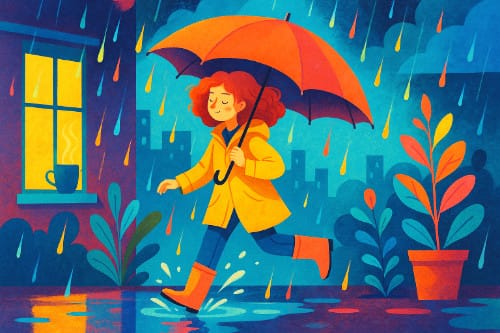
Rain taps against the window with the persistence of a jazz drummer who never learned to keep time. Outside, the world is washed in slate gray, but inside, creativity stirs like a pot left on simmer. If you’ve ever found yourself staring at a wet street and wondering what to do with your day, you’re in good company. Let’s lean into the drizzle and discover why rainy days just might be the unsung heroes of creative living.
Coffee, Creativity, and Crypto
The first step is obvious: brew something comforting. For some, it’s a robust pour-over; for others, a tea so fragrant it might tempt the cat to investigate. As the rain rattles the window, the world shrinks to the size of your living room or studio. Here’s where the magic happens.
This is prime time for creative side gigs. If you’ve ever thought about selling AI-generated art, now’s the moment to experiment. Open Midjourney or DALL-E and prompt it for “an umbrella garden on the California coast, seen through the eyes of Monet.” The results might be wild, slightly surreal, and worthy of sharing or making into a watercolor.
Rain also has a funny way of reminding us about the delights of low-stakes tinkering. Maybe you’ll finally organize your Bitcoin notes, sketch out a new investment plan, or see if you can get ChatGPT to help you compose a rain-inspired haiku. (“Drizzle on my pane / Satoshi’s ghost counts the drops / Dreams accumulate.”)
The Indoor Explorer’s Toolkit
Technology and rainy days go together like tomato soup and grilled cheese. If you’re an Apple aficionado, rainy weather is the perfect excuse to rediscover old devices. Diig up that forgotten iPod classic, or experiment with Shortcuts on your iPhone to automate your rainy day ritual. Maybe you set your HomePod to play vintage jazz whenever precipitation is detected. The possibilities, as any weather app will tell you, are scattered with occasional brilliance.
For the more analog-inclined, today’s the day to sketch out your next garden plan with a watercolor set, fingers smudged and page edges curling as you imagine next spring’s riot of color. Or dig through your old travel journals and map out a dream trip, preferably somewhere sun-soaked and bougainvillea-lined, but with a page or two dedicated to “charming rainy day cafés.”
Soggy Socks, Soundscapes, and Serendipity
Let’s not forget the simple joy of opening the window (just a crack) and letting the cool air in. There’s a particular scent—earth, ozone, something green and alive—that reminds you the world is still out there, growing quietly while you hunker down.
Play with sound. Try layering rain recordings with Bill Evans or Esperanza Spalding, letting piano and water weave together until you forget which is which. Maybe you’ll sample the sound of rain on your roof, feeding it into GarageBand and creating a beat so hypnotic even the dog cocks an ear in appreciation.
If you’re feeling particularly adventurous, put on a raincoat and take a walk with your phone camera. Seek out reflections in puddles, snails on sidewalks, or the single, defiant geranium blooming despite the drizzle. Upload the photos to your favorite creative app and see what emerges—rain is the ultimate filter, softening edges, adding a little mystery.
Community, Connection, and the Art of Waiting It Out
Rainy days are naturally communal. If you’re lucky, there’s someone nearby who doesn’t mind your slightly odd taste in jazz or your insistence on explaining how blockchains work over soup. Invite them for a potluck of creative endeavors—perhaps one of you bakes while the other writes, or you collaborate on a digital collage that captures the many moods of a Central Coast storm.
Or connect online, sharing your day’s projects in an art or tech forum. Nothing breaks the ice like posting a photo of your rain-soaked tomato plants and asking, “Anyone else thinking of NFT-ing their gardening misadventures?”
When the clouds finally part, the world looks new, rinsed and a little brighter. But you might find you’re reluctant to leave the cocoon of creative focus a rainy day brings. Maybe, just maybe, you’ll hope for a little drizzle tomorrow.
by Patrix | Oct 27, 2025
Creativity rarely shows up on command. You can open your laptop, cue your favorite playlist, even brew the perfect cup of coffee, and still find your ideas stubbornly silent. But walk toward the ocean, and something shifts. The chatter in your head starts to soften. Thoughts become lighter, looser. Somewhere between the sound of surf and the scent of salt, your creative mind quietly wakes up.
The beach, it turns out, might be one of the best creative studios there is. No rent, no deadlines, no desk. Just an open invitation to see differently.
The Natural Reset Button
Modern life keeps us perpetually switched on. We scroll, swipe, and refresh more often than we breathe deeply. Our brains are remarkable at processing information, but they are terrible at resting while doing it. The result is a kind of low-grade static that dulls imagination.
The beach doesn’t participate in that noise. Its rhythm is ancient, steady, and impossible to rush. The tide will come in, whether your notifications do or not. When we spend time near that rhythm, we subconsciously match it. Our thoughts slow to something closer to the pace of waves. That slowness is not laziness. It is space, and space is where creativity lives.
The Science Behind the Calm
Marine biologist Wallace J. Nichols calls this state Blue Mind. It is a calm yet alert condition that often appears when we are near, on, or under water. In that state, stress hormones drop and alpha brain waves increase, the same gentle waves of relaxed focus that artists and meditators know well.
Science has finally caught up to what poets always suspected: proximity to water changes how we think. It helps ideas link together more fluidly, almost as if the brain itself starts to drift and merge like currents. Instead of forcing solutions, you begin to notice them. Instead of pushing for originality, you rediscover curiosity.
That simple shift is powerful. When you create from calm instead of pressure, the work feels more like discovery than effort.
A Studio Without Walls
There is something liberating about a workspace that never holds still. The beach is never the same two days in a row. Light moves across the sand like a brushstroke. Colors appear and fade. Even the air feels creative, reshaping every few seconds.
When you make art, write, or think in that environment, the landscape itself becomes a collaborator. You respond to it. You listen. You notice how sound carries differently when it moves across open space. You remember that impermanence can be beautiful, not inconvenient. In that sense, the beach is a lesson in creative flow. Nothing stays fixed. Neither should your ideas.
Bring only a notebook, a sketchpad, or an iPad if you must. Leave the perfectionism at home. Let the environment guide you instead of the outline. The result may surprise you.
Light, Air, and the Digital Detox
Most of us spend our creative hours bathed in artificial light. Screens tell us what color the world should be. Indoors, we work in rectangles, both literal and mental. When you step into natural light, something changes physiologically. Your pupils relax. Your posture opens. Your sense of depth returns.
The ocean reminds your body that you exist in more than two dimensions. The breeze moves across your skin. The light shifts minute by minute. This sensory variety feeds the mind’s need for novelty without overwhelming it. It is stimulation with space built in.
When you create in that kind of light, your attention expands. You stop producing and start participating. That is a rare feeling in a world that measures everything by output.
Imperfection as Inspiration
Sand is not a perfect surface. The wind will move your pages. Seagulls will critique your work loudly. The sun will shift at the worst possible moment. Yet all those inconveniences are part of the creative experience. They remind you that art and life are not meant to be frictionless.
Perfectionism is a form of control, and control is the enemy of discovery. The beach offers gentle resistance. It reminds you that beauty often comes from impermanence, just like wabi-sabi teaches in Japanese aesthetics. The sketch you make in uneven light might not be technically precise, but it might feel truer than anything you’ve made indoors.
The creative process, like the tide, erases itself and begins again. That impermanence is not a flaw. It is freedom.
Bringing It Back Home
Eventually, you pack up and leave the sand behind. You rinse off, open your laptop again, and return to deadlines. But something subtle lingers. Your mind feels less like a machine and more like a landscape. The noise is quieter. The work feels lighter. You realize that the beach did not just inspire you; it recalibrated you.
Creativity is not about running away from life. It is about reentering it with clearer vision. The beach reminds us that ideas grow in cycles, not straight lines. Every tide leaves something behind. Every retreat makes room for something new.
So the next time your mind feels crowded, skip the productivity hacks. Go outside. Let the ocean reset your inner studio. You might come home with pages of ideas, or maybe just a better way of seeing. Either is enough.
by Patrix | Oct 13, 2025
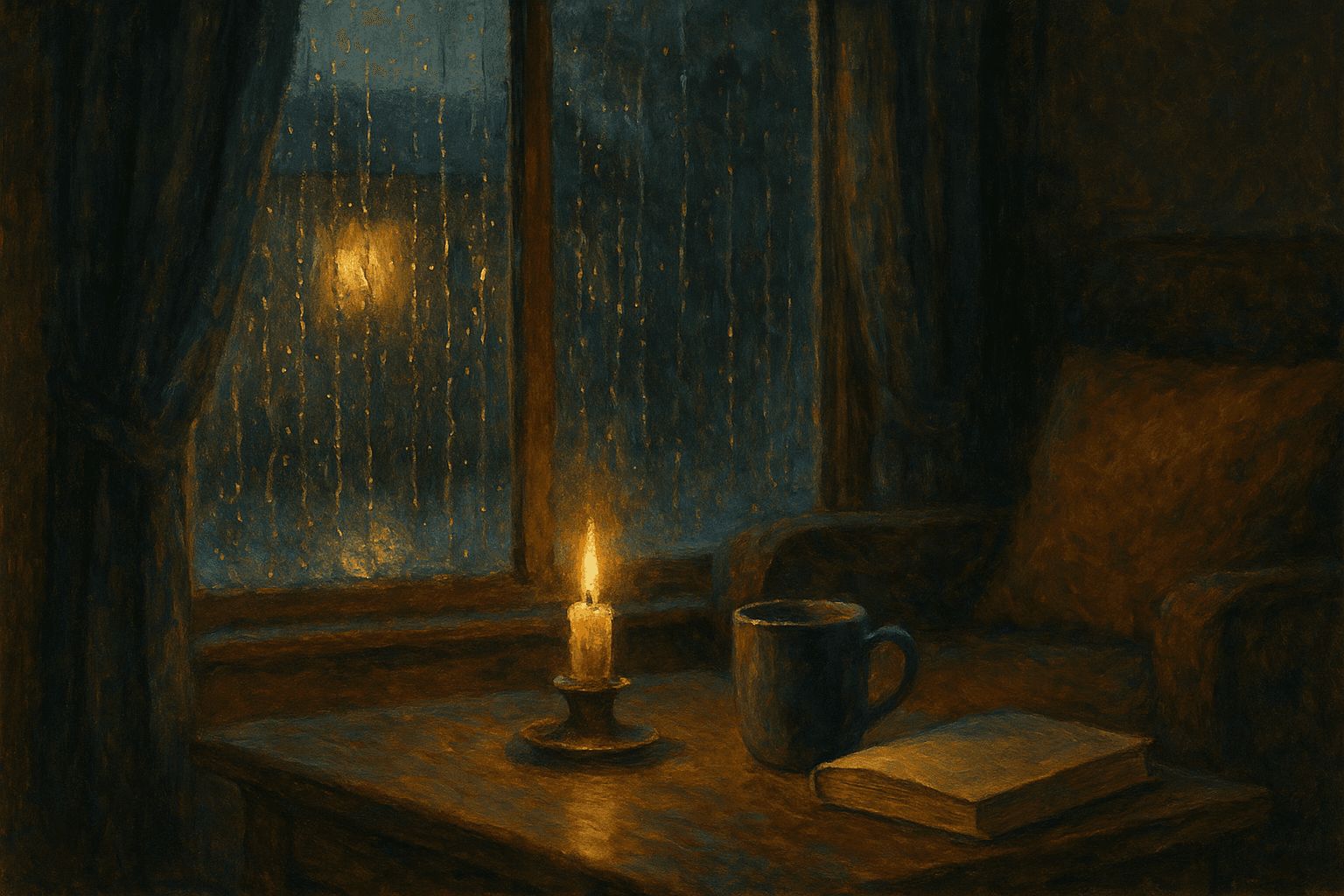
There’s a kind of evening when the world seems to sigh in relief. Rain drifts softly against the windows, the air smells faintly of earth, and the lights inside take on a golden glow. It’s a mood that wraps around you, quiet but alive. A rainy night has a way of smoothing the edges of the day. It tells you, without words, that it’s time to rest.
For reasons both scientific and emotional, rain has always been comforting. It’s not only about being dry indoors; it’s about being protected. There’s something ancient and familiar in the rhythm of falling water, as if the planet itself were humming a lullaby.
Why Rain Feels Like a Hug for the Nervous System
The calming effect of rain isn’t just in our imagination. The steady patter produces what’s called pink noise, a gentler cousin of white noise. It evens out sudden sounds and helps the brain settle. That’s why so many people drift off more easily when it’s raining. The pattern tells our nervous system that the world outside is stable and safe.
Long before smart homes and streaming playlists, our ancestors found the same comfort in a rainstorm. It meant they could rest. Animals were quieter, the air was cooler, and there was less to fear. That instinct remains in us, even if the campfire has been replaced by a reading lamp and a cup of tea.
When the world outside turns damp and gray, the interior world feels richer. Candlelight seems to glow with more purpose. The steam from a cup of cocoa rises like a small celebration. The ordinary suddenly becomes precious.
The Art of Doing Nothing
Rainy nights remind us that stillness isn’t a flaw in the schedule. The sound on the roof, the smell of wet pavement, the fog on the window—these are invitations to slow down. A culture that rewards constant motion rarely gives permission for rest, but the rain does. It falls without judgment, asking nothing in return.
Doing nothing well is its own quiet craft. You might light a candle, pull a blanket close, and simply listen. Maybe you cook something slow and fragrant, letting the scent fill the house. Or you sit with an open notebook, waiting for thoughts to drift through. The rain doesn’t demand activity; it offers space for reflection.
Creative people often find this time restorative. Artists, writers, and dreamers know that ideas sometimes arrive only when we stop chasing them. The gentle rhythm of the rain is a companion to imagination—a muse in liquid form.
Digital Rain and Modern Comfort
Technology has made it possible to bring that same atmosphere anywhere. A rainstorm playlist, a looping video of thunderclouds, or a smart lamp that mimics candlelight can recreate the feeling of a rainy night even in the desert. What once required weather now fits in your pocket.
There’s a subtle beauty in that. In a fast, digital world, our devices are learning how to help us slow down. AI-generated soundscapes and ambient art installations are helping people reconnect with something ancient. Maybe that’s what the meeting point of art and technology truly is: a way to remember what it means to be still.
When the screen glows softly and the rain sounds play through the speakers, you can almost forget that the weather outside is dry. It’s an illusion, but a healing one. It gives the mind the same permission the real thing does—to breathe.
Memory, Melancholy, and the Rain
Rain has a way of stirring emotion. It invites us to look inward, to remember, to feel. Nostalgia rises as easily as the scent of wet earth. Sometimes it brings a quiet sadness, but it’s the kind that soothes rather than stings. Like washing dust from a window, the rain clears the mind.
It also softens memories. You might think of someone you once knew, a house you once lived in, or a night that mattered for reasons you can’t quite explain. Under the sound of rain, even loss feels gentler. The melancholy becomes a kind of music—a reminder that feeling deeply is its own form of being alive.
Poets and filmmakers return to this again and again because rain is both metaphor and mood. It’s the sound of reflection, the light of memory, the silence between thoughts.
The Ritual of Comfort
Rain encourages ritual. A soft sweater, a warm drink, a pet curled nearby—these small gestures become ceremonies of peace. They remind us that comfort doesn’t depend on grand moments. It lives in ordinary things: a roof overhead, the scent of rain, a moment of gratitude for both.
You might put on a slow record, make soup from scratch, or simply sit by the window and watch. These are quiet rebellions against the noise of the day. They tell the body and mind that there is value in calm, that not every hour needs to be filled with achievement.
In the glow of lamplight, with the soft percussion outside, time changes shape. The hours stretch in a good way. You are no longer chasing the day; you are inhabiting it. That is the secret comfort of a rainy night—it draws you back into the present.
Letting the Rain In
So when the clouds gather and the drops begin to fall, don’t rush for the forecast or worry about plans delayed. Let the world slow down. Light the candle. Let the rain speak to the quiet parts of you that are too often ignored.
You are not wasting time when you pause to listen. You are syncing with the rhythm of something older than memory. The comfort of a rainy night comes not from the weather, but from the way it reminds us who we are: small, warm, and wonderfully alive.
by Patrix | Sep 28, 2025
If you’ve ever heard someone described as a “Stepford Wife,” you know what it means. The phrase comes from Ira Levin’s 1972 novel The Stepford Wives (and later the 1975 movie), which imagined a suburban Connecticut town where the women were replaced by eerily perfect, compliant robot replicas. Beneath the polished hair and polite smiles was a chilling truth: individuality and dissent had been erased in favor of mechanical harmony.
I recently discovered a community that seems to have created and nurtured this type mentality on it’s own; naturally, without any intervention of AI. (As far as I know.)
Today, when we talk about AI, we’re often worried about surveillance, job loss, or runaway superintelligence. But another risk lurks in the cultural shadows: the possibility that AI could become a kind of Stepford force, smoothing away rough edges, standardizing behavior, and nudging us toward bland perfection. And what’s even more unsettling is that we may not need robots at all—some American communities already function like natural Stepford experiments.
AI as a Conformity Machine
AI excels at optimization. Algorithms are built to predict what we want, what we’ll click, what will make us stay on the app, or what product we’re most likely to buy. That optimization flattens us into predictable patterns. A feed full of AI-curated content can start to feel like a Stepford neighborhood, everyone watching the same shows, parroting the same opinions, wearing the same “best-selling” jacket an e-commerce engine recommended.
Large language models are trained on massive datasets, which means they tend to generate the most statistically probable, “safe” answers. This is useful for clarity, but it can also have the unintended effect of reinforcing norms and sanding off eccentricities. Imagine a future where personal AI assistants manage not just your calendar and shopping lists, but also your dating profiles, political talking points, or even your conversations with friends. If everyone’s assistant leans toward the same optimized tone, society could slip into a homogenized script. We’d all sound like Stepford versions of ourselves.
The Allure of Perfection
The Stepford fantasy wasn’t just about control; it was also about desire. The men in the story didn’t want messy, complex, fully human partners; they wanted idealized, uncomplaining companions. In our era, AI companions, virtual influencers, and digital girlfriends/boyfriends are growing industries. They’re responsive, affirming, and endlessly available. The danger is that the more time people spend with AI “partners” who never argue, age, or demand compromise, the less patience they may have for real, complicated humans.
This isn’t a far-off sci-fi idea. If you scroll through communities around AI companions, you’ll already find people saying their chatbot “partner” feels more reliable than their spouse. It raises a Stepford-like possibility: what happens when society prefers optimized, synthetic relationships over the unpredictable, inconvenient messiness of human ones?
Stepford Without Robots: Real-World Parallels
Before we blame AI for this, it’s worth noticing that Stepford-like communities already exist without technology. Certain suburban enclaves, retirement villages, and gated developments in the U.S. cultivate a striking uniformity. Drive through some of these neighborhoods and you’ll see nearly identical homes, matching lawns, even synchronized seasonal decorations. The social norms can be equally rigid; everyone goes to the same churches, votes the same way, plays at the same tennis clubs, and ostracizes those who don’t fit in.
This isn’t inherently sinister; humans are tribal creatures who like belonging. But there’s a thin line between community and conformity. In towns where deviation is discouraged, you end up with something close to a Stepford effect: the appearance of harmony masking the quiet pressure to comply. No robots required.
Sociologists sometimes call this “cultural homogeneity,” and it shows up in more than just white-picket-fence suburbs. It can be found in tightly bound religious communities, affluent gated communities, or even “intentional living” developments that tout sustainability and minimalism. Everyone’s smiling, everyone’s agreeable—but individuality quietly erodes.
The Stepford–AI Feedback Loop
What happens when AI tools amplify these already-existing tendencies? A homogenous community that uses the same AI tutors, the same AI writing assistants, and the same AI shopping algorithms may find its cultural uniformity intensified. Instead of just looking alike, people could start to think alike, guided by algorithms that reward the same language, values, and styles. Over time, dissent could feel not just socially costly but algorithmically irrelevant.
Everyday examples
- Schools: AI essay graders might favor “clear, structured” writing, punishing more experimental or quirky voices.
- Dating: AI-optimized profiles could push everyone toward the same attractive clichés, making uniqueness less visible.
- Politics: AI-curated feeds might reinforce echo chambers, filtering out nuance and disagreement until only Stepford-approved narratives remain.
The Stepford scenario, then, isn’t about robots replacing us with mechanical clones. It’s about technology reinforcing our existing hunger for conformity until individuality feels like an error in the system.
A Step Beyond Stepford?
Here’s the unsettling thought: Stepford may not just be a metaphor. AI has the potential to create personalized “versions” of us that function in society on our behalf; digital clones trained on our data. Imagine your AI personal assistant scheduling your calls, answering your emails, even chatting with friends. Over time, that assistant might become the “you” people prefer, because it’s a smoother, less complicated version. That’s Stepford 2.0: not robot wives, but algorithmic proxies.
The real question isn’t whether AI will cause a Stepford society. It’s whether we’ll choose to let it. After all, conformity has always been tempting. Technology just makes it easier, faster, and harder to notice.
Keeping the Humanity in the Loop
The antidote to Stepford thinking isn’t paranoia—it’s cultivation of individuality. AI doesn’t have to strip away human messiness if we actively protect it. Consider a few practical habits that keep creativity and dissent alive:
- Prompt for divergence: Ask AI tools to present outlier perspectives and minority viewpoints, not only the “most likely” answer.
- Value pluralism: Seek communities that reward difference, creativity, and dissent. Treat friction as a sign that something real is happening.
- Keep the mess: In relationships, remember that the “inconvenience” of human emotion is where depth comes from. Don’t let frictionless AI companionship replace hard-won intimacy.
- Audit your feeds: Periodically reset algorithms, subscribe to unfamiliar creators, and intentionally add noise to avoid a sterile, optimized bubble.
- Teach style, not templates: In education and the workplace, use AI to model multiple styles and voices rather than funneling everyone into a single rubric.
The Stepford story endures because it warns us what happens when comfort outweighs authenticity. In an AI-saturated world, that lesson may be more relevant than ever. We can use these tools to explore, question, and diversify our perspectives; or we can let them sand us down until we fit the mold.
The choice, at least for now, still belongs to us.
by Patrix | Jun 23, 2025
Mycologists rejoice! Growing mushrooms at home has gone mainstream—and it’s getting a tech upgrade. Forget musty kits shoved in dark closets. Today’s mushroom-growing gear blends sensors, automation, and science-lab precision to help even beginners cultivate gourmet fungi with near-magical consistency. Whether you’re craving lion’s mane for your nootropic smoothie or just want to impress guests with home-grown oyster mushrooms, the future of fungi is fresh, smart, and kind of beautiful.
What’s New in Home Mushroom Tech
Mushroom cultivation is all about maintaining very specific conditions: temperature, humidity, airflow, and light. Too dry? No mushrooms. Too warm? Contamination. It’s a Goldilocks zone of biology, and until recently, that meant constant babysitting or messy DIY fixes.
Today’s tech? It’s practically plug and play. Here’s what’s new:
1. Smart Mushroom Fruiting Chambers
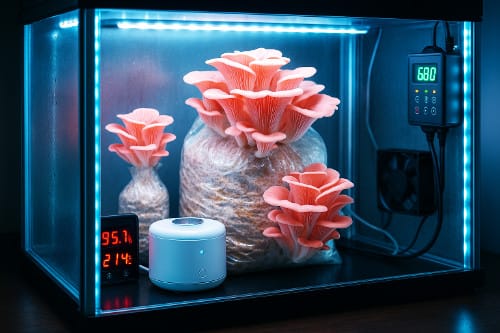
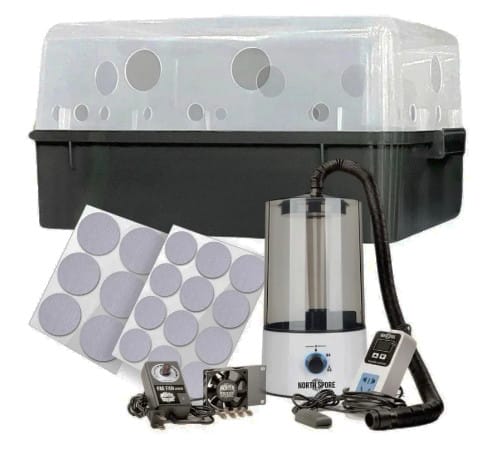
Modern mushroom fruiting chambers—also known as “grow boxes”—now come equipped with IoT (Internet of Things) tech. These sleek countertop units monitor and automatically adjust humidity, temperature, and airflow. Think of it like a terrarium crossed with a wine fridge.

The automated BoomerBin monotub
2. Sensor-Based Environmental Monitors
If you like geeking out on data, you can outfit your grow setup with Bluetooth sensors to log humidity, temp, and CO₂ levels. Tools like SensorPush or Govee can send alerts to your phone if your mushrooms are in trouble.
3. Automated Misting & Air Exchange
Ultrasonic humidifiers controlled by smart switches (like Kasa Smart Plugs) can mist your mushrooms on a schedule. Pair it with a small fan on a cycle timer, and you’ve got airflow and humidity dialed in without lifting a finger.
Bonus: You can control it all from your phone—or even integrate it into a smart home system with voice commands. “Alexa, mist the mushrooms.”
4. High-Tech Spawn and Substrate Innovations
Even the substrates (growing medium) are getting a glow-up. Companies now sell sterilized substrate bags pre-inoculated with gourmet strains, sealed and ready to fruit. Some include injection ports and air filters for clean airflow and reduced contamination.
Cool tech note: Some growers are experimenting with liquid culture syringes grown in lab-like conditions to ensure genetics are clean and strong—kind of like sourdough starter, but for mushrooms.
5. AI and App Guidance
Platforms like Shroomify or MushroomGrowerPro offer strain-specific grow schedules and alerts, guiding users with step-by-step instructions. Some integrate with smart sensors to provide recommendations based on your live data—“Your humidity is a bit low for pink oyster. Consider misting more frequently.”
It’s like having a mushroom consultant in your pocket.
What Can You Grow?
With these tools, the home grower isn’t limited to button mushrooms. Some popular choices:
- Oyster (blue, pink, golden) – Fast and forgiving
- Lion’s Mane – Great for brain health, super fuzzy and dramatic
- Shiitake – Rich, meaty flavor, but needs patience
- Enoki – Beautiful, but delicate conditions
- Reishi – More medicinal than culinary, looks like antlers
Then there are the nootropic options, which for obvious reasons I won’t detail here. But the same basic knowledge, tech and know-how applies.
A Quick Anecdote from the Garden Lab
Last winter, I set up a small box on my kitchen counter with a simple growbag that was inoculated with Lion’s Mane. I grew a flush of Lion’s Mane mushrooms that looked like white coral reefs. In about 14 days, I had a large cauliflower-sized growth. I sliced it up and sauteed in a little garlic and butter and YUM!
Whether you’re a curious cook, a health nut, a psychonaut, or just like weird science experiments that you can eat, the tech is ready for you.
by Patrix | Jun 16, 2025
This is the time of year that backyard tomato growers are nurturing their plants and hoping for a large and delicious yield. If your tomato plants are lush and leafy but skimping on the fruit, you’re not alone. Growing tomatoes can sometimes feel like you’re giving a lot of love but not getting much in return. There are a few strategic tricks that I have discovered that can dramatically boost your tomato yield — including one surprisingly effective hack that involves a humble electric toothbrush.
Let’s walk through a few proven methods to coax more tomatoes from your plants.
1. Prune for Power
Tomato plants are naturally vigorous, often growing a wild tangle of stems and leaves. But all that leafy energy can come at the expense of fruit production. That’s where pruning comes in.
By removing the “suckers” — those little shoots that grow in the crook between the main stem and a branch — you’re helping the plant focus its energy on the main stems and fruit clusters. Pruning also improves airflow, reducing disease risk and allowing sunlight to reach the inner branches. Healthier plant, more tomatoes.
2. Feed Like You Mean It
Tomatoes are hungry. To get high yields, you’ve got to keep them well-fed — but not just any fertilizer will do.
- Start with a balanced fertilizer when transplanting (like 10-10-10).
- Once the plant starts flowering, switch to a low-nitrogen, high-phosphorus formula (like 5-10-10).
Too much nitrogen = lush leaves and very few tomatoes. Phosphorus encourages flowering and fruiting. Think of it as a shift in diet once your plant hits puberty.
3. Stress Just a Little (But Not Too Much)
This one sounds counterintuitive, but slight water stress can encourage tomato plants to fruit. When the plant senses a tough season ahead, it shifts into survival mode — producing fruit and seeds to reproduce.
Don’t let your plant wilt or dry out completely, but slightly reducing watering once the fruit sets can prompt more consistent ripening and bigger yields.
4. The Ingenious Electric Toothbrush Trick
Tomatoes are self-pollinating, which means they technically have both the male and female parts on the same flower. But for successful fruit set, the pollen still needs to move — and in nature, bees or the wind usually help.
Enter: the electric toothbrush.
Yep, that $20 multipack from Costco might be the best tomato tool you own. Here’s how it works:
- Wait until your tomato plants are flowering.
- Turn on the toothbrush and gently touch it to the flower stem, not the petals themselves.
- Just a couple of seconds per flower cluster will do. The vibration shakes loose the pollen, simulating the buzz of a bee.
This method — sometimes called buzz pollination — dramatically increases fruit set, especially in greenhouses or in calm weather where natural pollinators are scarce.
I tried this last summer on a few Cherokee Purple plants that weren’t producing. After giving each flower a quick buzz every morning, I had more tomatoes than I knew what to do with. It’s simple, cheap, and oddly satisfying.
A few flowers a day, a few seconds per cluster — and suddenly you’re a tomato whisperer. Add that to smart pruning and the right fertilizer, and you’ll be hauling in baskets of ripe, juicy tomatoes in no time.
I still plant pollinator flowers throughout my garden to encourage nature to do its thing. But sometimes a clever hack can make a big difference.
Happy tomato-ing!