by Patrix | Oct 10, 2025
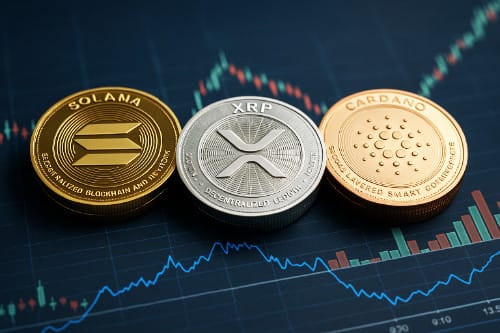
For years, the cryptocurrency market has danced to the rhythm of Bitcoin and Ethereum, with everyone else trying to keep up. But something new is stirring. The U.S. Securities and Exchange Commission (SEC) appears to be softening its stance on digital assets, hinting at potential approval for a wave of exchange-traded funds tied to other cryptocurrencies. Among the contenders, three names keep coming up: Solana (SOL), Ripple’s XRP, and Cardano (ADA). If these coins receive ETF approval, it could mark a defining moment for the broader crypto ecosystem.
The new regulatory opening
In late 2025, the SEC introduced generic listing standards for commodity-based exchange-traded products. That might sound like paperwork, but it’s a quiet revolution. Until now, every crypto ETF crawled through a lengthy and highly public approval process. The new framework streamlines that ordeal, allowing issuers to list ETFs tracking eligible digital assets as long as they meet defined requirements.
This shift also prompted applicants to withdraw and resubmit ETF filings for coins like Solana, XRP, Cardano, and others under the new rules. The message is straightforward: resubmit on the new rails and the timeline shortens. Windows that once stretched across half a year could compress to a couple of months. For investors, that change isn’t just procedural; it’s a signal that crypto is getting a clearer regulatory on-ramp.
A second back-office update also matters. “In-kind” creation and redemption — the ability for ETFs to transact in the underlying crypto rather than cash — reduces frictions and costs. Most people never see that machinery, yet it is the kind of infrastructure improvement that invites larger pools of capital to participate without operational headaches.
Why Solana, XRP, and ADA lead the pack
Solana (SOL) is the high-performance chain that developers lean on when speed and cost matter. With fast block times and low fees, it has become home base for a wide range of decentralized apps, from DeFi to consumer-facing experiments. Institutions like SOL because it behaves more like a modern tech platform than a speculative meme. If a Solana ETF gains approval, expect liquidity to deepen and spreads to tighten. That combination often attracts additional flows, which can snowball into momentum. Solana’s critics point to historic network outages and congestion. Those are real concerns, yet the recent trend has been toward better stability. If the chain continues to hold up under heavy load, SOL could become the “Apple-like” infrastructure layer of crypto — streamlined, efficient, and ready for mainstream adoption.
XRP brings something different. Its central story is payments. Ripple’s technology aims to move value across borders quickly and at low cost, and that makes XRP less of a casino chip and more of a bridge asset. After a long legal slugfest, XRP has clearer precedent than most altcoins. That doesn’t erase risk, but it reduces the fog. If an XRP ETF hits the market, it is easy to imagine conservative institutions warming to it as part of their “plumbing” allocation — an asset that helps them express a view on the future of settlement and tokenized value transfer. The potential upside is meaningful if a wave of cautious capital decides XRP is the safest way to gain altcoin exposure inside a traditional wrapper.
Cardano (ADA) takes the methodical route. It is built on peer-reviewed research and emphasizes security, sustainability, and energy efficiency. That slower, academic cadence has earned ADA a reputation for reliability rather than flash. If ADA secures ETF status, the initial surge might be gentler than SOL or XRP, yet it could prove more durable. ESG-minded allocators who want long-term exposure to a utility-first blockchain may find it appealing. Patience is the keyword: if approvals for ADA arrive after SOL or XRP, the delayed timeline could still work in Cardano’s favor by aligning with its steady-build narrative.
How ETF approval could reshape the market
ETF approval for these coins would do more than stir prices. It would change how money flows in the crypto economy. When capital enters through regulated ETFs, it often stays longer. Institutional investors prefer compliance, liquidity, and transparency, and ETFs deliver exactly that.
If ETFs for SOL, XRP, and ADA become available, traders will finally have familiar, regulated vehicles to gain exposure without the operational burden of custody and direct token handling. That invites pension funds, endowments, insurance companies, and large family offices to participate with clearer guardrails. A likely outcome is the gradual erosion of the Bitcoin-and-Ether near-monopoly on institutional attention. Capital that once concentrated in those two giants may begin to diversify into a compact set of “infrastructure” altcoins.
Diversification can also affect volatility. Deeper liquidity and tighter spreads generally tame wild swings. Expect the beta of SOL, XRP, and ADA to adjust if ETF volumes are significant. That doesn’t mean prices will move in a straight line. In the short term, regulation tends to spark speculation. Solana has a history of overreacting to hype, and XRP holders are famous for conviction. Short-term rallies and sharp corrections are likely. Cardano’s reaction may be smoother but still positive, especially if it benefits from slow-and-steady institutional accumulation.
What could go wrong
The biggest risk is political. A change in regulatory tone or a new round of enforcement could delay or even unwind progress. Even mundane issues, such as a government funding lapse, can slow reviews. If timelines slip, traders may rotate back into Bitcoin and Ether as safer holdings.
Another risk is fragmentation. If only one or two ETFs are approved initially, capital could rush into those while others languish. That can create choppy relative performance. Once ETFs exist, derivatives will proliferate. Options and futures on these funds can amplify both optimism and fear, raising the stakes for risk management.
What to watch and how to navigate
Investors should track the SEC announcement cadence and watch how issuers amend filings. On-chain activity is also a useful compass: developer traction, total value locked, and user adoption often foreshadow how resilient any post-approval rally will be.
Position sizing is more important than prediction. Regulatory momentum can move prices faster than fundamentals justify. If you catch a pop, it may be wise to realize gains methodically and leave room for consolidation. The market rewards those who plan exits as carefully as entries.
A quiet revolution
The SEC’s evolving approach to altcoin ETFs could turn out to be one of the decade’s most consequential financial shifts. Once institutional capital can flow freely into multiple regulated crypto funds, digital assets will no longer sit at the edge of the capital markets. They will live beside gold, oil, and equities in diversified portfolios.
Solana could mature into the chain of choice for speed and consumer apps. XRP might take root as the bridge for fast settlement and tokenized value. Cardano could become the patient investor’s pick for sustainable, research-driven infrastructure. Together, they offer a picture of a crypto market that looks less like a speculative carnival and more like a structured opportunity set for long-term builders and savers.
I think of it like switching from a gravel road to a paved highway. The destination doesn’t change — a digital, programmable financial system — but the ride becomes smoother, safer, and more accessible. With ETFs opening the on-ramps, the next stretch could be where crypto finally drives like a mainstream asset class.
by Patrix | Oct 4, 2025
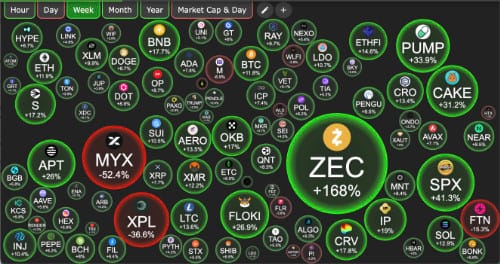
If there’s one thing as volatile as crypto price charts, it’s the challenge of making sense of crypto data. Raw numbers, candlestick graphs, order books — these can overwhelm. That’s where clever visualizations of numbers and patterns step in: they translate complexity into clarity, reveal hidden patterns, and invite exploration. One standout in this space is CryptoBubbles.net, which turns the crypto market into a dynamic bubble chart you can navigate. In this post, I want to explore the current state of the art in data visualization (with an eye toward crypto), and dive into what makes CryptoBubbles an intriguing tool for crypto investors and analysts.
The Landscape of Modern Data Visualization
Why visualization matters
- Humans are pattern-seeking animals. Data visualizations let us see structure — clusters, outliers, trends — that would otherwise hide in rows of numbers.
- Cryptomarkets are high-dimensional: price, volume, volatility, correlation, on-chain metrics, sentiment. Visual tools help us navigate many dimensions at once.
- In fast-moving domains like crypto, interactivity is key — static charts often lag the story.
Some current trends & techniques
Here are a few of the visualization trends shaping how we view complex data today:
- Grammar-of-graphics tools: Frameworks like Vega / Vega-Lite let developers specify visualizations declaratively and support interactivity. (They help separate design from data plumbing.)
- Scalable visualization for large datasets: Techniques like progressive rendering, level-of-detail, tiling/streaming, and aggregation help with thousands/millions of points.
- Multivariate, multi-attribute views: Rather than just plotting price over time, many visual systems layer or juxtapose multiple metrics (volume, volatility, network activity).
- Hybrid visual–analytics and visual reasoning: Interactive dashboards with linked views, filtering, drill-downs, and back-end querying.
- Blockchain-specific visualization tools: Because blockchain data has structure (blocks, transactions, flows), dedicated tools map that structure into intuitive visuals (graph layouts, flow charts, ledgers).
- Emerging research: invertible visualizations & adaptive encoding: Projects like InvVis embed data into visualizations so that you can reverse them; others propose models that suggest optimal visual encodings.
Challenges & tradeoffs
- Perceptual limits: Humans can only process so many colors, shapes, sizes effectively. Too many variables can confuse.
- Stability vs. reactivity: In live data, updating visuals must balance freshness with layout stability to avoid disorienting users.
- Scalability and performance: Rendering many interactive elements smoothly — especially on mobile — is technically challenging.
- Context & interpretability: Visuals need legends, guides, tooltips, explanations. Without that, interaction becomes confusing.
- Data integrity, latency & correctness: In financial/crypto domains, small data issues can mislead; the backend pipeline must be robust.
CryptoBubbles.net — A Closer Look
What is CryptoBubbles.net?
CryptoBubbles (also called Crypto Bubbles) is an interactive, web-based platform that visualizes the top ~1,000 cryptocurrencies using a bubble chart interface. Each bubble represents one coin or token; attributes such as size, color, and position encode metrics like market capitalization, price change, volume, etc.
It also has mobile apps (Android and iOS) so users can take it on the go. It brands itself as an “independent visualization tool and data aggregator,” free to use and ad-free.
Limitations, tradeoffs, and things to watch
- Dimensional saturation: Bubble charts are intuitive but can’t encode unlimited variables cleanly.
- Overplotting & clutter: Showing ~1,000 bubbles can lead to overlap or tiny bubbles in dense clusters.
- Perceptual distortion: Human perception of area is nonlinear; bubble size differences aren’t judged as precisely as bar lengths.
- Temporal movement and instability: Frequent repositioning or rescaling may disorient users.
- Data freshness & source reliability: The value depends on reliable, low-latency data pipelines.
- Analytical depth: CryptoBubbles is a visual “overview” tool, not a full-blown analytics engine.
- Competitive alternatives & reach: It competes with major crypto dashboards (CoinGecko, The Block, etc.).
Use cases & what it’s good for
- Quick market overview: spot which coins are surging/fading.
- Discovery/screening: find under-the-radar coins showing momentum.
- Portfolio tracking: mark and monitor favorites.
- Visual storytelling: embed bubble visuals in reports or blogs.
- On-the-go scanning: mobile app helps monitor trends outside the desk.
Position in the visualization ecosystem
CryptoBubbles is a “gateway” viz: a visually intuitive layer that invites you in, rather than a deep analytical end-state. It demonstrates how good visual affordances can engage users while keeping complexity manageable.
Potential enhancements and future directions
- Hybrid linked views: Pair a bubble view with time-series, correlation, network graph views, all linked by interactions.
- Temporal animation / “bubble race” view: Animate bubble trajectories over months/years, with careful layout stability.
- Embedding on-chain / sentiment data: Let users morph between price view, transaction view, social sentiment view.
- Predictive / alert overlays: Flag bubbles with alerts (e.g., volume spikes, news), integrate simple ML models.
- Better layout algorithms & stability: Use advanced bubble-packing and spatial embedding to cluster relationally meaningful groups.
- Invertible / embed metadata: Use techniques like InvVis so visuals carry hidden metadata for extraction or sharing.
- Visualization SDK / embedding: Provide embeddable components or APIs so others can incorporate CryptoBubbles into their own apps or sites.
Data visualization in the crypto world is not just about making charts — it’s about turning noisy, high-dimensional data into something our eyes and minds can explore. The best visualizations live in a balance: expressive enough to hint at complexity, yet simple enough to grasp instantly.
CryptoBubbles.net is a vivid example of that balance in practice. It gives you a dynamic, intuitive visual map of the crypto market — a visual “big picture” you can scan, probe, and react to. It doesn’t supplant deeper analytics, but it’s a powerful complement to them.
If you’re exploring crypto, or you teach/present crypto trends, or just like interesting data visualization, I recommend checking out CryptoBubbles.net
by Patrix | Oct 2, 2025
Bitcoin is back to doing what Bitcoin does best: being unpredictable, dramatic, and strangely magnetic. As I write this, it’s rising around $119,000, up about 4% on the day. That’s enough to make people turn their heads, squint at the chart, and whisper to themselves, “Well, isn’t that interesting?”
For me, it’s not only about the charts or the profits. It’s more about the experience of watching something alive with energy. Bitcoin feels like a weather system rolling across the financial sky — sometimes stormy, sometimes brilliantly clear. I don’t control it, I don’t fully understand it, but I can’t help but enjoy the view and marvel at the patterns.
And just so it’s said clearly at the start: this is not investment advice. I’m not telling you what to do. I’m just one curious person who likes to explore how art, technology, and money all tangle together. I watch it with the same curiosity I’d bring to a tide pool, a lightning storm, or a painting I can’t quite make sense of.
Why the Buzz Feels Different Right Now
Every Bitcoin cycle has its mood. Some are euphoric, some are gloomy, and some are just confusing. This one feels like a blend of anticipation and restraint. The crowd isn’t shouting yet, but you can feel a kind of hum in the air.
Here’s what I notice:
- The macro backdrop: Inflation has been cooling, interest rates may be easing, and the dollar is softening. These shifts quietly encourage investors to peek outside the traditional system and ask, “What else is out there?”
- Big money stepping in: ETFs have made it easier for institutions to wade into Bitcoin. In a way, it feels like the lifeguards finally joined the kids in the pool. The vibe changes when serious money shows up.
- Scarcity at work: Bitcoin’s supply gets tighter with each halving, and long-term holders rarely sell. Scarcity has a way of making people curious.
- Regulatory frameworks: Governments are slowly moving from “What is this thing?” to “Here are the rules.” Like a chaotic jam session finally finding a rhythm, this brings some structure to the sound.
Put all of that together, and it feels like we’re standing at the edge of something interesting. Maybe it’s a surge. Maybe it’s a fake-out. But either way, it’s fun to watch.
The Temptation of “Before the Surge”
It’s easy to get caught up in the daydream of what comes next. Analysts toss around numbers like $150,000 or $200,000 within the next year or so. Maybe that happens, maybe not.
Bitcoin right now is testing resistance around $120,000. If it pushes above that level, history says it could run higher. If it doesn’t, then we chalk it up as another dance step in this long, unpredictable waltz.
Either way, I can’t help but smile at the spectacle. Watching Bitcoin move is like standing on the shoreline and seeing a wave rise. You don’t know if it’ll crash early or carry all the way to shore, but the rising motion itself is worth marveling at.
The Flip Side: When Bitcoin Reminds Us Who’s Boss
Of course, for every dreamy chart there’s a hard reminder that Bitcoin does what it wants. I’ve seen it soar just when everyone had given up, and I’ve seen it fall 30% in a week while the world was cheering it on.
What could derail the current optimism? A regulatory curveball. A sudden move by the Federal Reserve. Or simply too much excitement too soon — markets can burn out if they sprint too fast.
And that’s part of Bitcoin’s charm. If it were predictable, it wouldn’t be Bitcoin.
Enjoying the Wonder More Than the Outcome
When I step back, I realize that what I love most about Bitcoin isn’t the profit potential. It’s the wonder of it all. That a digital idea — invisible, intangible, fiercely debated — can ripple across economies and imaginations.
Sometimes I buy a little. Sometimes I just watch. Either way, I’m learning. And for me, that’s the real reward.
Bitcoin feels like digital gravity. It keeps pulling people in, not because it promises certainty, but because it dares us to look closer, to question the systems we take for granted, and to imagine what money could be.
And whether it’s heading to $200,000 or back down to $90,000, it remains one of the most fascinating experiments of our time.
So I’ll keep watching, with curiosity and a touch of playfulness — because life is better when we enjoy the ride, not just the destination.
by Patrix | Sep 20, 2025
For seasoned crypto followers, September has long been considered the worst month on the calendar. Traders even coined phrases like “Red September” because, historically, Bitcoin almost always lost value during this stretch. Since 2013, only a couple of Septembers finished green, and the average return was deeply negative. This made September a month of dread, especially for short-term traders who set their strategies around seasonality.
Yet here we are in September 2025, watching Bitcoin climb more than 8% mid-month — and if the trend holds, it will be Bitcoin’s best September in 13 years. That’s not just a minor blip in a price chart. It’s a signal that the old patterns may be changing, and that the crypto market is evolving in ways that go beyond the usual narratives.
Let’s unpack what’s driving this unexpected September surge, why it matters for the broader financial landscape, and what everyday investors and curious onlookers should take away from it.
The Weight of History: Why September Was Always Bad
Before we look at the current rally, it helps to understand the baggage. Historically, September was a weak month for risk assets in general, not just Bitcoin. Stocks also tend to underperform in September — analysts blame factors like end-of-summer trading slumps, tax-loss harvesting, and portfolio rebalancing by institutional investors.
Bitcoin inherited much of this seasonal weakness, but it often magnified it. Since Bitcoin is more volatile than most assets, September’s market drags frequently turned into sharp drops. Traders would often “front run” this expectation, shorting Bitcoin simply because September had such a bad reputation. In markets, self-fulfilling prophecies are a powerful force.
So when September 2025 began with Bitcoin around $56,000, few expected anything other than another dip. Instead, the market turned upward — and quickly.
The Rally So Far
By the third week of September, Bitcoin had gained roughly 8%. That might not sound earth-shattering compared to the 20% leaps the asset sometimes delivers in bull runs, but context matters. In September, positive numbers of any size are rare. This year’s rally is already on pace to be the best September since 2012, when Bitcoin was still trading under $15.
Equally important, the price strength has come during a period of relative calm. There hasn’t been a single high-profile regulatory announcement or sudden corporate adoption headline that can explain away the gains. Instead, the drivers are subtler but potentially more significant.
What’s Driving the Comeback?
1. Anticipation of Interest Rate Cuts
The U.S. Federal Reserve has been signaling that rate cuts could come as soon as early 2026. Even the mere expectation of looser monetary policy tends to lift risk assets. Bitcoin, often described as “digital gold,” benefits in two ways: as a hedge against future inflation and as a high-beta asset that thrives when money gets cheaper.
2. Institutional Steadiness
Unlike earlier cycles, institutions are now holding rather than fleeing. ETFs holding Bitcoin have seen consistent inflows this year. Pension funds and family offices that once avoided crypto are dipping their toes in, while the so-called “tourist money” (short-term speculators) has been less dominant. This suggests a maturing market that reacts less dramatically to seasonal quirks.
3. Market Structure and Supply Dynamics
Bitcoin’s supply schedule doesn’t change, but the halving earlier this year tightened the flow of new coins. Mining rewards dropped from 6.25 BTC to 3.125 BTC per block, and history shows that halvings often set the stage for multi-month uptrends. The September rally may simply be one chapter in this larger story.
4. Global Macro Tensions
Geopolitical uncertainty — from trade disputes to currency instability in emerging markets — is reinforcing Bitcoin’s appeal as a borderless, non-sovereign store of value. Countries experiencing inflationary pressures (like Argentina and Turkey) continue to drive grassroots demand.
5. A Shift in Narrative
Finally, there’s psychology. For more than a decade, September has been seen as doomed for Bitcoin. This year, breaking that streak creates a fresh story: that Bitcoin is decoupling from its past cycles and maturing into a more stable, mainstream asset. In markets, stories are as important as statistics.
What This Means for Investors
For long-term Bitcoin holders, the September rally doesn’t mean much in the grand scheme. If you’ve held since $20,000 or lower, an 8% bump is just another squiggle in the long-term chart. But psychologically, it may matter more than the raw numbers suggest.
Breaking the September curse could shift trader behavior for years to come. If people stop shorting Bitcoin reflexively every September, the market could see reduced volatility and healthier price action.
For newcomers, the lesson is clear: past patterns are useful guides but not guarantees. Seasonal trends, technical charts, and even famous “rules of thumb” in markets always bend when fundamentals shift. The key is to stay curious and flexible rather than betting on history repeating itself forever.
What About Altcoins?
Whenever Bitcoin rallies, the natural question is: what about Ethereum, Solana, or smaller tokens? Historically, Bitcoin strength has a mixed impact. Sometimes it sucks liquidity away from altcoins, as traders pile into the safer big name. Other times, Bitcoin rallies act like a green light for altcoin speculation.
So far in September, altcoins have underperformed relative to Bitcoin, which is typical in the early stages of a new narrative. If Bitcoin keeps climbing into October, expect money to spill into other projects. But right now, Bitcoin is clearly setting the tone.
Is This the Start of a Bigger Bull Run?
Every time Bitcoin rises, someone asks whether a new all-time high is imminent. With the halving behind us, institutional money flowing in, and macro tailwinds ahead, the case is strong. But calling the timing of a bull run is always dangerous.
Still, this September feels different. It’s not driven by meme mania or a single Elon Musk tweet. It’s a quieter, steadier move upward. That suggests durability — the kind of rally that builds foundations rather than castles in the air.
What to Watch in the Coming Weeks
- ETF Flows: Continued inflows into Bitcoin ETFs suggest sustained institutional interest.
- Federal Reserve Meetings: Any change in tone on interest rates could fuel momentum.
- Global Currency Volatility: Watch places like Argentina, Turkey, and Japan — their monetary struggles often spark Bitcoin demand.
- Altcoin Rotation: If Ethereum or Solana start catching up, it could signal broader risk appetite.
- Technical Resistance: Bitcoin’s next big psychological test will be around $60,000. If it breaks that level in October, the conversation could shift toward retesting all-time highs.
As someone who’s watched Bitcoin since its scrappy early days, I find this September rally fascinating not just for the price action, but for what it says about crypto’s cultural maturity. A decade ago, Bitcoin lived or died by retail traders chasing headlines. Today, it’s increasingly shaped by institutions, macro trends, and global demand for alternatives to fiat currency.
by Patrix | Jul 18, 2025
From the smartphone in your hand to the electric car zipping down the street, much of modern life runs on the quiet strength of two unassuming elements: copper and rare earth metals. They’re not flashy like gold or controversial like oil, but if you’re curious about where the next big tech bottleneck—or opportunity—might come from, look no further than these metallic workhorses.
Copper
Copper is the tech world’s favorite team player. It’s in the wiring of nearly every gadget, charging station, server farm, and EV on the planet. Why? Because copper is one of the best electrical conductors available that isn’t prohibitively expensive.
Just a few of copper’s key roles:
- Electric vehicles (EVs): A traditional gas-powered car uses about 18–49 pounds of copper. An EV? Around 180 pounds.
- Renewable energy systems: Wind turbines and solar panels rely heavily on copper wiring and grounding systems.
- Data centers and AI infrastructure: As AI models get larger and data centers scale, the demand for efficient, high-conductivity materials like copper rises sharply.
In other words, the green and digital revolutions are painted in copper. And demand is skyrocketing—some analysts predict copper demand will double by 2035.
Rare Earth Metals
Rare earths aren’t actually that rare, but mining and refining them is tricky, toxic, and geopolitically sensitive. These 17 metallic elements go by names like neodymium, dysprosium, and terbium—none of which are likely to show up in your Scrabble game, but all of which are crucial to modern life.
Here’s where rare earths show up:
- Magnets: Neodymium magnets are found in hard drives, headphones, and wind turbines.
- Displays and screens: Europium and terbium are used in LED and LCD displays.
- Electric motors: Rare earth magnets help reduce weight and improve efficiency in EV motors.
- Military tech: Precision-guided weapons, satellites, and stealth systems all rely on these elements.
The kicker? China currently controls the majority of rare earth mining and processing, which raises big questions about supply chain security for Western nations and tech companies.
Investment Opportunity?
Here’s the thing: you can’t scale the future—AI, electrification, renewables—without scaling the raw materials underneath. That’s where copper and rare earths come in, and that’s why investing in their production and acquisition is looking increasingly attractive.
Some trends worth noting:
- Global scarcity: New copper mines take years (sometimes decades) to develop. And many rare earth mines are either geographically limited or under intense regulatory scrutiny.
- Government interest: The U.S. and EU are funneling money into domestic mining and refining projects to reduce reliance on foreign suppliers.
- Private sector momentum: Companies like MP Materials and Lynas are building out the rare earth supply chain. Big mining players like Rio Tinto and BHP are betting big on copper.
- Green mandates: Global policies pushing EV adoption and net-zero goals are putting structural, long-term pressure on demand.
In short, this isn’t a short-term play. It’s more like getting into oil before the Model T.
What to Watch If You’re An Investor
You don’t need to go panning for dysprosium yourself, but there are multiple ways to get exposure:
- Mining stocks: Look at major copper producers (Freeport-McMoRan, Southern Copper) or rare earth specialists (MP Materials, Lynas).
- ETFs: There are ETFs that focus on critical minerals or the electrification supply chain.
- Junior miners: Higher risk, but also higher reward if they strike something valuable.
- Geopolitical shifts: Keep an eye on how governments are reshaping mining policy and subsidizing domestic production.
This isn’t just about resource speculation—it’s about betting on the bedrock of modern tech.
We like to imagine technology as sleek and weightless, flying through fiber optics and 5G waves. But the reality is much more grounded: our digital future still has to be dug from the earth. Copper and rare earth metals may be buried, but their importance is only rising—and investors who understand this may just strike a vein of long-term value.