by Patrix | Nov 7, 2025
If you’ve ever wondered where all our data actually lives, you’ve probably heard the comforting term “the cloud.” Of course, that cloud is really a collection of physical servers packed inside noisy, power-hungry warehouses scattered across the globe. But what if the next version of the cloud doesn’t sit on Earth at all?
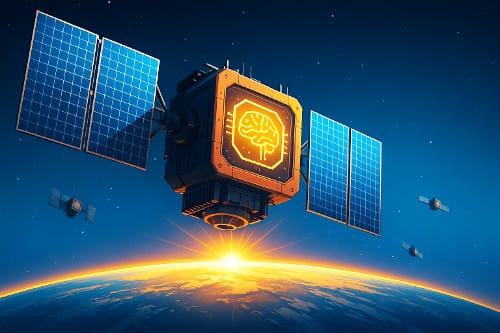
That is exactly what a handful of innovators are exploring. And with Google’s new Project SunCatcher, the concept of space-based AI infrastructure is moving from science fiction into real-world research. The idea is simple enough to sound crazy: move AI data centers into orbit, where they can soak up endless sunlight, operate in microgravity, and power the next generation of intelligent systems.
The Great Leap from Cloud to Cosmos
Our current data infrastructure is impressive but under pressure. Every time someone asks ChatGPT to draft an email, or Midjourney to render an image, or Gemini to summarize an article, those requests pull from massive GPU clusters that consume staggering amounts of electricity. Some AI training runs now use more energy than a small city.
That rising demand has pushed engineers to look upward, literally. Above the atmosphere, solar energy is abundant, cooling is efficient, and there’s no need for land, water, or zoning. A satellite in orbit can harvest continuous sunlight and radiate waste heat into the dark cold of space.
Google’s SunCatcher is built around that simple idea. Instead of expanding data centers outward across the planet, the company is experimenting with expanding upward into space, building compute constellations powered entirely by sunlight.
Project SunCatcher
Announced in late 2025, Project SunCatcher is Google’s research initiative to design a scalable AI compute system that lives in orbit. It’s still in the early stages, but it comes with real engineering blueprints and published research describing how it could work.
SunCatcher envisions constellations of AI satellites operating in sun-synchronous orbits, where they are almost always exposed to sunlight. Their solar arrays could generate power nearly 24 hours a day. Each satellite would contain high-performance processors, likely versions of Google’s Tensor Processing Units (TPUs), and communicate with others through laser-based optical links capable of transmitting data at terabits per second.
In theory, this could create a kind of orbital neural network. Each satellite would work together with others in real time, training or running large language models and vision systems without relying on ground-based data centers.
Why Space Makes Sense for AI
The first advantage is energy. Solar power in space is far more efficient than on Earth because there’s no atmosphere to block or scatter light. In some orbits, solar panels receive up to eight times more usable energy than those on the ground.
The second advantage is cooling. AI computation generates intense heat, and data centers on Earth spend nearly half their energy budget on cooling. In space, radiative cooling is naturally efficient. Heat can be emitted through carefully engineered panels that glow in infrared and release thermal energy directly into the void.
A third advantage is independence from Earth’s resources. Data centers require land, water, and access to power grids. Space-based systems need none of that. They don’t compete with agriculture or local utilities, and they avoid political or environmental disputes tied to infrastructure.
Finally, there’s the potential for real-time processing. AI models in orbit could process satellite imagery, weather data, or planetary sensor streams directly, without transmitting raw data back to Earth. This creates what researchers call “cosmic edge computing,” an AI network hovering above the planet that can analyze, learn, and act on information as it happens.
Technical Challenges
Of course, none of this is easy. Space is unforgiving. Radiation, temperature swings, and micrometeoroids can quickly damage electronics. Every launch costs money, and maintenance hundreds of miles above Earth is extremely difficult.
To address that, Google’s engineers have been testing radiation-hardened TPUs. Early prototypes have shown resilience up to about fifteen kilorads, which is surprisingly robust for commercial chips.
Communication is another challenge. To link satellites together into a functional network, Google proposes using optical communication rather than radio. Laser-based links could deliver multi-terabit bandwidth, potentially making orbital AI as fast and interconnected as the biggest terrestrial cloud clusters.
Managing heat is tricky too. While space is cold, getting rid of excess heat from tightly packed electronics requires thoughtful design. Radiators must be large, lightweight, and capable of radiating in the right wavelengths to keep chips stable.
And then there’s cost. Even with launch prices dropping below two hundred dollars per kilogram by the mid-2030s, sending large amounts of hardware into orbit is expensive. Yet Google’s research suggests that at scale, orbital AI compute could become economically competitive with Earth-based facilities, especially when you account for free solar energy and reduced cooling costs.
A Broader Movement Beyond Google
Google is not the only player thinking about orbital computing. Microsoft’s Azure Space division is integrating satellite connectivity with its cloud systems. Amazon’s AWS Ground Station lets researchers control satellites directly from their cloud consoles. IBM and the European Space Agency are experimenting with in-orbit AI analysis of telescope data.
Smaller companies are also entering the picture. Lonestar Data Holdings is testing lunar-based servers. Others are exploring mesh networks of satellites dedicated to environmental AI systems that might monitor deforestation or ocean health from orbit, running machine learning locally.
All these efforts point toward the same idea: compute is leaving the ground. Just as the internet moved from local servers to the cloud, we may now be witnessing the early move from the cloud to the cosmos.
The Creative Possibilities
For artists, writers, and independent technologists, this future has surprising implications. Every creative tool we use—from image generators to video editors—depends on computing power. If that power becomes abundant, clean, and orbital, creative freedom expands dramatically.
Imagine a generative art project that uses live satellite data to paint cloud movements across a digital canvas. Imagine a composer tapping into magnetospheric sensors to turn the Earth’s natural rhythms into music. Or imagine a filmmaker using orbital rendering farms that run entirely on solar energy, their radiators glowing gently in the night sky.
Throughout history, new infrastructure has always fueled new art forms. The printing press gave us the novel. Photography gave us cinema. The cloud gave us AI-assisted creation. It’s easy to picture orbital computing giving rise to a new creative medium—one that turns real-time planetary data into color, sound, and motion.
The Deeper Meaning Behind SunCatcher
There’s a poetic side to all this. Artificial intelligence began as a reflection of human reasoning, built from circuits and code. Now it’s rising into space, orbiting the very planet that imagined it. It’s as if intelligence itself is beginning to wrap around Earth, illuminated by sunlight.
Google’s researchers note that the Sun provides over one hundred trillion times more energy than humanity currently uses. The idea of drawing just a fraction of that to power computation reframes the relationship between AI and nature. Instead of seeing AI as an energy glutton, SunCatcher imagines it as something that harmonizes with the cosmos.
It’s an audacious but strangely organic vision: a planetary mind fueled by the same light that grows our food and warms our skin.
What Comes Next
Project SunCatcher is still experimental. Google has not announced any specific launch schedule, though the company hints that prototype missions could happen before 2030. If successful, these would be the first true orbital data centers, proof that AI can live and work in space.
But with innovation come responsibilities. Space is already crowded with satellites, and debris is a growing concern. The more infrastructure we add, the more we must think about regulation, sustainability, and global access.
Even so, the vision is inspiring. A future where AI compute is powered by sunlight and cooled by starlight is one where technology feels a little less extractive and a little more symbiotic.
So the next time you ask an AI to create a painting or write a melody, imagine your request traveling not through server farms in Virginia or Oregon, but through beams of light connecting satellites above the planet. Somewhere, in orbit, an array of processors is catching the Sun, turning pure energy into thought.
by Patrix | Sep 12, 2025
If you’ve ever dug your hands into rich garden soil and noticed the earthy smell, you’ve already met the silent microfauna orchestra beneath your feet. That scent is partly produced by soil microbes—the bacteria, fungi, nematodes, and tiny critters that transform dirt into life-giving earth. For centuries, gardeners worked mostly by feel and observation: is the soil crumbly? Does it smell fresh? Do the plants thrive? Today, technology offers us a chance to peer into that underground world and actually measure the health of soil life.
Why Microfauna Matter
Soil is not just “dirt.” It’s a living system, and its microfauna are the engines that power it. Bacteria fix nitrogen, fungi form symbiotic networks that feed roots, nematodes recycle nutrients, and protozoa keep the whole system in balance. If these microscopic players vanish or weaken, plants become more vulnerable to disease, pests, and nutrient deficiencies.
Think of soil microfauna like a city’s infrastructure. If the water pipes and power lines stop working, life above ground quickly suffers. Likewise, when the microbial highways underground break down, plants can’t flourish no matter how much fertilizer you add. That’s why gardeners, farmers, and even urban balcony growers are paying closer attention to the hidden life in their soil.
Old-School Soil Testing vs. Tech-Assisted Insights
Traditional soil testing focused on chemistry: nitrogen, phosphorus, potassium (the famous NPK trio). While that’s still important, it ignores the biological side of soil health. Enter modern tools that let you explore living soil rather than just dead minerals.
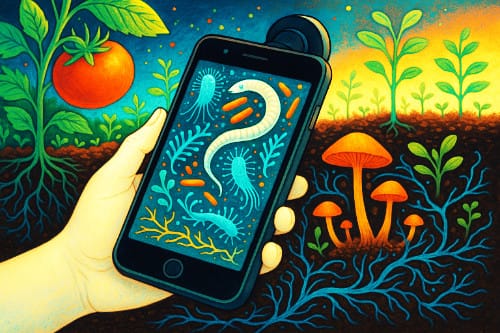
- Phone microscopes: A simple clip-on lens can turn your smartphone into a mini-lab, letting you see fungal threads, wiggling nematodes, or clusters of bacteria.
- Soil respiration meters: These measure how much CO₂ your soil produces, a proxy for microbial activity. More “breathing” means more life.
- AI-assisted apps: Emerging tools let you snap photos of soil organisms and get instant identification—like Shazam, but for microbes.
- Citizen science platforms: Upload soil-life images and contribute to global biodiversity maps. Your backyard microbes may help researchers understand planetary ecosystems.
This doesn’t require a PhD or a thousand-dollar lab setup. The beauty of today’s tech is that hobbyists can start small, with gear that costs less than a fancy houseplant.
Science in Your Garden
Exploring soil life is not just about data; it’s about delight. Imagine peering at a drop of compost tea under a clip-on scope and spotting a microscopic worm wriggling. Suddenly, composting isn’t just “rotting stuff”—it’s a bustling metropolis.
Here’s a simple experiment anyone can try:
- Take a teaspoon of garden soil and place it in a clear dish.
- Add a drop of water and cover it with a slide or piece of plastic.
- Look through a phone microscope. You’ll likely see fungal threads or tiny ciliates zooming around.
- Compare soils. Grab a sample from a neglected corner of the yard and another from your compost pile. Which has more life?
This isn’t just fun—it’s informative. You’re learning which parts of your garden are biologically rich and which might need a boost.
Compost and the Microbial Dance
One of the easiest ways to improve soil life is compost. But how do you know when your compost is “alive enough”? Here’s where tech helps again. A quick respiration test (even a DIY jar-and-sensor kit) can tell you if microbes are actively breaking down organic matter. Alternatively, a microscope view can reveal whether your compost is dominated by bacteria or has moved on to the more complex fungal stage.
- Early compost: Mostly bacteria, lots of heat.
- Mid-stage: Protozoa and nematodes join the party.
- Finished compost: A balanced mix, with fungal networks and stable humus.
Tech doesn’t replace the gardener’s senses—it adds another layer. The smell test and the crumbly feel of compost still matter, but now you can back it up with evidence.
Soil, Climate, and Community
Here’s where the geeky side meets the global stakes. Soil microbes are not just about healthy zucchini in your backyard. They’re central to climate change, because healthy soils sequester carbon while degraded soils release it. By fostering rich microbial life, gardeners are literally helping pull carbon out of the atmosphere.
On a community level, citizen scientists using microscopes and apps are mapping soil biodiversity across cities and farms. Imagine thousands of people uploading soil snapshots, creating a global microbial atlas. Your backyard contribution could help scientists understand resilience in the face of drought, heat, or pests.
The Joy of Seeing the Invisible
There’s something profoundly humbling about realizing that your tomato harvest depends on creatures too small to see without magnification. With modern tools, though, we no longer need to take it entirely on faith. We can actually witness these invisible allies at work.
And once you’ve seen them, it changes how you garden. You’re not just growing plants—you’re cultivating an underground civilization. Tech becomes less about screens and more about lenses that reveal what’s always been there, humming away under your feet.
Where to Begin
If you’re intrigued, here are three easy entry points:
- Buy a phone microscope: Start with the thrill of spotting nematodes and fungal threads.
- Join a citizen science project: Look for platforms that welcome microfauna images and observations.
- Experiment with compost monitoring: Try a simple CO₂ test kit to measure microbial “breath.”
From there, you can dive deeper—perhaps exploring open-source AI tools that help classify microbes, or 3D-printing your own lab gear to create a compact, affordable “soil life station.”
Soil health has always been about life, but until recently, that life was invisible. Now, with affordable tech, gardeners can step into the role of scientist, explorer, and steward. The garden becomes more than a place to grow vegetables—it becomes a window into the hidden universe that makes all life possible.
by Patrix | Aug 4, 2025
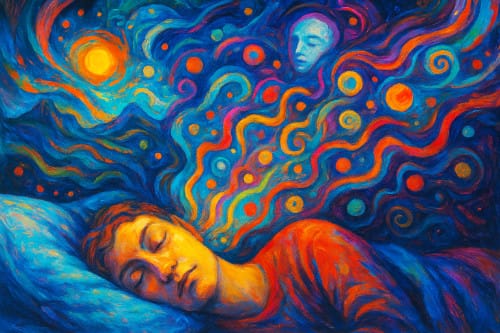
Ever had that dreamy moment when you’re just starting to doze off, and suddenly your mind floods with strange images, sounds, or ideas that seem to come from nowhere? Maybe it felt like falling, or maybe you heard your name called out from the void—only to realize you’re still half-awake. Welcome to the weird and wonderful world of hypnagogia, the twilight state between wakefulness and sleep.
It’s a mental borderland where creativity blossoms, logic loosens, and the subconscious starts stretching its legs. Artists, inventors, and philosophers have long dipped into this semi-dream state for inspiration. And now, in a world driven by sleep science, cognitive hacking, and AI, hypnagogia is making a comeback.
What Is Hypnagogia?
Hypnagogia (pronounced hip-nuh-GO-jee-uh) refers to the transitional state your brain enters as you fall asleep. It’s the soft descent from conscious awareness to unconscious dreaming. Unlike REM sleep (when dreams get cinematic), hypnagogia tends to be more fragmentary, fleeting, and surreal—like the mind whispering to itself just before the lights go out.
Neuroscientifically, it’s marked by changes in brainwave activity: your alert beta waves start to give way to slower alpha and theta waves. You’re no longer fully awake, but not quite asleep either.
This state is often rich in:
- Visual hallucinations: Shapes, colors, faces, landscapes
- Auditory distortions: Echoes, single words, music, or whispers
- Physical sensations: The infamous “falling” feeling or sleep starts (called hypnic jerks)
- Creative thoughts: Sudden insights or strange mental associations
In other words, hypnagogia is a temporary suspension of the rules—your usual mental filters go offline just long enough for your inner world to get weird.
History’s Most Famous Half-Asleep Thinkers
Many brilliant minds throughout history have tapped into the hypnagogic state as a wellspring of creative insight.
- Salvador Dalí used what he called “slumber with a key”: he’d nap in a chair while holding a metal key over a plate. As he drifted off and dropped the key, the clatter would wake him—allowing him to grab whatever surreal images floated through his mind.
- Thomas Edison reportedly used a similar technique with ball bearings, a chair, and a tin plate. He believed this liminal state was the gateway to his best ideas.
- Mary Shelley, author of Frankenstein, described seeing her famous monster in a waking dream—not quite asleep, not quite awake.
- August Kekulé, a 19th-century chemist, had a hypnagogic vision of a snake biting its own tail—which led him to realize the ring structure of the benzene molecule.
What Happens in the Brain During Hypnagogia?
Brain imaging studies show that during hypnagogia, activity in the default mode network (DMN) ramps up. This part of the brain is associated with daydreaming, self-reflection, and internal narrative. Simultaneously, areas responsible for sensory processing remain semi-active, which explains why hypnagogic visions and sounds feel so vivid.
It’s also a time when executive function—the brain’s taskmaster—lets down its guard. That’s why your thoughts might jump from an old memory to a strange image to a new idea, all in a matter of seconds. It’s nonlinear, associative thinking at its finest.
Can You Use Hypnagogia for Creativity?
Yes—and people are doing it.
Some creatives actively try to induce hypnagogia through intentional napping, meditation, or lucid dreaming techniques. Here are a few practical ways to experiment:
1. Hypnagogic Journaling
Lie down with a journal nearby. As you begin to doze, try to stay aware of the images or phrases that come to mind. The moment you jerk awake or stir, jot down anything you remember—no matter how odd.
2. The Dalí Method (with a modern twist)
Try holding a small object—like a spoon or coin—in your hand while resting in a chair. Place a metal or ceramic plate underneath. As you drift off and drop the object, the sound will wake you. Capture whatever you saw or thought about.
3. Audio Triggers
Some people use soft ambient music, binaural beats, or even AI-generated soundscapes to help ease into the hypnagogic zone. Apps like Endel, Brain.fm, or YouTube’s sleep music loops can help coax the brain into theta territory.
Why Hypnagogia Matters in an Age of Hyper-Productivity
In a culture obsessed with productivity hacks, attention spans, and the “optimization” of every waking moment, hypnagogia is a gentle rebellion. It’s a reminder that creativity doesn’t always emerge from grinding harder—it can come from surrender, softness, and liminal mental space.
AI is increasingly being trained to simulate aspects of human creativity, but it’s the irrational, fluid, dreamlike logic of states like hypnagogia that remain uniquely human—for now. In fact, some researchers are studying hypnagogic imagery as a model for how future AI might mimic human associative thinking.
At the same time, scientists are looking into the potential therapeutic benefits of this state. Some early work suggests it might help in processing trauma, enhancing memory, or even supporting problem-solving during sleep onset.
Next time you’re nodding off and a bizarre image flashes across your mind—don’t shrug it off. That may just be your subconscious offering up a sliver of wisdom wrapped in weirdness.
Hypnagogia is a liminal zone, a soft corridor between two worlds. You don’t have to sleep through it. You can explore it, learn from it, and maybe even create something wonderful while dancing on the edge of dreaming.