
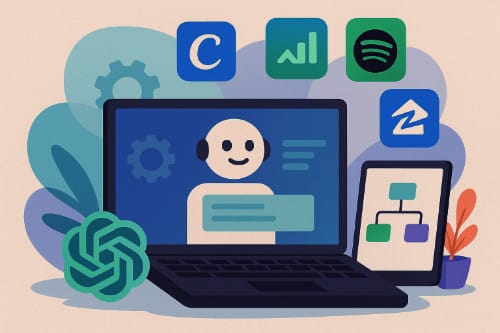
There was a time when ChatGPT was little more than a polite conversationalist with an impressive memory for facts. You typed a question, it answered. That’s changing fast. OpenAI has just unveiled two new features that push ChatGPT far beyond its roots as a chatbot: the ability to call on apps directly within ChatGPT, and a new developer framework called AgentKit. Together, these tools hint at an ambitious vision: ChatGPT not as a single AI assistant, but as a digital platform where apps, agents, and creativity converge.
Apps Inside ChatGPT
The most visible new feature is the introduction of apps that can operate right inside a ChatGPT conversation. Instead of merely linking to external websites or APIs, ChatGPT can now load interactive tools within the chat window. You might ask it to design a logo, book a flight, or create a playlist, and it can bring in apps like Canva, Expedia, Zillow, or Spotify to handle the details — without ever leaving the chat.
In practical terms, this means you can now conduct tasks that used to require jumping between tabs. Imagine asking ChatGPT to “find homes in Paso Robles with vineyard views under $900,000,” and it opens a Zillow panel with live listings. Or you could say “design a minimalist poster for my local art fair,” and ChatGPT brings in Canva to help you customize layouts right there in your conversation.
Developers can create these embedded tools using OpenAI’s new Apps SDK, which opens the door for a new ecosystem of chat-native software. Instead of designing apps around menus, screens, and icons, developers are designing for conversation — an interface where users describe what they want and see the result unfold naturally.
This shift is bigger than it might first appear. It positions ChatGPT as something like a conversational operating system, or as some tech writers have called it, “a chat-first super-app.” The traditional app model depends on users finding and opening apps individually. In the new model, you stay in one environment, and the right tool appears when you need it.
For users, this reduces friction dramatically. For developers, it’s an invitation to reach hundreds of millions of people directly inside a space where users already spend time thinking, researching, and planning. And for OpenAI, it’s a strategic move toward making ChatGPT the hub where digital tasks begin and end.
Of course, there are challenges. Integrating apps into ChatGPT means new considerations for privacy and permissions. Users may need to authorize data sharing between ChatGPT and third-party services, and OpenAI will have to ensure transparency about how that data is used. There’s also the question of monetization: will developers be able to sell their in-chat apps? And will ChatGPT recommend partner apps more often than others? Those answers will likely emerge as the platform matures.
Still, the potential is obvious. With apps inside ChatGPT, we’re watching the boundaries between AI conversation and software interaction blur into something seamless.
AgentKit: Building the Brains Behind the Interface
While embedded apps handle tasks, OpenAI’s second major release, AgentKit, is about building autonomous intelligence. If the new ChatGPT apps are the hands of the operation, AgentKit is the brain.
AgentKit is a toolkit that lets developers (and soon, power users) create AI agents — autonomous systems that can perform complex workflows on their own. These agents don’t just respond to prompts; they act. They can fetch information, call APIs, take actions, evaluate results, and loop back to improve performance.
At its core, AgentKit combines several components:
- A visual agent builder, where you can design workflows through a drag-and-drop interface.
- A connector registry, offering prebuilt connections to popular APIs and services so you don’t need to write all the plumbing code yourself.
- A chat interface builder (called ChatKit), which lets you embed your agent into a website or app.
- An evaluation framework that helps test, monitor, and optimize how agents behave over time.
What’s remarkable about AgentKit is that it lowers the barrier to entry for building autonomous systems. In the past, developing an AI agent required juggling multiple services — prompt chains, data connectors, guardrails, and UI layers. AgentKit packages all of this into a single, coherent stack.
Imagine you run a small online business and want an AI that checks your Shopify store daily, flags low inventory, drafts a reorder email to your supplier, and then posts a status update to your team Slack. With AgentKit, that kind of automation could soon be built visually, without deep coding skills.
Or picture an indie researcher building an agent that monitors new publications in climate science, summarizes findings weekly, and updates a shared knowledge base. These aren’t far-off scenarios; they’re the kind of things developers are already experimenting with as the toolkit rolls out.
AgentKit also addresses one of the toughest problems in AI development: evaluation. It includes built-in tools to measure how well an agent performs its intended task, detect errors or hallucinations, and adjust its logic automatically. This kind of systematic feedback loop is essential if autonomous agents are to be trusted for serious work.
Why It Matters for Creatives and Entrepreneurs
For many ArtsyGeeky readers, this evolution means a new wave of opportunity. You don’t need to be a large company to harness AI anymore.
With apps inside ChatGPT, you can create, design, research, and organize projects from one conversational hub. A photographer could brainstorm blog titles, generate social media captions, open Canva to lay out a promo card, and then call Shopify to upload it — all from a single chat.
With AgentKit, you can automate what happens next. That same photographer could build an agent that tracks engagement data, suggests which images performed best, and recommends the next set of edits to promote.
This convergence of tools and intelligence transforms ChatGPT into a kind of creative studio. It’s not just reactive; it’s collaborative. The line between “asking an AI” and “working with an AI” is fading.
A Few Cautions Along the Way
As with any new technology, there are some caveats. AI agents, even well-trained ones, can still make mistakes. They can misinterpret intent, generate inaccurate data, or act in ways you didn’t expect if guardrails aren’t set properly. That’s why AgentKit includes safety tools and permissions systems to keep actions transparent and reversible.
Privacy is another key issue. Because apps and agents may access your data or connect with external accounts, users should pay attention to what they authorize. OpenAI will need to earn user trust by keeping permissions explicit and data use limited.
Finally, there’s the question of ecosystem fragmentation. Will developers build hundreds of different agent frameworks, each with its own quirks? Or will OpenAI’s ecosystem unify around a shared standard? For now, the company seems determined to make AgentKit the common language of AI automation.
The Next Frontier
When you put these two features together — apps inside ChatGPT and AgentKit — the larger picture comes into focus. OpenAI is positioning ChatGPT not as a single product, but as a platform for intelligent interaction. It’s a place where conversation becomes command, and AI becomes a co-worker.
Soon, users might chain together agents and apps in one session. A planning agent could call on Expedia to check flights, Canva to generate an itinerary design, and Google Sheets (through a connector) to budget the trip. It’s not hard to see how this could evolve into a fully integrated, conversational workspace — a kind of digital command center for modern creative life.
For those of us who’ve watched AI progress from curiosity to collaborator, it’s an exciting turn. Whether you’re a developer, a designer, or simply someone who loves tinkering with new ideas, the door just opened a little wider.