
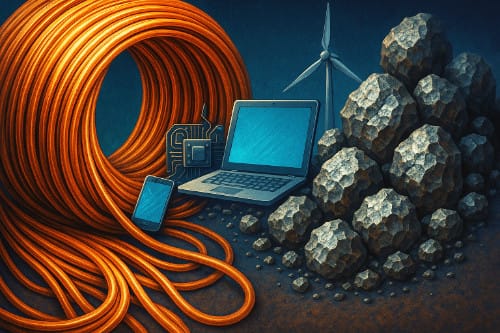
From the smartphone in your hand to the electric car zipping down the street, much of modern life runs on the quiet strength of two unassuming elements: copper and rare earth metals. They’re not flashy like gold or controversial like oil, but if you’re curious about where the next big tech bottleneck—or opportunity—might come from, look no further than these metallic workhorses.
Copper
Copper is the tech world’s favorite team player. It’s in the wiring of nearly every gadget, charging station, server farm, and EV on the planet. Why? Because copper is one of the best electrical conductors available that isn’t prohibitively expensive.
Just a few of copper’s key roles:
- Electric vehicles (EVs): A traditional gas-powered car uses about 18–49 pounds of copper. An EV? Around 180 pounds.
- Renewable energy systems: Wind turbines and solar panels rely heavily on copper wiring and grounding systems.
- Data centers and AI infrastructure: As AI models get larger and data centers scale, the demand for efficient, high-conductivity materials like copper rises sharply.
In other words, the green and digital revolutions are painted in copper. And demand is skyrocketing—some analysts predict copper demand will double by 2035.
Rare Earth Metals
Rare earths aren’t actually that rare, but mining and refining them is tricky, toxic, and geopolitically sensitive. These 17 metallic elements go by names like neodymium, dysprosium, and terbium—none of which are likely to show up in your Scrabble game, but all of which are crucial to modern life.
Here’s where rare earths show up:
- Magnets: Neodymium magnets are found in hard drives, headphones, and wind turbines.
- Displays and screens: Europium and terbium are used in LED and LCD displays.
- Electric motors: Rare earth magnets help reduce weight and improve efficiency in EV motors.
- Military tech: Precision-guided weapons, satellites, and stealth systems all rely on these elements.
The kicker? China currently controls the majority of rare earth mining and processing, which raises big questions about supply chain security for Western nations and tech companies.
Investment Opportunity?
Here’s the thing: you can’t scale the future—AI, electrification, renewables—without scaling the raw materials underneath. That’s where copper and rare earths come in, and that’s why investing in their production and acquisition is looking increasingly attractive.
Some trends worth noting:
- Global scarcity: New copper mines take years (sometimes decades) to develop. And many rare earth mines are either geographically limited or under intense regulatory scrutiny.
- Government interest: The U.S. and EU are funneling money into domestic mining and refining projects to reduce reliance on foreign suppliers.
- Private sector momentum: Companies like MP Materials and Lynas are building out the rare earth supply chain. Big mining players like Rio Tinto and BHP are betting big on copper.
- Green mandates: Global policies pushing EV adoption and net-zero goals are putting structural, long-term pressure on demand.
In short, this isn’t a short-term play. It’s more like getting into oil before the Model T.
What to Watch If You’re An Investor
You don’t need to go panning for dysprosium yourself, but there are multiple ways to get exposure:
- Mining stocks: Look at major copper producers (Freeport-McMoRan, Southern Copper) or rare earth specialists (MP Materials, Lynas).
- ETFs: There are ETFs that focus on critical minerals or the electrification supply chain.
- Junior miners: Higher risk, but also higher reward if they strike something valuable.
- Geopolitical shifts: Keep an eye on how governments are reshaping mining policy and subsidizing domestic production.
This isn’t just about resource speculation—it’s about betting on the bedrock of modern tech.
We like to imagine technology as sleek and weightless, flying through fiber optics and 5G waves. But the reality is much more grounded: our digital future still has to be dug from the earth. Copper and rare earth metals may be buried, but their importance is only rising—and investors who understand this may just strike a vein of long-term value.