
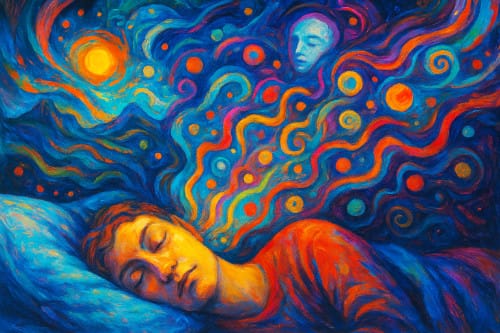
Ever had that dreamy moment when you’re just starting to doze off, and suddenly your mind floods with strange images, sounds, or ideas that seem to come from nowhere? Maybe it felt like falling, or maybe you heard your name called out from the void—only to realize you’re still half-awake. Welcome to the weird and wonderful world of hypnagogia, the twilight state between wakefulness and sleep.
It’s a mental borderland where creativity blossoms, logic loosens, and the subconscious starts stretching its legs. Artists, inventors, and philosophers have long dipped into this semi-dream state for inspiration. And now, in a world driven by sleep science, cognitive hacking, and AI, hypnagogia is making a comeback.
What Is Hypnagogia?
Hypnagogia (pronounced hip-nuh-GO-jee-uh) refers to the transitional state your brain enters as you fall asleep. It’s the soft descent from conscious awareness to unconscious dreaming. Unlike REM sleep (when dreams get cinematic), hypnagogia tends to be more fragmentary, fleeting, and surreal—like the mind whispering to itself just before the lights go out.
Neuroscientifically, it’s marked by changes in brainwave activity: your alert beta waves start to give way to slower alpha and theta waves. You’re no longer fully awake, but not quite asleep either.
This state is often rich in:
- Visual hallucinations: Shapes, colors, faces, landscapes
- Auditory distortions: Echoes, single words, music, or whispers
- Physical sensations: The infamous “falling” feeling or sleep starts (called hypnic jerks)
- Creative thoughts: Sudden insights or strange mental associations
In other words, hypnagogia is a temporary suspension of the rules—your usual mental filters go offline just long enough for your inner world to get weird.
History’s Most Famous Half-Asleep Thinkers
Many brilliant minds throughout history have tapped into the hypnagogic state as a wellspring of creative insight.
- Salvador Dalí used what he called “slumber with a key”: he’d nap in a chair while holding a metal key over a plate. As he drifted off and dropped the key, the clatter would wake him—allowing him to grab whatever surreal images floated through his mind.
- Thomas Edison reportedly used a similar technique with ball bearings, a chair, and a tin plate. He believed this liminal state was the gateway to his best ideas.
- Mary Shelley, author of Frankenstein, described seeing her famous monster in a waking dream—not quite asleep, not quite awake.
- August Kekulé, a 19th-century chemist, had a hypnagogic vision of a snake biting its own tail—which led him to realize the ring structure of the benzene molecule.
What Happens in the Brain During Hypnagogia?
Brain imaging studies show that during hypnagogia, activity in the default mode network (DMN) ramps up. This part of the brain is associated with daydreaming, self-reflection, and internal narrative. Simultaneously, areas responsible for sensory processing remain semi-active, which explains why hypnagogic visions and sounds feel so vivid.
It’s also a time when executive function—the brain’s taskmaster—lets down its guard. That’s why your thoughts might jump from an old memory to a strange image to a new idea, all in a matter of seconds. It’s nonlinear, associative thinking at its finest.
Can You Use Hypnagogia for Creativity?
Yes—and people are doing it.
Some creatives actively try to induce hypnagogia through intentional napping, meditation, or lucid dreaming techniques. Here are a few practical ways to experiment:
1. Hypnagogic Journaling
Lie down with a journal nearby. As you begin to doze, try to stay aware of the images or phrases that come to mind. The moment you jerk awake or stir, jot down anything you remember—no matter how odd.
2. The Dalí Method (with a modern twist)
Try holding a small object—like a spoon or coin—in your hand while resting in a chair. Place a metal or ceramic plate underneath. As you drift off and drop the object, the sound will wake you. Capture whatever you saw or thought about.
3. Audio Triggers
Some people use soft ambient music, binaural beats, or even AI-generated soundscapes to help ease into the hypnagogic zone. Apps like Endel, Brain.fm, or YouTube’s sleep music loops can help coax the brain into theta territory.
Why Hypnagogia Matters in an Age of Hyper-Productivity
In a culture obsessed with productivity hacks, attention spans, and the “optimization” of every waking moment, hypnagogia is a gentle rebellion. It’s a reminder that creativity doesn’t always emerge from grinding harder—it can come from surrender, softness, and liminal mental space.
AI is increasingly being trained to simulate aspects of human creativity, but it’s the irrational, fluid, dreamlike logic of states like hypnagogia that remain uniquely human—for now. In fact, some researchers are studying hypnagogic imagery as a model for how future AI might mimic human associative thinking.
At the same time, scientists are looking into the potential therapeutic benefits of this state. Some early work suggests it might help in processing trauma, enhancing memory, or even supporting problem-solving during sleep onset.
Next time you’re nodding off and a bizarre image flashes across your mind—don’t shrug it off. That may just be your subconscious offering up a sliver of wisdom wrapped in weirdness.
Hypnagogia is a liminal zone, a soft corridor between two worlds. You don’t have to sleep through it. You can explore it, learn from it, and maybe even create something wonderful while dancing on the edge of dreaming.