
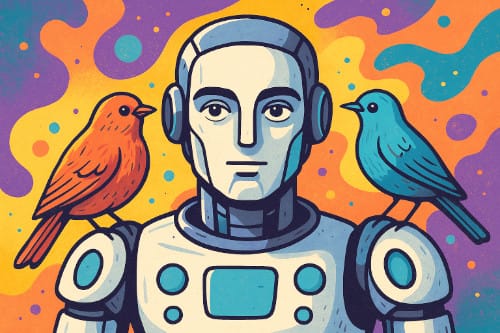
On August 7, 2025, OpenAI officially unveiled GPT-5, its flagship successor to GPT-4, GPT-4.5, GPT-4o, and the O-series models. What makes this so exciting isn’t just raw power—it’s the model’s polished intelligence, uncanny adaptability, and the sense it wants to collaborate, not just respond.
Why GPT-5 Is a Game Changer: Smarter, Smoother, More Attuned
GPT-5 isn’t merely bigger—it’s wiser and more agile. OpenAI layered it with a real-time router, seamlessly choosing between fast answers or deep reasoning depending on the ask—without user input required. Across coding, math, writing, health advice, and visual perception, GPT-5 delivers state-of-the-art performance—what OpenAI terms “expert-level responses”.
Hallucinations? Sharply reduced. Instructions? Followed more precisely. Sycophancy? Dialed way back. GPT-5 aims to “refuse unsafe queries gently while providing more helpful answers when possible”. It’s faster and more accurate across everyday tasks like writing, coding, and health conversations.
New Capabilities That Blend Power with UX Ease
GPT-5 redefines what users expect from AI:
- Unified access across free, Plus, Pro, enterprise, and educational users—no more confusing model picker menus.
- Personality options—choose tones like “Cynic,” “Listener,” or “Nerd”—and UI themes, plus voice enhancements.
- Long-context memory and reasoning—handles inputs up to 272,000 tokens and 128,000 tokens in output, delivering coherence across epic conversations.
- Safety-first design through over 5,000 hours of testing, improved uncertainty handling, and safe completion logic.
- Multimodal prowess—text and image inputs (and in some accounts, even audio/video support), making GPT-5 more versatile than ever.
For Developers: A Toolkit of Precision and Power
Coders, rejoice. GPT-5 is designed to be a true coding partner:
- Top-tier scores on SWE-bench Verified (74.9%) and Aider polyglot (88%) benchmarks.
- Sharper tool calling—accuracy, error handling, preambles between calls, and seamless chaining in complex tasks.
- New API controls like
verbosity(low/medium/high) andreasoning_effort(including a nifty “minimal” fast mode) for customizable trade-offs. - Three API tiers—GPT-5, GPT-5-mini, GPT-5-nano—offer flexible pricing and performance tiers.
- Impressive benchmarks on τ²-bench telecom (96.7% tool-driven accuracy) and long-context retrieval tasks (89% accuracy across 128K–256K tokens inputs).
Real-World Rollouts & Partnerships
This isn’t theory—GPT-5 is already live. It replaced past models like GPT-4o and GPT-4.5 across ChatGPT. Microsoft is embedding GPT-5 across Copilot and services; whispers say Apple will integrate it into Apple Intelligence features.
A Word on Costs & Environmental Footprint
Power costs energy. GPT-5 eats around 18 watt-hours for a medium-length reply—higher than GPT-4o—though that’s expected for a model this capable. As AI scales, energy consumption and carbon footprints remain real concerns, and GPT-5 offers no free pass.
Early Reception: Cheers and Caution Flags
Many users and creators celebrate GPT-5’s polish and power. Publications like Wired and Tom’s Guide applaud its performance, personalization, and integration with Gmail/Calendar.
But not all feedback is glow—some users found GPT-5’s responses “flat” compared to GPT-4o, and early routing glitches caused inconsistency. OpenAI has since fixed the router and pledged to restore GPT-4o access for Plus users while raising personalization options.
MIT Technology Review called GPT-5 “a refined product more than a transformative leap”—not revolutionary, but polished and purpose-driven. Which, for creative and independent thinkers, may well be exactly what the moment demands.
What GPT-5 Means for the Future of AI
GPT-5 signals a shift from novelty to nuance. It’s not just about raw intelligence—it’s about steerability, accessibility, context-awareness, and integration. We’re seeing:
- AI that adapts to you, not generic prompts.
- Agents embedded seamlessly in workflows—email, code, projects, calendars—with long memory.
- Developer tools that let builders refine speed, depth, cost, and tool orchestration.
- A model that knows when to think fast and when to dig deep, intuitively and elegantly.
In short, GPT-5 isn’t a toy—it’s a collaborator. We’re inching closer to Artificial General Assistance: AI that generates, *reasons*, and *works with* us—smart, safe, and stylish.
Let me know if you’d like to spin in comparisons with other models, creative use cases for artists and retirees, or SEO tips for long-form AI content.