
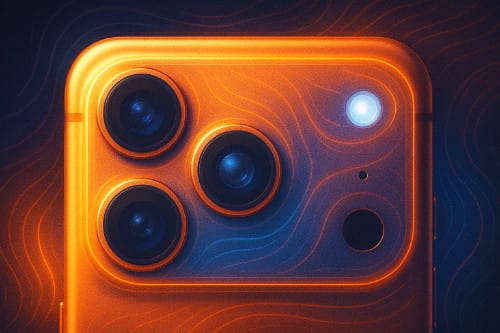
I’ve had the iPhone 17 Pro for just about a week now, and I’ve concluded that it isn’t just another annual polish by Apple.
It’s a camera-first, silicon-forward statement aimed at creators and anyone curious about where on-device AI is going next. The headline upgrades are straightforward: three 48-megapixel rear sensors with the longest iPhone zoom yet, and the new A19 Pro chip with a reworked cooling system that’s built to keep serious workloads from wilting. The question is whether those upgrades add up to real-world gains — and whether the trade-offs (price, durability chatter, repairability) dull the shine.
I lived with the 17 Pro like a travel-light creator would: shooting portraits at golden hour, zooming into birds over the surf, slicing short clips together, and pushing edits while streaming a match replay. Here’s where it sings, where it scuffs, and who should buy it.
What’s genuinely new — and why it matters
Apple’s own pitch is simple: A19 Pro performance with “vapor-cooled” stability, an all-48MP “Fusion” rear camera trio, and a smarter front camera with Center Stage framing. That framework is real, not marketing fluff. On paper, you’re looking at a 6-core CPU, 6-core GPU, and a 16-core Neural Engine, plus per-GPU “Neural Accelerators” that juice matrix math — the bread-and-butter of modern AI tasks like summarization, image upscaling, and local transcription. That silicon is the bedrock for the next few iOS cycles, when more of Apple’s “intelligence” features shift from the cloud to your pocket.
Cameras: the rule of three (48 MP, 48 MP, 48 MP)
For the first time, every rear camera lands at 48 megapixels: wide, ultra-wide, and telephoto. It’s the most coherent camera lineup Apple’s shipped, and it pays off in two ways. First, color and detail feel more consistent as you hop lenses. Second, Apple leans heavily on confident center-crop pipelines, which enable that attention-grabbing “8× optical-quality” reach without turning textures to watercolor. The tetraprism telephoto sits on a larger, higher-resolution sensor than last year’s, and it shows when you zoom into signage, wildlife, or architectural details. If you’re a travel shooter or you love candid portraits from across the courtyard, this is the first iPhone telephoto that feels like a dependable tool, not a party trick.
Video remains Apple’s home turf. Dual Capture (front and rear), ProRes, and a robust pipeline make the phone an easy “shoot, trim, publish” machine. It’s the sort of practical edge that matters more than a spec sheet if you’re vlogging a winery visit or layering B-roll of waves over voiceover. That versatility means fewer excuses to bring a second camera — and fewer steps between idea and upload.
A quick note on the front camera: Center Stage framing now helps with group selfies and handheld video diaries. It’s a subtle assist, but it saves retakes. Think of it as a tiny, polite director nudging the composition.
The A19 Pro and the coming wave of on-device AI
Benchmarks are only one piece of the story, but they capture the thrust: Apple’s A19 family sets a new high-water mark for single-core efficiency, and the Pro variant is purpose-built for sustained bursts rather than quick sprints. That matters because modern “AI features” aren’t single taps; they’re background model runs, longer transcriptions, and real-time effects that stress thermals. Pair that with iOS 26’s early forays into on-device “intelligence,” and you can see why Apple prioritized a cooler that quietly does the unglamorous work. If you keep phones for three to four years, that headroom is the kind of future-proofing that actually pays off.
In practical terms, that means you can transcribe a long interview in a coffee shop without watching the battery nosedive or the frame rate tank when you open a map. And if Apple’s next-wave features (on-device image generation, smarter video indexing, richer voice synthesis) really land, the 17 Pro is poised to run them locally rather than punting everything to a server.
Display, battery, and day-to-day
The Pro’s OLED still looks superb outdoors, with a friendlier anti-reflective layer that helps in bright beach light. Battery life has crept up again — especially on the Pro Max — and the combination of silicon efficiency and the vapor chamber means your second hour of a task feels a lot like your first. It’s the small, cumulative wins that make a device feel reliable rather than flashy. Specs like the 6.3-inch display, 206 g weight (233 g on Pro Max), and 8.75 mm depth mean it’s still a dense slab, but the balance is good in hand.
The trade-offs: price, repair, and “scratchgate”
Premium pricing remains premium. Start around the thousand-dollar mark and climb fast with storage. If you’ll truly use the camera stack and compute headroom, the math can work. If not, the standard iPhone 17 is very capable for less.
Repairability is still Apple-esque: most jobs route through the display first, and parts pairing nudges you toward official service. You may never crack it open, but it affects total cost of ownership if you keep phones beyond AppleCare.
Then there’s the conversation of the month: scuffing around the “camera plateau.” Independent teardowns and microscope shots suggest the anodized aluminum finish is most vulnerable at sharp bump edges where the coating can flake under abrasion. Apple, for its part, has argued some store-unit marks came from worn MagSafe stands transferring material — which is plausible for certain scuffs, but it doesn’t fully explain the edge wear seen in stress tests. Bottom line: if you’re case-averse, keep this in mind, especially if you value trade-in value later.
Who should upgrade?
If you shoot often (especially portraits, travel, and wildlife), the 17 Pro’s uniform 48 MP lineup and telephoto reach are substantive. If you edit and publish from your phone, the A19 Pro plus vapor cooling is meaningful. And if you want to be early to Apple’s local-AI story, this is the safe bet.
If your use is casual and you’re not zoom-happy, the base 17 will likely satisfy. If you’re sensitive to finish wear and don’t like cases, you might wait a cycle to see if Apple softens those camera-bump edges.
A practical buying guide in one paragraph
Choose iPhone 17 Pro if your camera roll is your portfolio, you edit on the go, and you want silicon that’ll carry the next few years of on-device AI. Choose Pro Max if you prize battery and the biggest canvas. Choose iPhone 17 if you want most of the experience without the price or mass. Whichever you pick, consider a slim case — not for drops, but to protect that camera plateau from the slow grind of pockets, mounts, and countertops.
I sometimes tell friends that phones are like kitchen knives: the right one makes you cook more, not just cut faster. The iPhone 17 Pro is that kind of tool for image-makers and tinkerers. It doesn’t merely benchmark well; it invites you to create more often — and leaves headroom for the smarter workflows Apple hasn’t shipped yet.
One additional note: I don’t think the “Bitcoin Orange” option is just a happy accident!