If 2025 was the year everyone started talking to machines, 2026 will be the year we learn to talk beautifully to computers.
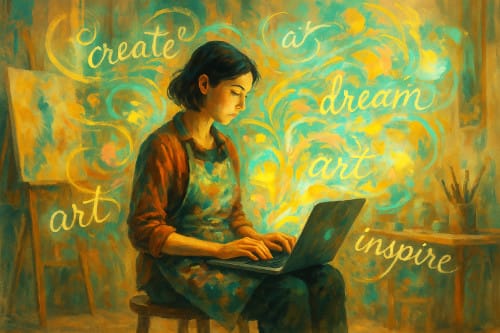
Across studios, coffee shops, and kitchen tables, artists and writers are discovering something quietly revolutionary: words are becoming brushstrokes. The way we describe an image to an AI model is starting to feel less like coding and more like painting. The prompt has evolved into a genuine art form, and how we craft it may soon define our creative era.
This isn’t about replacing artistry. It’s about extending it.
The Rise of the Prompt Era
There was a time when learning digital art meant memorizing software shortcuts. You knew your brushes in Photoshop or your layers in Procreate. But in 2026, the most powerful tool in the artist’s kit will language. It’s not what you click, it’s what you say.
Large language and diffusion models have matured. Tools like ChatGPT, Midjourney, DALL·E, and Google’s Gemini all interpret our phrases with nuance. Instead of telling a computer what to do, we tell it what to feel. A single sentence can now conjure entire worlds.
Why Prompts Are Like Brushstrokes
Think about how a painter works. A brushstroke can be gentle or bold, abstract or precise. The same goes for prompts. Every word carries a texture, a rhythm, a tone.
Try it.
Type this: “a cat in a garden.”
Now try this: “a sleepy Siamese cat lounging under pink bougainvillea, morning sunlight dappling its fur, watercolor style.”
Both describe a cat. Only one feels alive.
The difference isn’t in the AI; it’s in you. The artist’s voice has moved from the canvas to the sentence. The AI merely reflects it back.
We are discovering that the smallest change in phrasing—adding warmth, mystery, or mood—shifts everything. Like brush pressure or pigment density, language becomes the medium of emotion.
Finding Your Prompting Voice
Every artist has a signature. You can spot a Van Gogh sky or a Hopper shadow from a distance. The same individuality is emerging in prompt writing.
Your “prompting voice” is a mix of vocabulary, rhythm, and worldview. Some artists lean poetic. Others think in cinematic scenes or music-inspired imagery. The key is to write the way you see.
- Think in senses. Use texture, sound, and atmosphere. Instead of “a city,” say “a rain-washed city humming with neon reflections.”
- Reference artistic movements. “In the style of mid-century poster art” gives AI cultural context.
- Combine opposites. “Surreal yet minimalist” creates friction that often sparks originality.
Prompting is no longer about commanding a tool. It’s about conversing with one. The more personal your phrasing, the more the result feels yours.
Curation: The Hidden Art Form
Even the best prompts don’t always yield perfect images. That’s where curation steps in—the quiet act of choosing and refining.
Scrolling through a dozen AI outputs is like flipping through contact sheets from an old film shoot. Somewhere in that grid lies the soul of your idea. The trick is knowing which frame speaks to you.
Artists today are mixing worlds. They blend Midjourney generations with Procreate touch-ups or combine AI drafts with watercolor washes. The computer’s precision meets the human hand’s imperfection. The two together create something new and strangely honest.
Ethics, Originality, and Intention
Let’s be honest: AI art still walks a tricky line. These systems learn from vast pools of human-created work. So where does originality begin?
For me, it begins with intention.
If your goal is expression, exploration, and emotional truth, then the machine becomes a collaborator, not a thief. Artists have always borrowed from the past. Think of the way jazz riffs on older melodies or how painters reinterpret myths. The AI simply amplifies that process.
The key is transparency. Know what tools you’re using. Acknowledge influence. Mix in your own layers, words, or paint. Authenticity lives not in the medium but in the maker’s awareness.
A Simple Experiment
If you want to feel the magic firsthand, try this:
- Write one short, plain prompt: “a sunset over the ocean.”
- Then rewrite it with emotion and imagery: “the last glow of an orange sun dissolving into calm Pacific waters, a lone pelican gliding through the reflection.”
- Generate both, and compare.
Most people are stunned. The second image feels like it carries a soul. That’s not because the AI suddenly became smarter. It’s because you did.
The Future of Creative Language
By early 2026, new tools will make this collaboration even richer. We’re already seeing AI systems that merge text, sound, and movement. Type a scene and watch it unfold as animation. Speak a mood and hear music adapt in real time.
Soon, art students might study “prompt literacy” alongside color theory and composition. The brush and the pen are still here—they’ve just gained a digital cousin.
What excites me most is not what AI can do, but what it reveals: that creativity has never been about medium or tool. It’s about translation—turning the invisible inner world into something shareable. Whether through oil paint or text prompts, the mission is the same.
History Rhymes
We are the first generation to paint with words that machines can see. It feels a little like magic, and a little like history repeating itself.
Painters once feared photography. Writers feared the typewriter. Musicians feared the synthesizer. Each time, creativity adapted. And each time, art became more human, not less.
So yes, prompts are becoming the brushstrokes of our time. But they are still guided by the same hand, the same heart.