
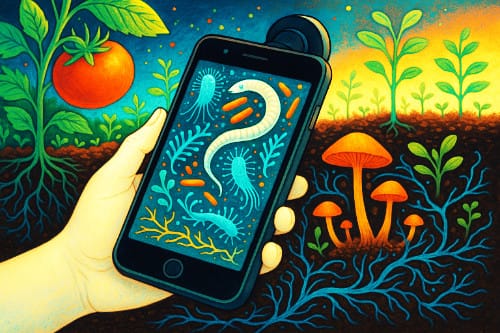
If you’ve ever dug your hands into rich garden soil and noticed the earthy smell, you’ve already met the silent microfauna orchestra beneath your feet. That scent is partly produced by soil microbes—the bacteria, fungi, nematodes, and tiny critters that transform dirt into life-giving earth. For centuries, gardeners worked mostly by feel and observation: is the soil crumbly? Does it smell fresh? Do the plants thrive? Today, technology offers us a chance to peer into that underground world and actually measure the health of soil life.
Why Microfauna Matter
Soil is not just “dirt.” It’s a living system, and its microfauna are the engines that power it. Bacteria fix nitrogen, fungi form symbiotic networks that feed roots, nematodes recycle nutrients, and protozoa keep the whole system in balance. If these microscopic players vanish or weaken, plants become more vulnerable to disease, pests, and nutrient deficiencies.
Think of soil microfauna like a city’s infrastructure. If the water pipes and power lines stop working, life above ground quickly suffers. Likewise, when the microbial highways underground break down, plants can’t flourish no matter how much fertilizer you add. That’s why gardeners, farmers, and even urban balcony growers are paying closer attention to the hidden life in their soil.
Old-School Soil Testing vs. Tech-Assisted Insights
Traditional soil testing focused on chemistry: nitrogen, phosphorus, potassium (the famous NPK trio). While that’s still important, it ignores the biological side of soil health. Enter modern tools that let you explore living soil rather than just dead minerals.
- Phone microscopes: A simple clip-on lens can turn your smartphone into a mini-lab, letting you see fungal threads, wiggling nematodes, or clusters of bacteria.
- Soil respiration meters: These measure how much CO₂ your soil produces, a proxy for microbial activity. More “breathing” means more life.
- AI-assisted apps: Emerging tools let you snap photos of soil organisms and get instant identification—like Shazam, but for microbes.
- Citizen science platforms: Upload soil-life images and contribute to global biodiversity maps. Your backyard microbes may help researchers understand planetary ecosystems.
This doesn’t require a PhD or a thousand-dollar lab setup. The beauty of today’s tech is that hobbyists can start small, with gear that costs less than a fancy houseplant.
Science in Your Garden
Exploring soil life is not just about data; it’s about delight. Imagine peering at a drop of compost tea under a clip-on scope and spotting a microscopic worm wriggling. Suddenly, composting isn’t just “rotting stuff”—it’s a bustling metropolis.
Here’s a simple experiment anyone can try:
- Take a teaspoon of garden soil and place it in a clear dish.
- Add a drop of water and cover it with a slide or piece of plastic.
- Look through a phone microscope. You’ll likely see fungal threads or tiny ciliates zooming around.
- Compare soils. Grab a sample from a neglected corner of the yard and another from your compost pile. Which has more life?
This isn’t just fun—it’s informative. You’re learning which parts of your garden are biologically rich and which might need a boost.
Compost and the Microbial Dance
One of the easiest ways to improve soil life is compost. But how do you know when your compost is “alive enough”? Here’s where tech helps again. A quick respiration test (even a DIY jar-and-sensor kit) can tell you if microbes are actively breaking down organic matter. Alternatively, a microscope view can reveal whether your compost is dominated by bacteria or has moved on to the more complex fungal stage.
- Early compost: Mostly bacteria, lots of heat.
- Mid-stage: Protozoa and nematodes join the party.
- Finished compost: A balanced mix, with fungal networks and stable humus.
Tech doesn’t replace the gardener’s senses—it adds another layer. The smell test and the crumbly feel of compost still matter, but now you can back it up with evidence.
Soil, Climate, and Community
Here’s where the geeky side meets the global stakes. Soil microbes are not just about healthy zucchini in your backyard. They’re central to climate change, because healthy soils sequester carbon while degraded soils release it. By fostering rich microbial life, gardeners are literally helping pull carbon out of the atmosphere.
On a community level, citizen scientists using microscopes and apps are mapping soil biodiversity across cities and farms. Imagine thousands of people uploading soil snapshots, creating a global microbial atlas. Your backyard contribution could help scientists understand resilience in the face of drought, heat, or pests.
The Joy of Seeing the Invisible
There’s something profoundly humbling about realizing that your tomato harvest depends on creatures too small to see without magnification. With modern tools, though, we no longer need to take it entirely on faith. We can actually witness these invisible allies at work.
And once you’ve seen them, it changes how you garden. You’re not just growing plants—you’re cultivating an underground civilization. Tech becomes less about screens and more about lenses that reveal what’s always been there, humming away under your feet.
Where to Begin
If you’re intrigued, here are three easy entry points:
- Buy a phone microscope: Start with the thrill of spotting nematodes and fungal threads.
- Join a citizen science project: Look for platforms that welcome microfauna images and observations.
- Experiment with compost monitoring: Try a simple CO₂ test kit to measure microbial “breath.”
From there, you can dive deeper—perhaps exploring open-source AI tools that help classify microbes, or 3D-printing your own lab gear to create a compact, affordable “soil life station.”
Soil health has always been about life, but until recently, that life was invisible. Now, with affordable tech, gardeners can step into the role of scientist, explorer, and steward. The garden becomes more than a place to grow vegetables—it becomes a window into the hidden universe that makes all life possible.