
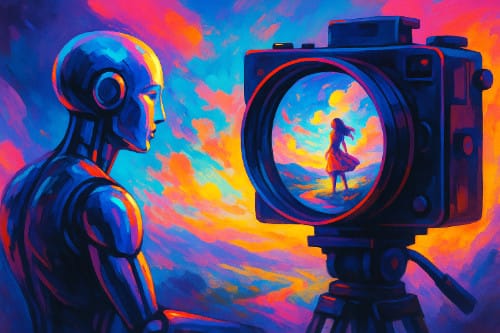
Every once in a while, a new technology feels less like an upgrade and more like an awakening. OpenAI’s Sora 2 is one of those moments. It doesn’t just generate video; it thinks in motion. Watching what it creates feels a bit like watching imagination learn how to use a camera.
When the first Sora appeared, it impressed people by turning short text prompts into moving images. But those clips felt like experiments: flashes of brilliance without continuity. Sora 2 is different. It connects scenes, sustains emotion, and follows light and logic the way a cinematographer would. For artists and filmmakers, it’s thrilling and unsettling all at once.
What Sora 2 Really Does
Sora 2 takes ordinary language and builds living, breathing video from it. You describe what you want — “a child chasing a red balloon through a rainy Paris street” — and Sora 2 delivers it in cinematic realism. Shadows stretch naturally. The camera tracks smoothly. The emotion holds.
What sets it apart is continuity. Earlier AI models could create five-second wonders but stumbled on sequences that needed flow. Now, Sora 2 handles longer scenes with believable transitions and consistent characters. It’s the difference between a flipbook and a film.
There’s also a new sense of interpretation. The model doesn’t just render what you type; it infers intent. It knows the tone behind the words and applies it to movement, light, and pacing. It’s like working with a gifted assistant who understands not just what you asked for, but what you meant.
From Tools to Creative Partners
Sora 2 changes our relationship with technology. For the first time, we’re not operating a machine; we’re directing it. You give guidance; it composes. That’s a quiet revolution in creativity.
When digital music first appeared, purists said it wasn’t “real” composition. Sampling, looping, and digital mixing felt like shortcuts. Yet those tools ended up expanding music itself. Sora 2 is the same kind of inflection point. It doesn’t eliminate artistry; it amplifies it. The keyboard becomes the director’s notebook, and language becomes the new lens.
Still, there’s a question that lingers: when an AI captures the rhythm of emotion, who’s the artist? That question isn’t a flaw. It’s the beginning of a new kind of authorship.
A Shift in Creative Work
For solo creators and small studios, Sora 2 is a windfall. You no longer need expensive cameras or editing suites to make compelling visuals. Storyboard, prompt, refine; that’s your workflow.
Educators can illustrate lessons instantly. Small brands can craft professional ads in an afternoon. Artists can test entire visual ideas without ever renting a light or scouting a location.
For larger studios, the news is more complicated. Routine work will likely move to AI generation. But that doesn’t mean the creative industry disappears. It evolves. The focus shifts from producing what everyone can make to telling what only you can.
Creativity, in other words, moves up the ladder. The new scarcity isn’t content; it’s perspective.
The End of Stock Footage
The stock video industry is quietly trembling. If anyone can generate a perfect “sunset surfer” clip in five seconds, who’s paying $300 for the licensed version? AI footage will outcompete traditional stock for speed, cost, and flexibility.
But something valuable may emerge in its place: authenticity. As synthetic media floods the web, “real” imagery will carry cultural weight again. Stock libraries could evolve into curators of truth, certifying what’s human-made, not machine-made. It’s ironic, but authenticity might soon become the new luxury.
Meanwhile, creators everywhere gain access to visual power once reserved for film studios. A travel vlogger could pre-visualize destinations. A journalist could reconstruct events for clarity. A teacher could animate an ancient civilization for tomorrow’s class. The visual language of the internet is about to grow richer — and noisier.
Learning to Watch Critically
As visuals become indistinguishable from reality, we’ll need to rethink trust. “Seeing is believing” no longer works. The realism of Sora 2 makes the term deepfake feel outdated.
The answer isn’t panic; it’s literacy. We’ll learn to watch the way we learned to read critically online. We’ll judge sources, not pixels. Truth will depend on credibility, not appearance. Over time, society adapts and this generation will develop sharper eyes and better instincts about what to believe.
Technology challenges perception, but it also refines it. In that sense, Sora 2 might be as much a teacher as a tool.
Blending the Creative Ecosystem
Sora 2 doesn’t stand alone. It fits into a growing ecosystem where AI and traditional software cooperate. You can imagine writing your story outline in ChatGPT, creating scenes in Sora, and finishing the cut in DaVinci Resolve.
This is where it gets exciting. The act of filmmaking becomes more like sketching with light. You draft ideas, see them unfold, and adjust. The process feels intuitive, almost playful. In that shift lies a profound truth: creativity is returning to spontaneity. Tools that once slowed us down are starting to disappear into the background.
Language is becoming the universal interface. You don’t have to master complex software; you just have to imagine clearly and describe it well.
Beyond Art and Film
It’s tempting to think of Sora 2 as just an art tool, but its implications go further. Teachers could generate immersive lessons in seconds. Therapists might use personalized visuals to help clients process memories. Historians could recreate events lost to time. Scientists could visualize complex processes instead of describing them abstractly.
When visualization becomes effortless, understanding expands. Sora 2 may quietly become one of the most educational tools of the decade; not because it entertains, but because it helps us see ideas come alive.
The Weight of Infinite Choice
All creative revolutions bring new responsibilities. When anyone can generate anything, the measure of creativity becomes intent. The power is no longer in the making, but in the meaning.
The best artists will be those who choose carefully, who use the infinite canvas to tell something true. In the coming years, originality will depend less on novelty and more on discernment.
Sora 2 doesn’t just extend what technology can do. It expands what we imagine possible. Watching it work feels a little like watching the future assemble itself, frame by frame.
The tool is here. The imagination is infinite. What we do with it will say everything about us.