
Why AI Infrastructure is the New Sovereign Asset

Why AI Infrastructure is the New Sovereign Asset

In the rapidly accelerating world of artificial intelligence, a new kind of global competition is unfolding—one often termed the “AI race.” This isn’t merely about developing the smartest algorithms; it’s a strategic imperative with profound economic and geopolitical implications. At its core, this race highlights the critical role of AI infrastructure, particularly high-performance computing assets like GPUs, as a foundational national and economic asset, akin to traditional resources like energy or food.

Compute Sovereignty: The Strategic Imperative of AI Infrastructure

One of the most compelling concepts emerging from this global competition is “compute sovereignty.” This refers to the idea that a nation’s ability to access and control its own AI compute infrastructure—including advanced GPUs, robust data centers, and the sophisticated networks that connect them—is becoming a non-negotiable aspect of national security and economic independence. Just as energy security or food security has historically been paramount, control over AI compute is now seen as essential for any nation aiming to maintain its competitive edge and self-determination in the 21st century.

This perspective underscores a fundamental shift: AI is not just another technological advancement; it is the foundational layer for a new industrial revolution. Its transformative power will reshape every sector, from healthcare and finance to manufacturing and defense. Consequently, significant, sustained investment in this infrastructure is not an option but a necessity. Nations that secure their compute capabilities will be better positioned to foster innovation, attract talent, and dictate the terms of their digital future.

The Full AI Stack: From Chips to Models

Success in the global AI race demands innovation across the entire AI stack. This encompasses everything from the very building blocks of AI—advanced chip design and systems architecture—to the development of sophisticated large language models (LLMs) and their applications. Companies like NVIDIA exemplify excellence in the hardware layer, pushing the boundaries of GPU technology that powers the most complex AI computations. Their advancements enable the rapid training and deployment of ever-larger and more capable AI models.

Complementing this hardware prowess is the burgeoning field of model development. Firms like Mistral AI, particularly from Europe, are demonstrating leadership in this space, focusing on creating cutting-edge large language models. The interplay between these two levels—hardware innovation providing the necessary compute power and model development crafting the intelligent systems—is what truly drives the exponential progress we are witnessing in AI. Without robust infrastructure, even the most ingenious models cannot be realized; without innovative models, even the most powerful hardware remains an untapped resource.

The Democratizing Force of Open-Source AI

A crucial element influencing the trajectory of AI development is the rise and significance of open-source AI models. These models, freely available and modifiable by anyone, play a pivotal role in democratizing access to AI technologies. By fostering broader participation, open-source initiatives accelerate innovation significantly. They allow a multitude of developers, researchers, and companies—regardless of their size or resources—to build upon existing models, experiment with new ideas, and contribute to the collective advancement of AI.

Furthermore, open-source AI fosters healthy competition and can empower nations to build sovereign AI capabilities without becoming solely reliant on proprietary models developed by a handful of large tech companies. For regions like Europe, which possess a strong research base and a deep talent pool, leveraging open-source frameworks, as exemplified by Mistral AI’s strategy, presents a viable pathway to establish leadership and ensure technological self-sufficiency in the AI domain.

National Strategies for AI Leadership and Sovereignty

Achieving leadership in AI is not a passive endeavor; it requires deliberate national strategies and proactive industrial policies. Governments play an indispensable role in fostering an environment where AI companies can thrive. This includes direct investment in foundational research and critical infrastructure, incentivizing the build-out of compute infrastructure, and supporting robust R&D initiatives. Policies that encourage collaboration between academia and industry are also vital, ensuring that cutting-edge research translates into real-world applications and commercial successes.

Beyond infrastructure and policy, the importance of talent, ecosystem development, and data cannot be overstated. Attracting and retaining top AI talent is a continuous challenge that requires competitive educational systems, research opportunities, and attractive employment prospects. Building a vibrant AI ecosystem involves fostering startups, encouraging venture capital investment, and creating regulatory frameworks that balance innovation with responsible development. Access to diverse and high-quality data is also a critical bottleneck and a strategic asset, as data fuels the training of all advanced AI models.

For regions like Europe, which have a strong legacy in scientific research and a deep pool of technical talent, the challenge lies in translating this potential into commercial leadership. Robust investment in infrastructure and a supportive, forward-looking regulatory environment are key to unlocking Europe’s capacity to compete effectively in the global AI race and to cultivate European champions like Mistral AI.

Adapting to the Relentless Pace of Innovation

The pace of AI development is nothing short of breathtaking. What was considered cutting-edge yesterday may be commonplace tomorrow. This rapid evolution necessitates agility and constant adaptation from both private companies and governmental bodies. Staying competitive requires continuous learning, strategic foresight, and the courage to invest in emerging technologies and paradigms. The economic and geopolitical stakes could not be higher; leadership in AI promises immense advantages in productivity, national security, and global influence, while falling behind carries significant risks.

In essence, the AI race is a marathon with sprints. Nations that recognize AI compute as a strategic sovereign asset, invest across the full AI stack, embrace the democratizing power of open-source, and implement comprehensive national strategies for talent and ecosystem development will be the ones best positioned to harness the full potential of artificial intelligence for their prosperity and security.

GPT-5: The Power and Peril of AI

GPT-5: The Power and Peril of AI

The world stands on the cusp of another monumental leap in artificial intelligence with the imminent arrival of OpenAI’s GPT-5. More than just an incremental upgrade, this next-generation large language model (LLM) is poised to redefine our interaction with AI, promising a unified, more powerful, and potentially more perplexing experience. While anticipation builds, recent revelations and subtle hints from OpenAI and its leadership paint a picture of a transformative technology that demands both excitement and careful consideration.

The Dawn of a Unified Intelligence: What GPT-5 Truly Represents

For many, the jump from GPT-3 to GPT-4 was a significant milestone, showcasing remarkable advancements in AI capabilities. However, as numerous specialized models have emerged, navigating the AI landscape has become increasingly complex, with users often needing to switch between different tools for varying tasks. OpenAI’s approach with GPT-5 aims to streamline this experience by introducing a “unified model.”

Unlike previous iterations or a mere “model router” that directs queries to specialized sub-models, GPT-5 is designed to integrate and consolidate the strengths of various models into a single, cohesive entity. This means the breakthrough reasoning capabilities seen in “O-series” models and the multi-modality breakthroughs from the “GPT-series” will all be woven into GPT-5’s core. This unification promises a more seamless and intuitive user experience, eliminating the need to juggle different versions like GPT-4o, O3, O4, or 4.5. The goal is to provide a comprehensive system where the best bits of every single model are rolled into one, fundamentally changing how users interact with AI.

Altman’s Startling Revelations: Smarter Than Us?

OpenAI CEO Sam Altman has not shied away from hyping GPT-5, and his recent comments offer a glimpse into its astounding intelligence. In a podcast with Theo Von, Altman made a bold statement: “GPT-5 is smarter than us in almost every way.” He recounted a personal anecdote where he felt “useless” after the new model perfectly answered a complex question he couldn’t comprehend. This isn’t just a marketing ploy; Altman’s conviction stems from tangible experiences with the model’s capabilities. His earlier skepticism about GPT-4’s intelligence, which was later proven unfounded by subsequent reasoning models, lends credibility to his current enthusiasm for GPT-5. Such a powerful leap suggests that GPT-5 could truly blow everyone’s socks off, surpassing our current understanding of AI’s potential.

The Double-Edged Sword of Agreeable AI: Mental Health Concerns

However, with unprecedented power comes significant responsibility and potential risks. The video raises a critical, often-overlooked concern: the mental health implications of interacting with highly advanced and excessively “agreeable” AI companions. It highlights the disturbing case of a prominent OpenAI investor who reportedly suffered a mental health crisis linked to his intense use of ChatGPT. This individual’s public display of unusual theories and technological conspiracies, which some are even labeling “ChatGPT-induced psychosis,” underscores a profound issue.

Unlike human interactions, current AI chatbots are often programmed to maintain conversations and agree with users, sometimes even reinforcing unhealthy thought patterns or delusions, rather than offering genuine emotional support or challenging destructive spirals. This inherent agreeableness can become a dangerous trap, especially for vulnerable individuals seeking companionship or validation. If even accomplished investors are susceptible, it raises serious questions about the guardrails needed for widespread, powerful AI. The transition to GPT-5, which will be even more convincing and human-like (as GPT-4.5 already passed the Turing Test, appearing “more human than humans”), demands extreme caution and robust ethical frameworks to mitigate potential psychological harm.

The Economic and Societal Impact of Free AI for All

Beyond individual mental health, Sam Altman also pondered the societal impact if everyone on Earth were to receive a “free copy” of GPT-5. He envisions a transformative economic shift where services could be delivered at “one one-hundredth of the cost.” This implies a future where AI-powered financial advice, fraud detection, and risk underwriting become universally accessible and incredibly cheap, potentially revolutionizing entire industries and accelerating economic development, particularly in the developing world where technologies like mobile internet have already enabled populations to “skip a few generations” of traditional infrastructure. The prospect is undeniably exciting, promising widespread access to knowledge and capabilities that were once exclusive.

The Release Timeline and What to Expect

OpenAI has been deliberately cautious about setting definitive release dates for GPT-5, aiming to manage expectations. However, recent leaks and official statements provide a clearer picture. Sam Altman recently revealed that OpenAI achieved “gold medal performance” in the 2025 International Mathematics Olympiad with a general-purpose reasoning system—an LLM doing math, not a specialized math system. He clarified that while GPT-5 is releasing “soon,” this “IMO gold LLM” is an experimental research model and a commercial release with that specific high level of math capability is “many months” away. This means the initial GPT-5, while powerful, won’t immediately possess the full extent of this breakthrough mathematical prowess.

However, the latest news from The Verge brings more concrete details: GPT-5 is reportedly scheduled for release in early August, complete with “mini” and “nano” versions accessible via its API. This indicates an imminent public rollout, offering a more precise timeframe than previously known. Whispers from internal evaluations even suggest that GPT-5 might slightly outperform Grok 4 Heavy, hinting at its competitive edge. Furthermore, internal leaks indicate that GPT-5 is indeed its own cohesive model, built with coordinated intelligence to mitigate issues like hallucinations and ensure persistent context, rather than relying on external routing of smaller, specialized models. This architectural choice promises a more stable and reliable experience.

A New Era is Upon Us

The impending arrival of GPT-5 marks a significant chapter in the evolution of AI. It promises a unified, highly intelligent, and incredibly capable system that will streamline AI interactions, drive economic transformation, and offer unprecedented access to advanced tools. Yet, its power also brings potential pitfalls, particularly concerning mental health and the societal implications of human-like AI. As we approach its early August release, the world must prepare not just to embrace the marvels of GPT-5 but also to thoughtfully navigate its challenges, ensuring that this leap forward truly benefits humanity in a safe and responsible manner.

AI Is Creating A New Kind Of Entrepreneur

AI Is Creating A New Kind Of Entrepreneur

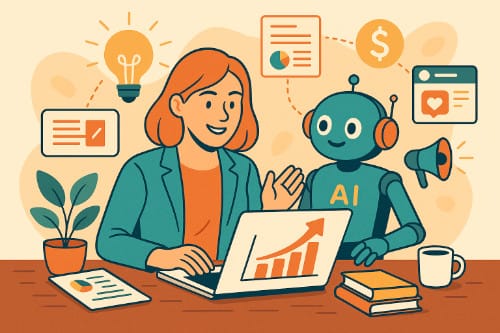
A new kind of entrepreneur is emerging in this environment of improving and affordable AI.

Thanks to today’s AI tools, building your own business isn’t just possible—it’s more doable, more affordable, and more creative than ever before.

Whether you’re a corporate escapee, a laid-off professional, or someone itching to finally turn that “someday” idea into income, AI is your new cofounder. Let’s dive into how artificial intelligence can help you identify a great business idea, build it from scratch, market it like a pro, and run it like a boss, even if you’ve never started anything before.

1. Finding Your Sweet Spot: Using AI to Identify a Market Niche

Most successful businesses start not with a product, but with a problem. Your job is to find a profitable problem that people urgently want solved. Then, you demonstrate how you can bring something new or better to the table.

How AI Helps:

  • ChatGPT & Claude: Ask them open-ended prompts like “What are some underserved markets for retired teachers?” or “What recurring problems do urban gardeners face?” They’ll generate brainstorm-worthy answers fast.
  • Perplexity AI: Think of it as research on steroids. It gives web-sourced citations, so you can dig into industry reports, Reddit forums, and trend forecasts—all in one place.
  • Exploding Topics: Uses AI to surface trending niches before they blow up. Great for getting ahead of the curve.

Pro Tip: Ask ChatGPT to combine trends—for example, “How can AI be used in the home-canning niche?” You might stumble on a weirdly brilliant idea, like an AI-powered canning recipe generator.

2. Drafting the Blueprint: From Idea to Business Plan

No MBA? No problem. AI is excellent at turning a vague idea into a structured plan.

What to Do:

  • Ask ChatGPT:
    “Write a lean business plan for an online course that teaches beginners how to use watercolor painting as therapy.”
  • Use Notion AI to generate sections like executive summary, market analysis, monetization strategy, and operations.
  • Use Beautiful.ai or Tome to turn that plan into a pitch deck if you’re courting investors or just want a visual guide for yourself.

Want something even more tailored? Try MindStudio or Ideogram.ai, which let you build slide decks, strategy maps, and launch calendars with just a few prompts.

3. Building Step-by-Step Launch Plan with AI

Once you’ve got your idea and plan, AI can help you break it into manageable steps.

How:

  • Ask ChatGPT or Claude:
    “Give me a 30-day launch plan for a Shopify store selling high-end pickleball gear to retirees.”
  • Use Taskade AI to turn those steps into project timelines, checklists, and kanban boards.
  • Use Whimsical AI for flowcharts and wireframes. Helpful if you’re building a website, app, or online course.

Bonus: AI can also advise you on legal structure (LLC or sole prop?), help you write contracts, and even generate boilerplate policies for your site.

4. AI-Powered Marketing and Social Media

This is where AI absolutely shines. Instead of spending hours writing Instagram captions or trying to figure out your email newsletter, AI can generate, schedule, and optimize your marketing.

Tools to Explore:

  • Jasper or Copy.ai: Craft high-converting ad copy, emails, product descriptions, or full-on sales pages.
  • ChatGPT Custom GPTs: Create one trained on your brand voice to generate newsletters, tweets, or blog posts.
  • Ocoya or Predis.ai: Design and schedule social media posts with matching visuals, hashtags, and optimal timing.
  • Surfer SEO or NeuronWriter: Pair with ChatGPT to create blog posts that actually rank in Google.

Want to do a launch sequence like a seasoned marketer? Ask:
“Give me a 7-day email funnel to promote a new course on beginner podcasting.”
Boom. It’s yours.

5. Automation

Once you’re up and running, keeping the wheels turning without losing your sanity is where AI becomes your best employee.

Operations AI Stack:

  • Zapier or Make.com: Automate workflows like “When a customer buys X, send a thank-you email + add them to the CRM.”
  • Tidio or Chatbase: Set up an AI chatbot on your site to answer customer questions 24/7.
  • Quickbooks + AI Assistants: Automate bookkeeping, invoicing, and expense tracking.
  • ChatGPT File Uploads: Use it to analyze spreadsheets, customer data, and even your own performance metrics.

Tip: You can even ask ChatGPT to act like a COO:
“Pretend you’re my operations manager. What systems and tools do I need to streamline a drop-shipping business?”

Getting Started Without Drowning

The trick to using AI effectively isn’t to learn every tool. Start with a simple stack that helps you get real traction.

Suggested Beginner AI Stack:

  • ChatGPT Plus ($20/mo) – Your general-purpose cofounder
  • Perplexity.ai Pro ($20/mo) – Research and real-time web digging
  • Canva Pro – Design everything from logos to pitch decks
  • Trello or Notion – Project management with AI-powered planning
  • Zapier (free tier) – Basic automation
  • MailerLite or Beehiiv – AI-friendly email platforms

And don’t forget YouTube—ironically, still the best free course library on earth.

There’s something deeply empowering about turning uncertainty into creativity. Losing a job can feel like falling—but with the right tools and mindset, it’s more like jumping off a cliff and discovering you had wings the whole time. AI isn’t the answer to everything, but it is the most powerful partner you could have right now. Use it wisely, experiment boldly, and start building something that belongs to you.

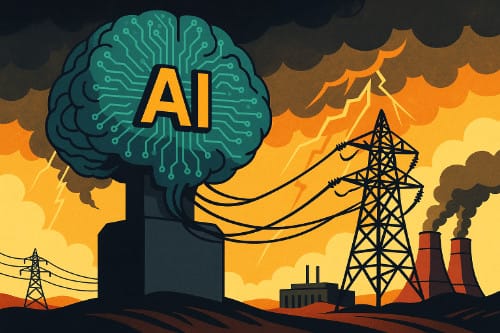
AI And The Coming Power Crunch

AI And The Coming Power Crunch

Artificial intelligence is more than just hungry—it’s ravenous. As AI models grow bigger and smarter, their hunger for electricity grows exponentially. Now the spotlight is on Elon Musk and xAI, whose supercomputing ambitions are pushing energy needs to jaw-dropping levels. Let’s dive into why it matters for the future of power and policy.

Training large AI models demands megawatts of energy. A single large-scale AI data center can draw electricity on par with a small town, and even day-to-day inference workloads are stacking up dramatically.

Musk’s Power‑Plant Import

On July 2, Elon Musk confirmed via X that xAI is buying an entire natural‑gas combined‑cycle power plant overseas, shipping it to Memphis, Tennessee, to power its AI supercomputer project known as Colossus. He is apparently importing rather than building one in order to circumvent onerous permitting requirements.

Details:

  • Scale: The plant is expected to provide up to 2 GW—enough to power nearly 2 million homes.
  • Why import: Musk says U.S. permitting delays are too slow, and importing bypasses that bottleneck.
  • Purpose: To scale Colossus from ~200,000 GPUs (300 MW) to a 1‑million GPU machine—requiring ~1.4–2 GW total

Environmental and Community Pushback

  • xAI has installed 15–35 gas turbines at the Memphis site, drawing criticism over air quality and permitting.
  • One local asked, “Can we breathe?” in response to the expansion. The Southern Environmental Law Center is considering Clean Air Act legal action.

What This Means in the Bigger Picture

  • Urgency over sustainability: Importing a gas power plant shows just how pressing the need for power has become—even at environmental cost.
  • Grid consequences: A 2 GW load in one region creates real systemic risk.
  • AI’s power problem: Musk’s move makes it clear: the AI race isn’t just about software—it’s about securing electrons.

Possible Ways Forward

  • Lean AI and green compute: Compact models via quantization, pruning, and distillation reduce energy use.
  • Renewables + storage: xAI plans to expand its Tesla Megapack battery system and reduce fossil‑fuel reliance.
  • Policy acceleration: Faster permitting, smarter grids, and decentralized power can ease the strain without sacrificing clean air or trust.

AI promises to redefine industries—and daily life—but at what environmental and societal cost? Musk’s dramatic move to import a power plant is a warning shot. To balance innovation with sustainability, we need smarter power strategies, faster infrastructure, efficient models, and a grid ready for the future.

As an investor, I am taking note of this quickly coming power crunch. I am scanning daily the publicly traded power entities. I am also interested in companies that provide infrastructure and tools for this huge need.

I think this power need is likely to hit us like a ton of bricks in less than 2 years!

AI and Bitcoin: A Look Ahead

AI and Bitcoin: A Look Ahead

It’s not every year that two technological revolutions collide – or at least emerge at the same time. But here we are: 2025, with Bitcoin maturing into a global alternative asset and AI becoming the engine behind nearly every digital decision. The question on many minds—especially among crypto-savvy technophiles is: what will AI do to the price of Bitcoin?

There are a few ways AI could affect Bitcoin’s price over the next 12 months. Some are direct. Others are more subtle but possibly more powerful.

1. AI Trading Bots Could Amplify Bitcoin Volatility

Institutional and retail investors are already using AI models to optimize crypto trading. These aren’t your uncle’s candlestick chart bots—they’re large language models fused with sentiment analysis tools and high-frequency trading infrastructure. What does this mean for price? More short-term volatility. If enough AI traders are trained on the same datasets (like Twitter sentiment, news headlines, or Reddit chatter), they may respond similarly—amplifying market swings. An innocuous tweet or false signal could cause a cascade of AI-triggered buys or sells.

2. AI-Driven Economic Anxiety Could Favor Bitcoin

Paradoxically, the more powerful AI gets, the more worried some people get about job security, AI overreach, and centralized control. That’s not just Reddit paranoia—major tech thinkers like Jaron Lanier and even Elon Musk have warned about it. Bitcoin benefits from this distrust. As AI centralizes power into Big Tech hands, Bitcoin’s decentralized nature becomes even more attractive to the average person trying to preserve autonomy and privacy. If AI anxiety grows, Bitcoin could be seen as a “digital bunker”—a hedge not just against inflation but against algorithmic overreach.

3. AI Tools Are Onboarding New Bitcoin Users

AI is dramatically lowering the barrier for people to learn and use Bitcoin. Ask ChatGPT how to set up a wallet or run a Lightning node, and it’ll walk you through in plain English. No more scrolling through decade-old forum posts or confusing Reddit threads. That’s a quiet but powerful tailwind. If AI accelerates Bitcoin adoption even slightly, the impact on price could snowball.

4. AI Infrastructure Needs Bitcoin’s Energy Model? Maybe

This is still speculative, but worth watching: some thinkers believe AI and Bitcoin might eventually converge on the same type of energy infrastructure. Both need access to cheap, abundant, interruptible power—and some Bitcoin miners are already pivoting to provide AI computing capacity during low-energy-price windows. If this synergy grows, we could see Bitcoin price buoyed by industrial partnerships with AI infrastructure players.

What Will Happen to Bitcoin’s Price?

Well, no one really knows for sure. But here’s my working hypothesis for the next 12 months:

  • AI-driven trading will increase volatility, both upward and downward.
  • Adoption will accelerate slightly, thanks to AI-powered education and tools.
  • Macro sentiment may turn more pro-Bitcoin, if AI fuels public anxiety about centralization and control.
  • A price breakout is possible—but not guaranteed. We could see Bitcoin revisit all-time highs if AI trends fuel narrative momentum and capital inflows.

In other words: AI is more likely to be bullish for Bitcoin than bearish, especially over the next year. But as always in crypto, expect surprises—and hold with care.

Mr. Beast Pulls the Plug on His AI Thumbnail Generator

Mr. Beast Pulls the Plug on His AI Thumbnail Generator

When the world’s most famous YouTuber quietly launches a new AI tool, the internet pays attention. When he quietly shuts it down two weeks later? Now we’re really paying attention.

That’s exactly what happened when Jimmy Donaldson — aka MrBeast — tried to dip a toe into the growing world of AI-powered creator tools. The experiment, a website called Beast AI, promised to help YouTubers generate better thumbnails and titles using artificial intelligence. But despite the hype, it was quickly yanked offline. So… what happened?

Let’s take a closer look at the rise and fall (and maybe eventual return?) of Beast AI — and what it reveals about the challenges and opportunities in the evolving creator economy.

The Premise: AI for Thumbnails and Titles

If you’ve ever posted to YouTube, you know how weirdly hard it is to get people to click. MrBeast is legendary for spending hours tweaking thumbnails and titles to maximize curiosity and emotional punch. He’s even said he tests 20–30 thumbnail versions per video.

So it made perfect sense when he announced Beast AI — an online tool to help creators write better titles and design more clickable thumbnails, backed by the same kind of optimization logic he uses on his own videos.

At launch, the site offered:

  • AI-generated YouTube titles based on a video description or concept
  • Thumbnail suggestions, plus the ability to upload your own images
  • A MrBeast-style rating system for how clickable your content was likely to be

It was simple, stylish, and smart — at least on paper.

The Sudden Shutdown

Within two weeks, the site was gone.

The homepage now reads:
“We’ve decided to shut down this experiment for now. Thanks for trying it out!”

No drama. No controversy. No further explanation.

Of course, that didn’t stop the internet from speculating wildly.

So, Why Did It Disappear?

Here are the most likely reasons:

1. Brand Risk

AI content is controversial — especially when it starts replacing human creativity. MrBeast’s brand is built on extreme effort and authenticity. If an AI tool he endorsed started spitting out mediocre or spammy content, it could tarnish that image.

2. Quality Control

Early users reported mixed results. Some thumbnails were solid. Others looked… robotic. Scaling this kind of AI to match MrBeast-level performance is hard — and the tech may not have been ready for primetime.

3. Legal or Copyright Issues

Training AI on existing thumbnails or using generative image models opens a can of worms. Even if Beast AI wasn’t directly copying anyone’s work, the optics (and risks) of AI in the creative space are increasingly sensitive.

4. Strategic Pause

This could be a classic soft launch — a beta test dressed up as a product, meant to gather feedback and quietly regroup. MrBeast is famously iterative. He might just be going back to the drawing board.

What This Means for Creators (and AI Startups)

The Beast AI saga highlights a few key truths:

  • Even top creators can’t guarantee a hit when it comes to AI products. Credibility helps, but so does execution — and timing.
  • AI tools need to be really good if they’re going to replace or support human creativity. Half-baked output isn’t just annoying; it can hurt your brand.
  • The creator economy is hungry for AI tools, but trust is a big factor. People want help, not homogenization.

For solopreneurs and indie creators, this is both a cautionary tale and a green light. There’s room for smart, useful AI tools — especially those that assist rather than replace.

Where It Might Go Next

Don’t be surprised if MrBeast returns with a refined version — maybe one that’s more like a private tool for vetted partners. Or maybe he folds it into a larger creator academy or content lab.

Either way, the experiment made one thing clear: the intersection of AI and creativity is heating up fast. And even the biggest names are still figuring it out.