by Patrix | Aug 4, 2025
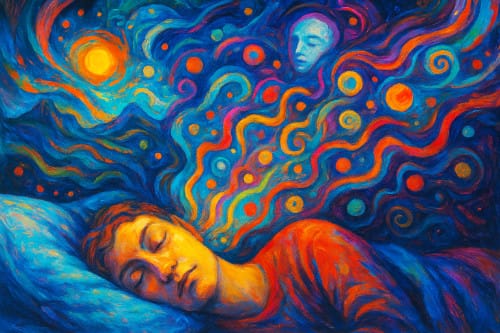
Ever had that dreamy moment when you’re just starting to doze off, and suddenly your mind floods with strange images, sounds, or ideas that seem to come from nowhere? Maybe it felt like falling, or maybe you heard your name called out from the void—only to realize you’re still half-awake. Welcome to the weird and wonderful world of hypnagogia, the twilight state between wakefulness and sleep.
It’s a mental borderland where creativity blossoms, logic loosens, and the subconscious starts stretching its legs. Artists, inventors, and philosophers have long dipped into this semi-dream state for inspiration. And now, in a world driven by sleep science, cognitive hacking, and AI, hypnagogia is making a comeback.
What Is Hypnagogia?
Hypnagogia (pronounced hip-nuh-GO-jee-uh) refers to the transitional state your brain enters as you fall asleep. It’s the soft descent from conscious awareness to unconscious dreaming. Unlike REM sleep (when dreams get cinematic), hypnagogia tends to be more fragmentary, fleeting, and surreal—like the mind whispering to itself just before the lights go out.
Neuroscientifically, it’s marked by changes in brainwave activity: your alert beta waves start to give way to slower alpha and theta waves. You’re no longer fully awake, but not quite asleep either.
This state is often rich in:
- Visual hallucinations: Shapes, colors, faces, landscapes
- Auditory distortions: Echoes, single words, music, or whispers
- Physical sensations: The infamous “falling” feeling or sleep starts (called hypnic jerks)
- Creative thoughts: Sudden insights or strange mental associations
In other words, hypnagogia is a temporary suspension of the rules—your usual mental filters go offline just long enough for your inner world to get weird.
History’s Most Famous Half-Asleep Thinkers
Many brilliant minds throughout history have tapped into the hypnagogic state as a wellspring of creative insight.
- Salvador Dalí used what he called “slumber with a key”: he’d nap in a chair while holding a metal key over a plate. As he drifted off and dropped the key, the clatter would wake him—allowing him to grab whatever surreal images floated through his mind.
- Thomas Edison reportedly used a similar technique with ball bearings, a chair, and a tin plate. He believed this liminal state was the gateway to his best ideas.
- Mary Shelley, author of Frankenstein, described seeing her famous monster in a waking dream—not quite asleep, not quite awake.
- August Kekulé, a 19th-century chemist, had a hypnagogic vision of a snake biting its own tail—which led him to realize the ring structure of the benzene molecule.
What Happens in the Brain During Hypnagogia?
Brain imaging studies show that during hypnagogia, activity in the default mode network (DMN) ramps up. This part of the brain is associated with daydreaming, self-reflection, and internal narrative. Simultaneously, areas responsible for sensory processing remain semi-active, which explains why hypnagogic visions and sounds feel so vivid.
It’s also a time when executive function—the brain’s taskmaster—lets down its guard. That’s why your thoughts might jump from an old memory to a strange image to a new idea, all in a matter of seconds. It’s nonlinear, associative thinking at its finest.
Can You Use Hypnagogia for Creativity?
Yes—and people are doing it.
Some creatives actively try to induce hypnagogia through intentional napping, meditation, or lucid dreaming techniques. Here are a few practical ways to experiment:
1. Hypnagogic Journaling
Lie down with a journal nearby. As you begin to doze, try to stay aware of the images or phrases that come to mind. The moment you jerk awake or stir, jot down anything you remember—no matter how odd.
2. The Dalí Method (with a modern twist)
Try holding a small object—like a spoon or coin—in your hand while resting in a chair. Place a metal or ceramic plate underneath. As you drift off and drop the object, the sound will wake you. Capture whatever you saw or thought about.
3. Audio Triggers
Some people use soft ambient music, binaural beats, or even AI-generated soundscapes to help ease into the hypnagogic zone. Apps like Endel, Brain.fm, or YouTube’s sleep music loops can help coax the brain into theta territory.
Why Hypnagogia Matters in an Age of Hyper-Productivity
In a culture obsessed with productivity hacks, attention spans, and the “optimization” of every waking moment, hypnagogia is a gentle rebellion. It’s a reminder that creativity doesn’t always emerge from grinding harder—it can come from surrender, softness, and liminal mental space.
AI is increasingly being trained to simulate aspects of human creativity, but it’s the irrational, fluid, dreamlike logic of states like hypnagogia that remain uniquely human—for now. In fact, some researchers are studying hypnagogic imagery as a model for how future AI might mimic human associative thinking.
At the same time, scientists are looking into the potential therapeutic benefits of this state. Some early work suggests it might help in processing trauma, enhancing memory, or even supporting problem-solving during sleep onset.
Next time you’re nodding off and a bizarre image flashes across your mind—don’t shrug it off. That may just be your subconscious offering up a sliver of wisdom wrapped in weirdness.
Hypnagogia is a liminal zone, a soft corridor between two worlds. You don’t have to sleep through it. You can explore it, learn from it, and maybe even create something wonderful while dancing on the edge of dreaming.
by Patrix | May 31, 2025
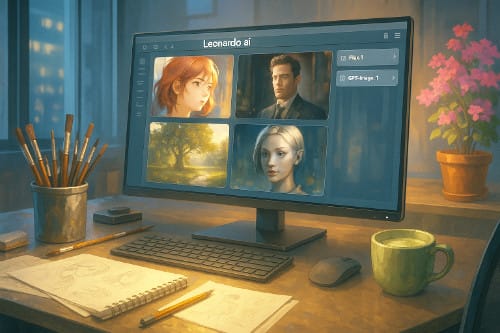
Leonardo.ai has rapidly become a go-to platform for creatives exploring AI-generated imagery. Its strength lies in offering a diverse suite of models tailored to various artistic needs all in one place. Particularly interesting to me is the recent addition of Black Forest Lab’s Flux.1 Kontext model and the GPT-Image-1 model. These 2 alone greatly enhance Leonardo’s capabilities, providing users with advanced tools for image generation.
I’m a bit of an AI image generation junky, so I burned through my free credits in 10 minutes. But Leonardo.ai offers a reasonable paid plan at $12 a month that provides enough credits to get your feet wet.
Leonardo.ai’s Model Lineup
Leonardo.ai offers a range of models, each designed for specific styles and outputs:
- Leonardo Lightning XL: A high-speed generalist model suitable for various styles, from photorealism to painterly effects.
- Leonardo Anime XL: Tailored for anime and illustrative styles, delivering high-speed, high-quality outputs.
- Leonardo Kino XL: Focuses on cinematic outputs, excelling at wider aspect ratios without requiring negative prompts.
- Leonardo Vision XL: Versatile in producing realistic and photographic images, especially effective with detailed prompts.
- Leonardo Diffusion XL: An evolution of the core Leonardo model, capable of generating stunning images even with concise prompts.
- AlbedoBase XL: Leans towards CG artistic outputs, offering a generalist approach with a unique flair.
Introducing Flux.1 Kontext and GPT-Image-1
Leonardo.ai’s recent integration of Flux.1 Kontext and GPT-Image-1 models marks a significant advancement in AI image generation:
Flux.1 by Black Forest Labs
Flux.1 is renowned for its photorealistic outputs and prompt adherence. Developed by Black Forest Labs, it offers multiple variants:
- Flux.1 Schnell: An open-source model under the Apache License, providing fast and efficient image generation.
- Flux.1 Dev: Available under a non-commercial license, suitable for development and testing purposes.
- Flux.1 Pro: A proprietary model offering high-resolution outputs and advanced features like Ultra and Raw modes, delivering images up to 4 megapixels with enhanced realism.
Flux.1’s integration into Leonardo.ai allows users to generate images with exceptional detail and accuracy, making it a valuable tool for professionals and hobbyists alike.
GPT-Image-1 by OpenAI
GPT-Image-1 introduces a novel approach by enabling multi-image referencing. Users can input up to five images, and the model intelligently combines elements from each based on textual instructions. This capability is particularly useful for creating composite images or blending styles and themes seamlessly.
Both Flux.1 and GPT-Image-1 are accessible through Leonardo.ai’s Omni Editor, offering users flexibility in creation and editing processes.
Why Choose Leonardo.ai?
Leonardo.ai stands out for its comprehensive suite of models catering to diverse creative needs. Whether you’re aiming for photorealism, anime-style illustrations, or cinematic visuals, Leonardo.ai provides the tools to bring your vision to life. The addition of Flux.1 and GPT-Image-1 further enhances its versatility, making it a robust platform for AI-driven image generation.
It’s nice to have a one-stop-shop for image generation. The only thing I’m worried about is burning through my credits in one day!
by Patrix | May 24, 2025
What if the future of art isn’t about machines replacing humans — but machines whispering strange, beautiful ideas into our ears? Yeah, that sounds a little creepy, but hear me out.
This is the path more artists are exploring as they embrace AI, not as a crutch, but as a muse. Amidst the controversy over AI-generated images that mimic living artists’ styles, a quieter revolution is happening. Creatives are using tools like ChatGPT, Sora, and Claude to provoke their own imagination, not outsource it.
Welcome to the new studio: part sketchpad, part silicon oracle.
The AI as Collaborator
Let’s be honest: it’s easy to feel threatened by AI’s ability to crank out music, images, and prose with disturbing speed. But what’s getting lost in the noise is how many artists are using these tools in a slower, more intimate way.
Think of ChatGPT not as an artist, but as a really intense, slightly surreal conversation partner. One who throws out wild metaphors, strange titles, unexpected color palettes, and story ideas that feel half-dreamed.
I once asked ChatGPT to give me names for imaginary art shows based on the theme “silence.” It came back with:
- The Geometry of Quiet
- Whispers of Secret Dreams
- Poetry of Butterflies
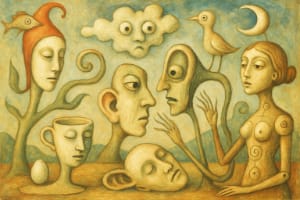
I then put “Whispers of Secret Dreams” into ChatGPT to create an image. This is what it created:

“Whispers of Secret Dreams”
Prompting as a Creative Ritual
Prompting a language model is part creative writing, part séance. Here are a few ways artists are using prompts as part of their daily practice:
For Writers:
- Ask for unusual metaphors for grief, joy, aging, or time.
- Request a dialogue between two imaginary creatures who live inside your closet.
- Generate random titles or first lines, then riff off them manually.
For Visual Artists:
- Feed it your own artist statement and ask it to give you surreal painting concepts based on your themes.
- Ask it to describe a dream landscape based on three emotions.
- Use it to “translate” music or poems into visual prompts.
For Musicians or Composers:
- Generate imaginary genres (“Ambient Baroque Punk” anyone?)
- Ask for a story or myth to base a suite or album around.
- Explore descriptions of unheard sounds, then try to recreate them.
In all cases, you’re not just accepting what the model spits out — you’re reacting to it, arguing with it, riffing off of it. Like jazz.
Real Artists Doing It Right
Some of my favorite examples of AI-as-muse come from creatives who treat it like a very peculiar studio assistant:
- A collage artist in Oregon who uses GPT to write poetic titles for their otherwise abstract pieces.
- A songwriter who brainstorms lyrics with Claude, then rewrites every single line to make it more personal.
- A digital painter who asks ChatGPT for “folk tales from a forgotten planet,” then illustrates them as storybook scenes.
None of them are blindly accepting the output. They’re wrestling with it. Which, honestly, is kind of the point.
The Soul Is in the Editing
If you’re worried about losing your creative identity to the machine — good. That worry means you care. It also probably means you won’t.
Because here’s the thing: real creativity doesn’t come from prompts. It comes from your response to the prompts. Your taste. Your weird inner logic. Your delight in breaking your own rules.
AI can offer the spark, but the fire? That’s yours.
Use the Machine For Your Art
If you’re an artist, you don’t have to reject AI outright. But you also don’t have to let it steal your spotlight. Use it like a mirror, a provocateur, a riddler.
Let it surprise you. Let it weird you out. Let it help you see something old in a new way.
But always remember: AI is not the artist. You are.
by Patrix | May 22, 2025
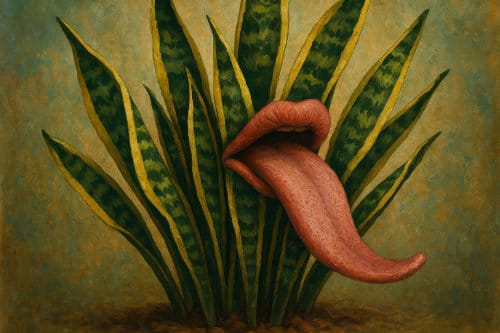
If you’re looking for a plant that checks all the boxes—easy to grow, nearly impossible to kill, purifies your air, and even produces oxygen at night—look no further than the Mother-in-Law’s Tongue, also known as the Snake Plant or Dracaena trifasciata (formerly Sansevieria trifasciata).
This sculptural beauty with its upright, sword-like leaves has earned a permanent spot in homes, offices, and minimalist design studios across the world. And it’s not just for looks. Let’s explore why this plant is more than just a pretty face.
A Champion of Air Purification
The Snake Plant was famously included in a NASA Clean Air Study, which found it capable of filtering out harmful indoor pollutants like:
- Formaldehyde (found in cleaning products and furniture)
- Benzene (from paints and plastics)
- Xylene and Toluene (from glues and varnishes)
While one plant won’t turn your home into a sterile lab, adding several can subtly improve indoor air quality—especially in enclosed spaces.
It Produces Oxygen
Unlike most plants that take a break from oxygen production when the sun goes down, the Snake Plant keeps working. Thanks to Crassulacean Acid Metabolism (CAM) photosynthesis, it opens its pores at night to absorb carbon dioxide and release oxygen.
This makes it one of the few plants that’s actually ideal for bedrooms. It quietly refreshes the air while you sleep.
Resilient and Nearly Indestructible
The Snake Plant thrives on neglect. That’s not a joke—it’s actually better to forget to water it than to overwater it.
- Watering: Every 2–4 weeks, depending on the humidity and temperature.
- Light: Prefers bright, indirect light but tolerates low light and even some direct sun.
- Soil: Needs well-draining soil—cactus or succulent mix is perfect.
- Pot: Use a pot with drainage holes to prevent root rot.
It’s drought-tolerant, pest-resistant, and adapts to a wide range of environments. Whether you live in a sun-drenched loft or a dim apartment, it won’t complain.
Easy to Propagate
Want more Snake Plants for free? You can easily propagate new plants from a single leaf. Just cut a healthy leaf, let the cut end dry for a day or two, and root it in water or soil. It’s a slow grower, but very rewarding.
One thing to note: if you’re propagating a variegated variety like Laurentii, the new plant may lose its yellow stripes. If you want an exact clone, use rhizome division instead of leaf cuttings.
Aesthetic Appeal
This plant adds structure and style to any room. Its tall, vertical form pairs well with modern, minimalist, or bohemian interiors. Whether potted in sleek ceramics or rustic baskets, it adds natural elegance without being flashy.
Pet Caution
One small downside: it’s toxic to cats and dogs if ingested. It’s not deadly, but can cause nausea or vomiting. Keep it out of reach if you have curious pets.
If you’re starting your plant journey, or just want something that offers real value without demanding your time, the Mother-in-Law’s Tongue is hard to beat. It’s more than décor—it’s a living, breathing air filter with timeless charm and effortless care.
Add one (or a few) to your home and let this green warrior quietly do its thing—no nagging required.
by Patrix | May 21, 2025
Back in the day, the invention of the paint tube changed everything. Suddenly, artists didn’t need to grind their own pigments or stay indoors—they could take their easels outside and paint the world as they saw it. It was a small shift in materials, but a massive leap in creative possibility.
Oil paints were once controversial.
When photography first came on the scene, some folks speculated it would be the end of painting..
Today, we’re facing something similar with AI art. Tools like Midjourney, DALL·E, and Stable Diffusion have arrived on the scene, stirring up both excitement and concern. Some see these tools as threats to traditional artistry. Others see them as toys or shortcuts. But for many of us—especially those curious about the intersection of creativity and technology—they offer something far more nuanced: a new way to explore our imagination.
A Brush That Listens
At its core, AI art is collaborative. You don’t just click a button and get a masterpiece. You describe what you see in your mind’s eye. You experiment, revise, and refine. You coax the image into existence through prompts, much like a sculptor chips away at marble. The results often surprise you. Sometimes, they’re flat-out wrong. But that back-and-forth, that act of shaping and reacting, is the creative process.
It’s easy to underestimate the skill involved until you try it for yourself. Crafting the right prompt takes intuition, clarity, and persistence. It’s not unlike directing a team—except your “team” happens to be a statistical model trained on billions of images.
Standing on the Shoulders of Giants (and Algorithms)
It helps to remember that artists have always used the tools available to them. The camera obscura once seemed like a trick. Photoshop was once debated in the world of photography. Even the idea of digital painting was initially met with skepticism. And yet, each of these innovations opened up new forms of expression.
AI might feel different because it seems to “create” on its own. But it doesn’t. It mirrors patterns and reflects inputs—it needs a human guide. If anything, it holds up a mirror to your own imagination and asks, “Is this what you meant?” Often, the answer is no. So you adjust. Try again. And somewhere in that process, art happens.
Personal Notes from the Prompt Trenches
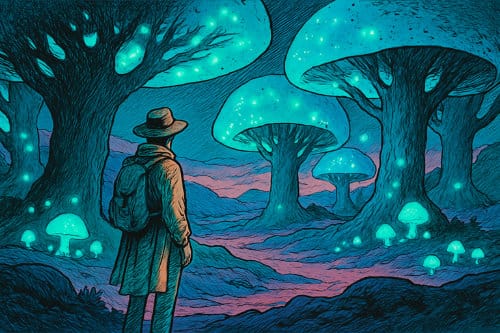
When I first started using Midjourney, I wasn’t trying to replace anything. I was just curious. I’d type in a phrase—something like “a lone figure under bioluminescent trees, painted in the style of Moebius”—and see what came back. Most of the time, the results weren’t quite right. But every so often, I’d get something that made me stop and stare. Not because it was perfect, but because it hinted at a story I hadn’t told yet. That moment of surprise—that’s the part that felt like art to me.
Over time, I began using AI not to finish work, but to start it. It became a sketchbook, a reference generator, a source of inspiration when I was stuck. It nudged me into new color palettes, strange compositions, and ideas I wouldn’t have thought of on my own.
A Tool, Not a Threat
None of this is to say that AI tools don’t raise serious questions—about authorship, copyright, originality. These are valid concerns, and we’ll need to grapple with them honestly. But dismissing AI outright, as if it’s cheating or lazy, misses the deeper truth: creativity has always been about making meaning with the tools we have. The brush changes, but the impulse to create, to express, to share—that doesn’t.
So maybe the real question isn’t whether AI art “counts.” Maybe it’s how we, as artists and humans, choose to use it.
Curious to try it for yourself?
Next time you feel a creative itch, try describing something impossible to an AI art generator. Not to show off or make a finished product—but to see what comes back. Treat it like a sketch, not a statement. You might just discover a new direction you hadn’t considered.
And if it feels weird or uncertain at first—that’s okay. Most good art does.
by Patrix | Apr 21, 2025
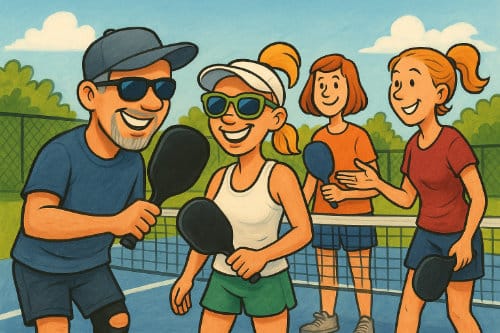
It started with a missed shot. Someone blamed the wind. Someone else blamed the paddle. And someone else blamed the cracks on the court. Then someone (let’s call him Patrick) said “Well, sometimes I am for the cracks.” Then the lady with the green glasses made one simple gesture: with an exaggerated surprised look on her face, she covered her butt with her paddle.
They laughed for minutes.
It’s not just a sport—it’s a stage. A recurring ensemble of characters shows up, paddles in hand, ready to rally and razz. And now, thanks to artificial intelligence, you can capture the drama, comedy, and chaos of your pickleball life in the form of a cartoon strip. No drawing skills required; just your imagination.
AI as Your New Comic Artist
I’ll admit, I was skeptical at first. Turning real-life moments into a cartoon seemed like something that required either years of practice or a teenager with Procreate. But AI image generators—like DALL·E, Bing Image Creator, Midjourney, and even ChatGPT—have gotten weirdly good at turning text descriptions into colorful, expressive visuals. Especially when you give them something playful to work with.
Pickleball, it turns out, is a perfect subject.
What Makes a Good Comic?
You don’t need much. Four or five panels is enough to tell a small story—something silly, familiar, and just exaggerated enough to make your friends laugh out loud (or groan).
The Characters
It helps to exaggerate a little. That quiet guy who’s secretly competitive? Turn him into a shadowy figure practicing dinks by moonlight. The friend who always shows up in matching visors and wristbands? She becomes the team fashion icon, complete with sparkles and a signature smirk.
To keep the AI from getting confused, I learned to describe characters consistently in every prompt. “Slim man with grey cap and right knee brace, cartoon style” became shorthand for Patrick. Cari? “Petite woman with green sunglasses and a white visor, energetic expression.” AI doesn’t remember from panel to panel, so you have to guide it carefully. But once you get the hang of it, it becomes a fun little collaboration—part art project, part improv comedy.
The Joy of Seeing It on the Screen
I think what surprised me most was how satisfying it was to see these ridiculous court moments frozen in cartoon form. Not polished. Not perfect. But funny in a way that felt both personal and sharable.
And the process—assembling the panels, adding text bubbles, tweaking expressions—reminded me that storytelling doesn’t have to be high art. Sometimes it’s just four friends on a pickleball court, trying to figure out which paddle is which, or which cracks are which.
It’s Not About the Art. It’s About the Memory.
AI can’t replace the warmth of real-life friendships, or the squeak of shoes on the court, or the quiet satisfaction of a well-placed drop shot. But it can help you capture those fleeting moments in a form that’s easy to share and impossible not to smile at.
You don’t need to be a tech expert. You don’t need to understand how neural networks work. All you need is a story—and a willingness to play with it.
Pickleball already gives you the characters, the drama, and the punchlines. All AI does is draw the panels.