by Patrix | Oct 29, 2025
When I first picked up watercolor, I assumed it would be the easy, meditative cousin of acrylics. After all, how hard could a few transparent washes be? Two hours later, I was staring at a murky brown puddle that had once been a hopeful sunset. That was the moment I realized watercolor isn’t just a medium. It’s a mindset.
Learning watercolor is like learning to surf or meditate or even use new tech tools. It punishes your need for control and rewards your willingness to adapt.
The Myth of Control
If you come from the world of digital art or even acrylics, watercolor feels like chaos. There is no “undo” button. Once that paint blooms across the paper, it is there for good. The brush hesitates for half a second too long, and the pigment decides to take a vacation in an unexpected direction.
Here’s the secret: watercolor teaches you to work with the medium, not against it. You start to notice how water moves, how paper absorbs, how color settles. You learn that a little patience and a lot of humility go further than a thousand “perfect” strokes.
Over time, you stop fighting the unpredictability, and that is when things start getting beautiful.
Mistakes That Make Magic
Every watercolorist has that moment when you spill water on your nearly finished piece. Panic sets in. But when it dries, the paper’s texture adds something you never could have planned — a subtle bloom, a soft transition, a hint of life.
Watercolor thrives on accidents. The best painters know this and use it deliberately. They will drop in clear water to create halos or tilt the page to let gravity paint for them. It is part skill, part surrender.
That is a life lesson in disguise. We spend so much energy trying to “fix” our mistakes in art, in work, in relationships. But sometimes the trick isn’t to fix them. It is to look closer and see what new texture they add.
What Watercolor Teaches About Technology
I once tried to paint while an AI tool “watched” me, with my webcam feeding into a style-analyzing app that predicted what I would do next. The irony was rich. Watercolor does not want to be predicted. That is its charm.
In a way, painting with watercolor is the analog antidote to our algorithmic lives. It resists control. It refuses perfection. It demands presence. And yet, that makes it oddly compatible with the digital world, a reminder that creativity isn’t about precision, it is about participation.
We talk a lot about “training data” in AI. Watercolor trains you. It rewires your expectations. It teaches you to enjoy the unpredictability and to trust that not every splash needs to be optimized.
The Tools Don’t Matter as Much as You Think
Watercolorists love to debate brushes and paper brands. Cold press or hot press, synthetic or sable, you will find endless opinions online. But here’s the truth: a two-dollar brush and a coffee mug of water are enough to start learning the watercolor mindset.
This is good news for tech lovers who already suffer from gear acquisition syndrome. With watercolor, the constraint is the freedom. The fewer choices you have, the more you notice what really matters — light, pigment, and patience.
I once painted an entire beach scene using leftover pigment on a travel palette and a hardware-store brush. It was not perfect, but it felt alive. That is the point.
Painting as a Metaphor for Living
Watercolor dries lighter than it looks. Every beginner learns this the hard way. You paint something bold and beautiful, only for it to fade into whispery pastels. It is frustrating, until you realize it is also kind of poetic.
Life is like that too. The moments that feel too intense, too messy, too heavy often dry softer than we expect. With a little time, the harsh edges fade, and what is left is something tender and worth keeping.
Maybe that is the ultimate watercolor mindset: not to chase perfection, but to stay curious about what the water will do next.
A Creative Life with a Bit of Blur
Learning watercolor will not make you rich or famous. But it might make you kinder, to yourself, to your mistakes, and to the process. You stop demanding that every attempt be “finished” and start seeing each page as an experiment in letting go.
And who knows? In that gentle blur between control and chaos, you might just find a clearer version of yourself.
by Patrix | Oct 13, 2025
There’s a kind of evening when the world seems to sigh in relief. Rain drifts softly against the windows, the air smells faintly of earth, and the lights inside take on a golden glow. It’s a mood that wraps around you, quiet but alive. A rainy night has a way of smoothing the edges of the day. It tells you, without words, that it’s time to rest.
For reasons both scientific and emotional, rain has always been comforting. It’s not only about being dry indoors; it’s about being protected. There’s something ancient and familiar in the rhythm of falling water, as if the planet itself were humming a lullaby.
Why Rain Feels Like a Hug for the Nervous System
The calming effect of rain isn’t just in our imagination. The steady patter produces what’s called pink noise, a gentler cousin of white noise. It evens out sudden sounds and helps the brain settle. That’s why so many people drift off more easily when it’s raining. The pattern tells our nervous system that the world outside is stable and safe.
Long before smart homes and streaming playlists, our ancestors found the same comfort in a rainstorm. It meant they could rest. Animals were quieter, the air was cooler, and there was less to fear. That instinct remains in us, even if the campfire has been replaced by a reading lamp and a cup of tea.
When the world outside turns damp and gray, the interior world feels richer. Candlelight seems to glow with more purpose. The steam from a cup of cocoa rises like a small celebration. The ordinary suddenly becomes precious.
The Art of Doing Nothing
Rainy nights remind us that stillness isn’t a flaw in the schedule. The sound on the roof, the smell of wet pavement, the fog on the window—these are invitations to slow down. A culture that rewards constant motion rarely gives permission for rest, but the rain does. It falls without judgment, asking nothing in return.
Doing nothing well is its own quiet craft. You might light a candle, pull a blanket close, and simply listen. Maybe you cook something slow and fragrant, letting the scent fill the house. Or you sit with an open notebook, waiting for thoughts to drift through. The rain doesn’t demand activity; it offers space for reflection.
Creative people often find this time restorative. Artists, writers, and dreamers know that ideas sometimes arrive only when we stop chasing them. The gentle rhythm of the rain is a companion to imagination—a muse in liquid form.
Digital Rain and Modern Comfort
Technology has made it possible to bring that same atmosphere anywhere. A rainstorm playlist, a looping video of thunderclouds, or a smart lamp that mimics candlelight can recreate the feeling of a rainy night even in the desert. What once required weather now fits in your pocket.
There’s a subtle beauty in that. In a fast, digital world, our devices are learning how to help us slow down. AI-generated soundscapes and ambient art installations are helping people reconnect with something ancient. Maybe that’s what the meeting point of art and technology truly is: a way to remember what it means to be still.
When the screen glows softly and the rain sounds play through the speakers, you can almost forget that the weather outside is dry. It’s an illusion, but a healing one. It gives the mind the same permission the real thing does—to breathe.
Memory, Melancholy, and the Rain
Rain has a way of stirring emotion. It invites us to look inward, to remember, to feel. Nostalgia rises as easily as the scent of wet earth. Sometimes it brings a quiet sadness, but it’s the kind that soothes rather than stings. Like washing dust from a window, the rain clears the mind.
It also softens memories. You might think of someone you once knew, a house you once lived in, or a night that mattered for reasons you can’t quite explain. Under the sound of rain, even loss feels gentler. The melancholy becomes a kind of music—a reminder that feeling deeply is its own form of being alive.
Poets and filmmakers return to this again and again because rain is both metaphor and mood. It’s the sound of reflection, the light of memory, the silence between thoughts.
The Ritual of Comfort
Rain encourages ritual. A soft sweater, a warm drink, a pet curled nearby—these small gestures become ceremonies of peace. They remind us that comfort doesn’t depend on grand moments. It lives in ordinary things: a roof overhead, the scent of rain, a moment of gratitude for both.
You might put on a slow record, make soup from scratch, or simply sit by the window and watch. These are quiet rebellions against the noise of the day. They tell the body and mind that there is value in calm, that not every hour needs to be filled with achievement.
In the glow of lamplight, with the soft percussion outside, time changes shape. The hours stretch in a good way. You are no longer chasing the day; you are inhabiting it. That is the secret comfort of a rainy night—it draws you back into the present.
Letting the Rain In
So when the clouds gather and the drops begin to fall, don’t rush for the forecast or worry about plans delayed. Let the world slow down. Light the candle. Let the rain speak to the quiet parts of you that are too often ignored.
You are not wasting time when you pause to listen. You are syncing with the rhythm of something older than memory. The comfort of a rainy night comes not from the weather, but from the way it reminds us who we are: small, warm, and wonderfully alive.
by Patrix | Oct 10, 2025
For years, the cryptocurrency market has danced to the rhythm of Bitcoin and Ethereum, with everyone else trying to keep up. But something new is stirring. The U.S. Securities and Exchange Commission (SEC) appears to be softening its stance on digital assets, hinting at potential approval for a wave of exchange-traded funds tied to other cryptocurrencies. Among the contenders, three names keep coming up: Solana (SOL), Ripple’s XRP, and Cardano (ADA). If these coins receive ETF approval, it could mark a defining moment for the broader crypto ecosystem.
The new regulatory opening
In late 2025, the SEC introduced generic listing standards for commodity-based exchange-traded products. That might sound like paperwork, but it’s a quiet revolution. Until now, every crypto ETF crawled through a lengthy and highly public approval process. The new framework streamlines that ordeal, allowing issuers to list ETFs tracking eligible digital assets as long as they meet defined requirements.
This shift also prompted applicants to withdraw and resubmit ETF filings for coins like Solana, XRP, Cardano, and others under the new rules. The message is straightforward: resubmit on the new rails and the timeline shortens. Windows that once stretched across half a year could compress to a couple of months. For investors, that change isn’t just procedural; it’s a signal that crypto is getting a clearer regulatory on-ramp.
A second back-office update also matters. “In-kind” creation and redemption — the ability for ETFs to transact in the underlying crypto rather than cash — reduces frictions and costs. Most people never see that machinery, yet it is the kind of infrastructure improvement that invites larger pools of capital to participate without operational headaches.
Why Solana, XRP, and ADA lead the pack
Solana (SOL) is the high-performance chain that developers lean on when speed and cost matter. With fast block times and low fees, it has become home base for a wide range of decentralized apps, from DeFi to consumer-facing experiments. Institutions like SOL because it behaves more like a modern tech platform than a speculative meme. If a Solana ETF gains approval, expect liquidity to deepen and spreads to tighten. That combination often attracts additional flows, which can snowball into momentum. Solana’s critics point to historic network outages and congestion. Those are real concerns, yet the recent trend has been toward better stability. If the chain continues to hold up under heavy load, SOL could become the “Apple-like” infrastructure layer of crypto — streamlined, efficient, and ready for mainstream adoption.
XRP brings something different. Its central story is payments. Ripple’s technology aims to move value across borders quickly and at low cost, and that makes XRP less of a casino chip and more of a bridge asset. After a long legal slugfest, XRP has clearer precedent than most altcoins. That doesn’t erase risk, but it reduces the fog. If an XRP ETF hits the market, it is easy to imagine conservative institutions warming to it as part of their “plumbing” allocation — an asset that helps them express a view on the future of settlement and tokenized value transfer. The potential upside is meaningful if a wave of cautious capital decides XRP is the safest way to gain altcoin exposure inside a traditional wrapper.
Cardano (ADA) takes the methodical route. It is built on peer-reviewed research and emphasizes security, sustainability, and energy efficiency. That slower, academic cadence has earned ADA a reputation for reliability rather than flash. If ADA secures ETF status, the initial surge might be gentler than SOL or XRP, yet it could prove more durable. ESG-minded allocators who want long-term exposure to a utility-first blockchain may find it appealing. Patience is the keyword: if approvals for ADA arrive after SOL or XRP, the delayed timeline could still work in Cardano’s favor by aligning with its steady-build narrative.
How ETF approval could reshape the market
ETF approval for these coins would do more than stir prices. It would change how money flows in the crypto economy. When capital enters through regulated ETFs, it often stays longer. Institutional investors prefer compliance, liquidity, and transparency, and ETFs deliver exactly that.
If ETFs for SOL, XRP, and ADA become available, traders will finally have familiar, regulated vehicles to gain exposure without the operational burden of custody and direct token handling. That invites pension funds, endowments, insurance companies, and large family offices to participate with clearer guardrails. A likely outcome is the gradual erosion of the Bitcoin-and-Ether near-monopoly on institutional attention. Capital that once concentrated in those two giants may begin to diversify into a compact set of “infrastructure” altcoins.
Diversification can also affect volatility. Deeper liquidity and tighter spreads generally tame wild swings. Expect the beta of SOL, XRP, and ADA to adjust if ETF volumes are significant. That doesn’t mean prices will move in a straight line. In the short term, regulation tends to spark speculation. Solana has a history of overreacting to hype, and XRP holders are famous for conviction. Short-term rallies and sharp corrections are likely. Cardano’s reaction may be smoother but still positive, especially if it benefits from slow-and-steady institutional accumulation.
What could go wrong
The biggest risk is political. A change in regulatory tone or a new round of enforcement could delay or even unwind progress. Even mundane issues, such as a government funding lapse, can slow reviews. If timelines slip, traders may rotate back into Bitcoin and Ether as safer holdings.
Another risk is fragmentation. If only one or two ETFs are approved initially, capital could rush into those while others languish. That can create choppy relative performance. Once ETFs exist, derivatives will proliferate. Options and futures on these funds can amplify both optimism and fear, raising the stakes for risk management.
What to watch and how to navigate
Investors should track the SEC announcement cadence and watch how issuers amend filings. On-chain activity is also a useful compass: developer traction, total value locked, and user adoption often foreshadow how resilient any post-approval rally will be.
Position sizing is more important than prediction. Regulatory momentum can move prices faster than fundamentals justify. If you catch a pop, it may be wise to realize gains methodically and leave room for consolidation. The market rewards those who plan exits as carefully as entries.
A quiet revolution
The SEC’s evolving approach to altcoin ETFs could turn out to be one of the decade’s most consequential financial shifts. Once institutional capital can flow freely into multiple regulated crypto funds, digital assets will no longer sit at the edge of the capital markets. They will live beside gold, oil, and equities in diversified portfolios.
Solana could mature into the chain of choice for speed and consumer apps. XRP might take root as the bridge for fast settlement and tokenized value. Cardano could become the patient investor’s pick for sustainable, research-driven infrastructure. Together, they offer a picture of a crypto market that looks less like a speculative carnival and more like a structured opportunity set for long-term builders and savers.
I think of it like switching from a gravel road to a paved highway. The destination doesn’t change — a digital, programmable financial system — but the ride becomes smoother, safer, and more accessible. With ETFs opening the on-ramps, the next stretch could be where crypto finally drives like a mainstream asset class.
by Patrix | Oct 7, 2025
There was a time when ChatGPT was little more than a polite conversationalist with an impressive memory for facts. You typed a question, it answered. That’s changing fast. OpenAI has just unveiled two new features that push ChatGPT far beyond its roots as a chatbot: the ability to call on apps directly within ChatGPT, and a new developer framework called AgentKit. Together, these tools hint at an ambitious vision: ChatGPT not as a single AI assistant, but as a digital platform where apps, agents, and creativity converge.
Apps Inside ChatGPT
The most visible new feature is the introduction of apps that can operate right inside a ChatGPT conversation. Instead of merely linking to external websites or APIs, ChatGPT can now load interactive tools within the chat window. You might ask it to design a logo, book a flight, or create a playlist, and it can bring in apps like Canva, Expedia, Zillow, or Spotify to handle the details — without ever leaving the chat.
In practical terms, this means you can now conduct tasks that used to require jumping between tabs. Imagine asking ChatGPT to “find homes in Paso Robles with vineyard views under $900,000,” and it opens a Zillow panel with live listings. Or you could say “design a minimalist poster for my local art fair,” and ChatGPT brings in Canva to help you customize layouts right there in your conversation.
Developers can create these embedded tools using OpenAI’s new Apps SDK, which opens the door for a new ecosystem of chat-native software. Instead of designing apps around menus, screens, and icons, developers are designing for conversation — an interface where users describe what they want and see the result unfold naturally.
This shift is bigger than it might first appear. It positions ChatGPT as something like a conversational operating system, or as some tech writers have called it, “a chat-first super-app.” The traditional app model depends on users finding and opening apps individually. In the new model, you stay in one environment, and the right tool appears when you need it.
For users, this reduces friction dramatically. For developers, it’s an invitation to reach hundreds of millions of people directly inside a space where users already spend time thinking, researching, and planning. And for OpenAI, it’s a strategic move toward making ChatGPT the hub where digital tasks begin and end.
Of course, there are challenges. Integrating apps into ChatGPT means new considerations for privacy and permissions. Users may need to authorize data sharing between ChatGPT and third-party services, and OpenAI will have to ensure transparency about how that data is used. There’s also the question of monetization: will developers be able to sell their in-chat apps? And will ChatGPT recommend partner apps more often than others? Those answers will likely emerge as the platform matures.
Still, the potential is obvious. With apps inside ChatGPT, we’re watching the boundaries between AI conversation and software interaction blur into something seamless.
AgentKit: Building the Brains Behind the Interface
While embedded apps handle tasks, OpenAI’s second major release, AgentKit, is about building autonomous intelligence. If the new ChatGPT apps are the hands of the operation, AgentKit is the brain.
AgentKit is a toolkit that lets developers (and soon, power users) create AI agents — autonomous systems that can perform complex workflows on their own. These agents don’t just respond to prompts; they act. They can fetch information, call APIs, take actions, evaluate results, and loop back to improve performance.
At its core, AgentKit combines several components:
- A visual agent builder, where you can design workflows through a drag-and-drop interface.
- A connector registry, offering prebuilt connections to popular APIs and services so you don’t need to write all the plumbing code yourself.
- A chat interface builder (called ChatKit), which lets you embed your agent into a website or app.
- An evaluation framework that helps test, monitor, and optimize how agents behave over time.
What’s remarkable about AgentKit is that it lowers the barrier to entry for building autonomous systems. In the past, developing an AI agent required juggling multiple services — prompt chains, data connectors, guardrails, and UI layers. AgentKit packages all of this into a single, coherent stack.
Imagine you run a small online business and want an AI that checks your Shopify store daily, flags low inventory, drafts a reorder email to your supplier, and then posts a status update to your team Slack. With AgentKit, that kind of automation could soon be built visually, without deep coding skills.
Or picture an indie researcher building an agent that monitors new publications in climate science, summarizes findings weekly, and updates a shared knowledge base. These aren’t far-off scenarios; they’re the kind of things developers are already experimenting with as the toolkit rolls out.
AgentKit also addresses one of the toughest problems in AI development: evaluation. It includes built-in tools to measure how well an agent performs its intended task, detect errors or hallucinations, and adjust its logic automatically. This kind of systematic feedback loop is essential if autonomous agents are to be trusted for serious work.
Why It Matters for Creatives and Entrepreneurs
For many ArtsyGeeky readers, this evolution means a new wave of opportunity. You don’t need to be a large company to harness AI anymore.
With apps inside ChatGPT, you can create, design, research, and organize projects from one conversational hub. A photographer could brainstorm blog titles, generate social media captions, open Canva to lay out a promo card, and then call Shopify to upload it — all from a single chat.
With AgentKit, you can automate what happens next. That same photographer could build an agent that tracks engagement data, suggests which images performed best, and recommends the next set of edits to promote.
This convergence of tools and intelligence transforms ChatGPT into a kind of creative studio. It’s not just reactive; it’s collaborative. The line between “asking an AI” and “working with an AI” is fading.
A Few Cautions Along the Way
As with any new technology, there are some caveats. AI agents, even well-trained ones, can still make mistakes. They can misinterpret intent, generate inaccurate data, or act in ways you didn’t expect if guardrails aren’t set properly. That’s why AgentKit includes safety tools and permissions systems to keep actions transparent and reversible.
Privacy is another key issue. Because apps and agents may access your data or connect with external accounts, users should pay attention to what they authorize. OpenAI will need to earn user trust by keeping permissions explicit and data use limited.
Finally, there’s the question of ecosystem fragmentation. Will developers build hundreds of different agent frameworks, each with its own quirks? Or will OpenAI’s ecosystem unify around a shared standard? For now, the company seems determined to make AgentKit the common language of AI automation.
The Next Frontier
When you put these two features together — apps inside ChatGPT and AgentKit — the larger picture comes into focus. OpenAI is positioning ChatGPT not as a single product, but as a platform for intelligent interaction. It’s a place where conversation becomes command, and AI becomes a co-worker.
Soon, users might chain together agents and apps in one session. A planning agent could call on Expedia to check flights, Canva to generate an itinerary design, and Google Sheets (through a connector) to budget the trip. It’s not hard to see how this could evolve into a fully integrated, conversational workspace — a kind of digital command center for modern creative life.
For those of us who’ve watched AI progress from curiosity to collaborator, it’s an exciting turn. Whether you’re a developer, a designer, or simply someone who loves tinkering with new ideas, the door just opened a little wider.
by Patrix | Oct 6, 2025
Every generation of programmers gets its magic moment. For those of us who remember watching code compile faster, the just-in-time compiler once felt revolutionary. Now, forty years later, “just-in-time” means something new. We’re not talking about optimization after you’ve written code — we’re talking about optimization while you’re writing it. Or rather, while your AI assistant is writing it for you.
In 2025, just-in-time coding is quietly redefining how software is made. It’s not a product you can buy or a single technology; it’s a workflow — a cultural shift toward code that materializes exactly when it’s needed, guided by AI models that understand intent, context, and consequences.
The New Meaning of “Just-in-Time”
In the old days, a just-in-time (JIT) compiler translated your code to machine language during execution for better performance. Today’s “JIT coding” flips that idea. Instead of optimizing after the code exists, the AI helps generate the right code as you think of it.
Here’s the general pattern that defines this new phase:
- You describe what you need in plain English — a feature, a fix, or a script.
- The AI plans a series of edits or new files.
- It writes, runs, tests, and revises that code — often without leaving your editor.
- You review the diff or pull request like a manager approving your apprentice’s work.
That’s it. The machine becomes a second set of hands that moves almost as fast as thought. It’s not a new compiler. It’s a new collaborator.
The Big Shift: Agents That Actually Code
The phrase “AI agent” has become a buzzword, but in this context, it means something tangible. An agentic coding system can reason about tasks, manage state, and act over time — not just autocomplete lines of code.
GitHub Copilot Workspace, for instance, turned heads when it was announced in 2024. It promised to take developers “from idea to runnable software” inside a single natural-language workflow. You could describe a feature, watch Copilot generate a plan, and then see it build, test, and run that feature in seconds.
Then came Claude Sonnet 4.5 from Anthropic in late 2025, and that raised the bar again. Claude’s long-context memory (up to a million tokens) lets it hold an entire project in its “head.” It can sustain a session for 30 hours without losing coherence — a milestone for anyone who’s watched a coding assistant forget what it was doing halfway through a refactor.
Anthropic didn’t stop at model performance. They released a Claude Code SDK and VS Code integration that let developers build their own autonomous agents with checkpoints, memory tools, and rollback features. For the first time, you can let an AI run with a task for hours, while still being able to pause, inspect, or rewind. It’s just-in-time coding with seat belts.
Why Latency Is the New Productivity Frontier
One of the underrated reasons this movement is taking off is speed. For just-in-time coding to feel natural, responses must appear faster than your brain can switch context.
That’s where new architectures like Fill-in-the-Middle (FIM) and speculative decoding come in. FIM models don’t just predict what comes next — they predict what goes between your existing lines, letting you type half an idea and watch it grow like a self-completing thought. Speculative decoding, meanwhile, lets the model draft multiple possibilities in parallel and return the best one almost instantly.
It might sound like inside baseball, but that half-second difference is everything. A delay of 600 milliseconds can break your flow; 200 milliseconds feels like magic. The line between “AI autocomplete” and “thinking partner” is now measured in tenths of a second.
From Code to Action: Dynamic Tools and Runtime Generation
“Just-in-time” also describes what’s happening under the hood of new dynamic agents. Systems like OpenAI’s tool-generation framework or Anthropic’s sandboxed code execution environment let a model create and run code safely at runtime — the digital equivalent of thinking on its feet.
Example: you’re analyzing crypto data. Instead of writing a Python script, you say, “Plot Bitcoin’s monthly average price for the last three years, overlay Ethereum in blue, export as PNG.” The model writes a quick script, runs it in a sandbox, checks for errors, and returns the chart.
That’s just-in-time coding in its purest form — functional, ephemeral, and focused.
The Tools to Watch
- Claude Sonnet 4.5 – The most agent-ready model of 2025, tuned for coding and long-term autonomy.
- GitHub Copilot + Workspace – Mainstream integration; the “Google Docs for code” everyone expected.
- Cursor, Windsurf, Zed – Editors born for AI: conversational refactors, project-level memory, PR management built in.
- Devin & OpenDevin – Full “AI software engineers” that can triage issues, write diffs, run tests, and open pull requests autonomously.
- Dynamic tool calling frameworks – OpenAI’s sandbox pattern for generating and executing one-off scripts with security limits.
The Human Side: Risks and Guardrails
Of course, giving your IDE a mind of its own isn’t without risk.
AI-generated code can hallucinate APIs, miss edge cases, or introduce subtle security bugs. Teams adopting JIT workflows need clear policies: sandbox every change, auto-generate tests first, and require human approval for all pull requests.
And beware of code churn — studies on AI-assisted repos show that automated edits tend to rewrite more lines than necessary, increasing maintenance overhead if you don’t enforce good reviews.
In short, these systems make brilliant assistants but terrible dictators. Treat them as colleagues who always need supervision.
What It Means Beyond Techies
For readers who aren’t full-time programmers, JIT coding matters because it blurs the boundary between using software and making it.
Artists can now generate creative scripts on the fly — from image batch converters to generative art filters — without “learning to code” in the traditional sense. Retirees exploring data visualization or small online businesses can prototype tools simply by describing them.
That’s the quiet revolution: software as conversation. Instead of waiting for a developer to build your idea, you co-build it in real time.
Try This Yourself
- Grab a free trial of Claude Code or Cursor.
- Paste in a CSV of crypto prices.
- Prompt: “Plot Bitcoin and Ethereum price trends on the same chart, color by volume, add a moving average.”
- Watch it reason, code, debug, and deliver a chart in seconds.
That’s not science fiction — that’s your first agentic coding session.
Where It’s Headed
- Persistent “memory agents” that know your project history across sessions.
- Domain-specific agents (finance, biotech, web automation).
- Smarter collaboration between human and machine through shared “plans.”
- A shift in education; from learning syntax to learning how to orchestrate AI.
The tools are getting better. The latency is dropping. The trust mechanisms are hardening. In short, coding is finally catching up to conversation speed.
The new frontier isn’t faster CPUs — it’s faster ideas.
by Patrix | Oct 4, 2025
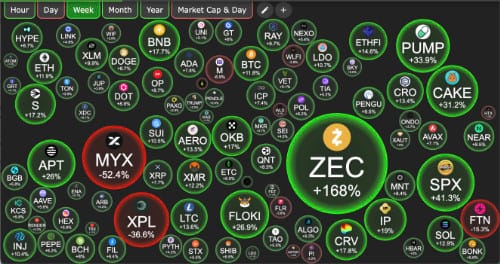
If there’s one thing as volatile as crypto price charts, it’s the challenge of making sense of crypto data. Raw numbers, candlestick graphs, order books — these can overwhelm. That’s where clever visualizations of numbers and patterns step in: they translate complexity into clarity, reveal hidden patterns, and invite exploration. One standout in this space is CryptoBubbles.net, which turns the crypto market into a dynamic bubble chart you can navigate. In this post, I want to explore the current state of the art in data visualization (with an eye toward crypto), and dive into what makes CryptoBubbles an intriguing tool for crypto investors and analysts.
The Landscape of Modern Data Visualization
Why visualization matters
- Humans are pattern-seeking animals. Data visualizations let us see structure — clusters, outliers, trends — that would otherwise hide in rows of numbers.
- Cryptomarkets are high-dimensional: price, volume, volatility, correlation, on-chain metrics, sentiment. Visual tools help us navigate many dimensions at once.
- In fast-moving domains like crypto, interactivity is key — static charts often lag the story.
Some current trends & techniques
Here are a few of the visualization trends shaping how we view complex data today:
- Grammar-of-graphics tools: Frameworks like Vega / Vega-Lite let developers specify visualizations declaratively and support interactivity. (They help separate design from data plumbing.)
- Scalable visualization for large datasets: Techniques like progressive rendering, level-of-detail, tiling/streaming, and aggregation help with thousands/millions of points.
- Multivariate, multi-attribute views: Rather than just plotting price over time, many visual systems layer or juxtapose multiple metrics (volume, volatility, network activity).
- Hybrid visual–analytics and visual reasoning: Interactive dashboards with linked views, filtering, drill-downs, and back-end querying.
- Blockchain-specific visualization tools: Because blockchain data has structure (blocks, transactions, flows), dedicated tools map that structure into intuitive visuals (graph layouts, flow charts, ledgers).
- Emerging research: invertible visualizations & adaptive encoding: Projects like InvVis embed data into visualizations so that you can reverse them; others propose models that suggest optimal visual encodings.
Challenges & tradeoffs
- Perceptual limits: Humans can only process so many colors, shapes, sizes effectively. Too many variables can confuse.
- Stability vs. reactivity: In live data, updating visuals must balance freshness with layout stability to avoid disorienting users.
- Scalability and performance: Rendering many interactive elements smoothly — especially on mobile — is technically challenging.
- Context & interpretability: Visuals need legends, guides, tooltips, explanations. Without that, interaction becomes confusing.
- Data integrity, latency & correctness: In financial/crypto domains, small data issues can mislead; the backend pipeline must be robust.
CryptoBubbles.net — A Closer Look
What is CryptoBubbles.net?
CryptoBubbles (also called Crypto Bubbles) is an interactive, web-based platform that visualizes the top ~1,000 cryptocurrencies using a bubble chart interface. Each bubble represents one coin or token; attributes such as size, color, and position encode metrics like market capitalization, price change, volume, etc.
It also has mobile apps (Android and iOS) so users can take it on the go. It brands itself as an “independent visualization tool and data aggregator,” free to use and ad-free.
Limitations, tradeoffs, and things to watch
- Dimensional saturation: Bubble charts are intuitive but can’t encode unlimited variables cleanly.
- Overplotting & clutter: Showing ~1,000 bubbles can lead to overlap or tiny bubbles in dense clusters.
- Perceptual distortion: Human perception of area is nonlinear; bubble size differences aren’t judged as precisely as bar lengths.
- Temporal movement and instability: Frequent repositioning or rescaling may disorient users.
- Data freshness & source reliability: The value depends on reliable, low-latency data pipelines.
- Analytical depth: CryptoBubbles is a visual “overview” tool, not a full-blown analytics engine.
- Competitive alternatives & reach: It competes with major crypto dashboards (CoinGecko, The Block, etc.).
Use cases & what it’s good for
- Quick market overview: spot which coins are surging/fading.
- Discovery/screening: find under-the-radar coins showing momentum.
- Portfolio tracking: mark and monitor favorites.
- Visual storytelling: embed bubble visuals in reports or blogs.
- On-the-go scanning: mobile app helps monitor trends outside the desk.
Position in the visualization ecosystem
CryptoBubbles is a “gateway” viz: a visually intuitive layer that invites you in, rather than a deep analytical end-state. It demonstrates how good visual affordances can engage users while keeping complexity manageable.
Potential enhancements and future directions
- Hybrid linked views: Pair a bubble view with time-series, correlation, network graph views, all linked by interactions.
- Temporal animation / “bubble race” view: Animate bubble trajectories over months/years, with careful layout stability.
- Embedding on-chain / sentiment data: Let users morph between price view, transaction view, social sentiment view.
- Predictive / alert overlays: Flag bubbles with alerts (e.g., volume spikes, news), integrate simple ML models.
- Better layout algorithms & stability: Use advanced bubble-packing and spatial embedding to cluster relationally meaningful groups.
- Invertible / embed metadata: Use techniques like InvVis so visuals carry hidden metadata for extraction or sharing.
- Visualization SDK / embedding: Provide embeddable components or APIs so others can incorporate CryptoBubbles into their own apps or sites.
Data visualization in the crypto world is not just about making charts — it’s about turning noisy, high-dimensional data into something our eyes and minds can explore. The best visualizations live in a balance: expressive enough to hint at complexity, yet simple enough to grasp instantly.
CryptoBubbles.net is a vivid example of that balance in practice. It gives you a dynamic, intuitive visual map of the crypto market — a visual “big picture” you can scan, probe, and react to. It doesn’t supplant deeper analytics, but it’s a powerful complement to them.
If you’re exploring crypto, or you teach/present crypto trends, or just like interesting data visualization, I recommend checking out CryptoBubbles.net