by Patrix | Oct 2, 2025
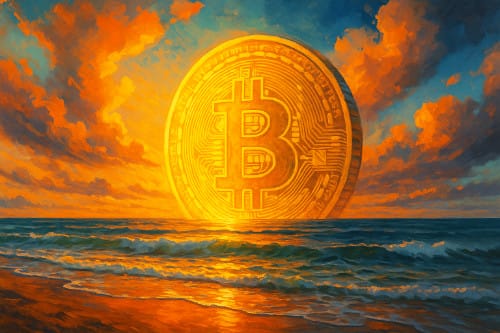
Bitcoin is back to doing what Bitcoin does best: being unpredictable, dramatic, and strangely magnetic. As I write this, it’s rising around $119,000, up about 4% on the day. That’s enough to make people turn their heads, squint at the chart, and whisper to themselves, “Well, isn’t that interesting?”
For me, it’s not only about the charts or the profits. It’s more about the experience of watching something alive with energy. Bitcoin feels like a weather system rolling across the financial sky — sometimes stormy, sometimes brilliantly clear. I don’t control it, I don’t fully understand it, but I can’t help but enjoy the view and marvel at the patterns.
And just so it’s said clearly at the start: this is not investment advice. I’m not telling you what to do. I’m just one curious person who likes to explore how art, technology, and money all tangle together. I watch it with the same curiosity I’d bring to a tide pool, a lightning storm, or a painting I can’t quite make sense of.
Why the Buzz Feels Different Right Now
Every Bitcoin cycle has its mood. Some are euphoric, some are gloomy, and some are just confusing. This one feels like a blend of anticipation and restraint. The crowd isn’t shouting yet, but you can feel a kind of hum in the air.
Here’s what I notice:
- The macro backdrop: Inflation has been cooling, interest rates may be easing, and the dollar is softening. These shifts quietly encourage investors to peek outside the traditional system and ask, “What else is out there?”
- Big money stepping in: ETFs have made it easier for institutions to wade into Bitcoin. In a way, it feels like the lifeguards finally joined the kids in the pool. The vibe changes when serious money shows up.
- Scarcity at work: Bitcoin’s supply gets tighter with each halving, and long-term holders rarely sell. Scarcity has a way of making people curious.
- Regulatory frameworks: Governments are slowly moving from “What is this thing?” to “Here are the rules.” Like a chaotic jam session finally finding a rhythm, this brings some structure to the sound.
Put all of that together, and it feels like we’re standing at the edge of something interesting. Maybe it’s a surge. Maybe it’s a fake-out. But either way, it’s fun to watch.
The Temptation of “Before the Surge”
It’s easy to get caught up in the daydream of what comes next. Analysts toss around numbers like $150,000 or $200,000 within the next year or so. Maybe that happens, maybe not.
Bitcoin right now is testing resistance around $120,000. If it pushes above that level, history says it could run higher. If it doesn’t, then we chalk it up as another dance step in this long, unpredictable waltz.
Either way, I can’t help but smile at the spectacle. Watching Bitcoin move is like standing on the shoreline and seeing a wave rise. You don’t know if it’ll crash early or carry all the way to shore, but the rising motion itself is worth marveling at.
The Flip Side: When Bitcoin Reminds Us Who’s Boss
Of course, for every dreamy chart there’s a hard reminder that Bitcoin does what it wants. I’ve seen it soar just when everyone had given up, and I’ve seen it fall 30% in a week while the world was cheering it on.
What could derail the current optimism? A regulatory curveball. A sudden move by the Federal Reserve. Or simply too much excitement too soon — markets can burn out if they sprint too fast.
And that’s part of Bitcoin’s charm. If it were predictable, it wouldn’t be Bitcoin.
Enjoying the Wonder More Than the Outcome
When I step back, I realize that what I love most about Bitcoin isn’t the profit potential. It’s the wonder of it all. That a digital idea — invisible, intangible, fiercely debated — can ripple across economies and imaginations.
Sometimes I buy a little. Sometimes I just watch. Either way, I’m learning. And for me, that’s the real reward.
Bitcoin feels like digital gravity. It keeps pulling people in, not because it promises certainty, but because it dares us to look closer, to question the systems we take for granted, and to imagine what money could be.
And whether it’s heading to $200,000 or back down to $90,000, it remains one of the most fascinating experiments of our time.
So I’ll keep watching, with curiosity and a touch of playfulness — because life is better when we enjoy the ride, not just the destination.
by Patrix | Aug 11, 2025
On August 7, 2025, OpenAI officially unveiled GPT-5, its flagship successor to GPT-4, GPT-4.5, GPT-4o, and the O-series models. What makes this so exciting isn’t just raw power—it’s the model’s polished intelligence, uncanny adaptability, and the sense it wants to collaborate, not just respond.
Why GPT-5 Is a Game Changer: Smarter, Smoother, More Attuned
GPT-5 isn’t merely bigger—it’s wiser and more agile. OpenAI layered it with a real-time router, seamlessly choosing between fast answers or deep reasoning depending on the ask—without user input required. Across coding, math, writing, health advice, and visual perception, GPT-5 delivers state-of-the-art performance—what OpenAI terms “expert-level responses”.
Hallucinations? Sharply reduced. Instructions? Followed more precisely. Sycophancy? Dialed way back. GPT-5 aims to “refuse unsafe queries gently while providing more helpful answers when possible”. It’s faster and more accurate across everyday tasks like writing, coding, and health conversations.
New Capabilities That Blend Power with UX Ease
GPT-5 redefines what users expect from AI:
- Unified access across free, Plus, Pro, enterprise, and educational users—no more confusing model picker menus.
- Personality options—choose tones like “Cynic,” “Listener,” or “Nerd”—and UI themes, plus voice enhancements.
- Long-context memory and reasoning—handles inputs up to 272,000 tokens and 128,000 tokens in output, delivering coherence across epic conversations.
- Safety-first design through over 5,000 hours of testing, improved uncertainty handling, and safe completion logic.
- Multimodal prowess—text and image inputs (and in some accounts, even audio/video support), making GPT-5 more versatile than ever.
For Developers: A Toolkit of Precision and Power
Coders, rejoice. GPT-5 is designed to be a true coding partner:
- Top-tier scores on SWE-bench Verified (74.9%) and Aider polyglot (88%) benchmarks.
- Sharper tool calling—accuracy, error handling, preambles between calls, and seamless chaining in complex tasks.
- New API controls like
verbosity (low/medium/high) and reasoning_effort (including a nifty “minimal” fast mode) for customizable trade-offs. - Three API tiers—GPT-5, GPT-5-mini, GPT-5-nano—offer flexible pricing and performance tiers.
- Impressive benchmarks on τ²-bench telecom (96.7% tool-driven accuracy) and long-context retrieval tasks (89% accuracy across 128K–256K tokens inputs).
Real-World Rollouts & Partnerships
This isn’t theory—GPT-5 is already live. It replaced past models like GPT-4o and GPT-4.5 across ChatGPT. Microsoft is embedding GPT-5 across Copilot and services; whispers say Apple will integrate it into Apple Intelligence features.
A Word on Costs & Environmental Footprint
Power costs energy. GPT-5 eats around 18 watt-hours for a medium-length reply—higher than GPT-4o—though that’s expected for a model this capable. As AI scales, energy consumption and carbon footprints remain real concerns, and GPT-5 offers no free pass.
Early Reception: Cheers and Caution Flags
Many users and creators celebrate GPT-5’s polish and power. Publications like Wired and Tom’s Guide applaud its performance, personalization, and integration with Gmail/Calendar.
But not all feedback is glow—some users found GPT-5’s responses “flat” compared to GPT-4o, and early routing glitches caused inconsistency. OpenAI has since fixed the router and pledged to restore GPT-4o access for Plus users while raising personalization options.
MIT Technology Review called GPT-5 “a refined product more than a transformative leap”—not revolutionary, but polished and purpose-driven. Which, for creative and independent thinkers, may well be exactly what the moment demands.
What GPT-5 Means for the Future of AI
GPT-5 signals a shift from novelty to nuance. It’s not just about raw intelligence—it’s about steerability, accessibility, context-awareness, and integration. We’re seeing:
- AI that adapts to you, not generic prompts.
- Agents embedded seamlessly in workflows—email, code, projects, calendars—with long memory.
- Developer tools that let builders refine speed, depth, cost, and tool orchestration.
- A model that knows when to think fast and when to dig deep, intuitively and elegantly.
In short, GPT-5 isn’t a toy—it’s a collaborator. We’re inching closer to Artificial General Assistance: AI that generates, *reasons*, and *works with* us—smart, safe, and stylish.
Let me know if you’d like to spin in comparisons with other models, creative use cases for artists and retirees, or SEO tips for long-form AI content.
by Patrix | Jul 24, 2025
If you’ve been watching the crypto markets lately and feel like something’s shifted in the wind, you’re not imagining it. It appears that Altcoin Season has begun!
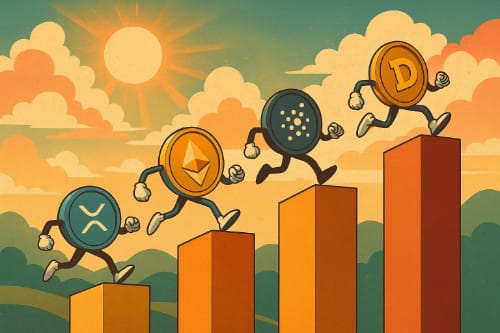
Over the past two weeks, the tides have turned in a way that seasoned investors and meme-loving traders alike recognize: altcoins are rising fast—and faster than Bitcoin. The long-anticipated “altcoin season” may finally be arriving. This surge in price activity from top altcoins like Ethereum (ETH), Ripple’s XRP, Solana (SOL), Cardano (ADA), and Dogecoin (DOGE) is setting off alarms across the crypto landscape. But this time, it feels different.
What is Altcoin Season?
In the cryptosphere, “altcoin season” refers to that rare and thrilling period when alternative cryptocurrencies begin outperforming Bitcoin. While BTC often leads the market in the early stages of a bull run, altcoin season marks a pivot in investor attention—away from Bitcoin’s safety and into the higher-risk, higher-reward world of other blockchain projects. When this happens, it typically signals a maturing rally, where the capital starts flowing more freely and speculatively across the board. Traders become bolder. Projects gain momentum. And savvy investors start paying attention to charts beyond the big orange coin.
The 14-Day Performance
So what exactly has been happening over the past 14 days? Ethereum has climbed roughly 18–20%, rising from the low $3,100s to well above $3,700. This rally is particularly significant, as it’s coinciding with the early success of spot Ethereum ETFs, which have pulled in more than $2.1 billion in net inflows in the past week alone. Unlike Bitcoin, which now has institutional exposure via several ETFs, Ethereum’s ETF push is still new and newsworthy. Investors are treating it as a green light for more mainstream acceptance—and the price has followed.
XRP, long plagued by regulatory uncertainty, seems to be breaking out of its cage. Its price leaped an impressive 25% over the same 14-day window, crossing $3.50 for the first time in over a year and briefly touching new highs. This move has come on the back of increasingly favorable legal tailwinds. As the SEC’s grip on XRP softens, traders and institutional holders alike are finding renewed confidence. Its unique utility for cross-border payments continues to hold real-world value, and that’s being priced back into the market.
Solana has also had a strong two weeks, climbing approximately 15%. While not as eye-catching as DOGE or XRP in raw percentage terms, it’s a steady gain that underscores a broader theme: Solana is being taken seriously again. Once sidelined due to outages and infrastructure concerns, SOL is now gaining favor with large decentralized finance (DeFi) platforms and new treasury fund inflows. It’s also in the conversation for future ETF consideration, which is pushing more capital its way. Importantly, Solana continues to be one of the most developer-friendly chains, with a growing ecosystem of apps, wallets, and NFT marketplaces rebuilding trust and attention.
Cardano’s ADA is up somewhere in the range of 18–23%, which is impressive considering how slow-moving ADA has been during past cycles. But this time, it’s part of the pack. ADA is benefiting from network upgrades and a quiet resurgence in utility. Unlike meme coins, ADA often trades based on long-term potential and institutional news. That it’s joining the current rally suggests confidence not just in hype, but in adoption.
And then there’s Dogecoin. Oh, Doge. The Shiba-faced meme coin has seen gains between 35–40% in just two weeks, once again proving that market sentiment and community buzz can’t be ignored. Whether it’s driven by social media antics, speculation, or true believers in the potential of DOGE as a low-fee transactional token, the coin continues to defy expectations. Some attribute the current spike to renewed interest in meme coins more broadly. Others suggest it’s simply the dopamine rush of seeing DOGE outperform blue chips like Ethereum and Bitcoin. Whatever the cause, DOGE is sprinting up the chart faster than nearly any other top-25 coin.
What Does It Mean?
What’s crucial to understand here is that these gains aren’t occurring in a vacuum. They’re part of a broader trend—a pivot from Bitcoin-centric investing toward a more diversified, speculative environment. The Altcoin Season Index, which tracks whether the majority of the top 50 coins are outperforming Bitcoin, has jumped from 28 in early June to nearly 60 today. Once it hits 75, we’re officially in altcoin season. But seasoned investors know the signs. We’re already feeling the energy.
Even more telling is Bitcoin dominance. When Bitcoin accounts for a shrinking percentage of total crypto market cap, that’s a red flag (or green flag, depending on your perspective). BTC dominance has dropped from 65% to about 60% over the past month—a dramatic shift. And just last week, it posted a 5.8% decline in market share, the largest single-week drop since mid-2022. Historically, these kinds of moves have preceded significant altcoin rallies.
So what’s driving this shift? Part of it is institutional inflows into newly approved altcoin ETFs. While Bitcoin and Ethereum are the most visible, analysts are already speculating about the next wave: SOL, ADA, and perhaps even XRP. Speculators tend to front-run these kinds of events, and that’s likely contributing to the rally.
Another driver is on-chain activity. Ethereum’s gas usage and staking figures are up. Solana’s developer activity and transaction throughput have returned to healthy levels. Cardano has seen renewed participation in DeFi and smart contract deployment. When you combine improved utility with investor interest and macro liquidity, you get a perfect recipe for altcoin strength.
There’s also the narrative momentum. Crypto, after a long bear market and a slog through regulatory headwinds, finally has a storyline again. And it’s not just one story—it’s many. Ethereum’s ETF is one. XRP’s regulatory clarity is another. Solana’s revival. Meme coin mania. AI-generated trading bots. Decentralized social networks. The vibe is back.
Investment Strategies
For investors, this is a signal to start thinking strategically. If you’ve been BTC-heavy, now may be the time to diversify into altcoins that show strong fundamentals and active ecosystems. If you’re already holding ETH or ADA, the current rally could present opportunities to scale in deeper or take partial profits on spikes. The important thing is to recognize that we are in a transitional phase—possibly early altcoin season—and that smart positioning now could pay off in multiples down the line.
Just remember: altcoin season, while fun and potentially very profitable, is also a time of volatility. Sharp gains can be followed by sharp corrections. This is not the time to “ape in” blindly or chase pumps without a plan. Instead, it’s a time to observe, track your entries and exits, and diversify with thought. The altcoin market rewards early insight and punishes late emotion.
So is this really the beginning of altcoin season? All signs point to yes. The question now is: will it be a short sprint, or the start of a marathon? If history is any guide, we may be in for an exhilarating ride.