by Patrix | Jun 12, 2025
Remember the first time you used online banking and thought, “Wow, this is kind of magical”? Well, welcome to the next wave — DeFi. Short for Decentralized Finance, it’s not just a buzzword. It’s a full-on reimagining of how money, credit, and trust can work without middlemen. Whether you’re a crypto-curious retiree or a tech-savvy artist looking to earn passive income, DeFi is worth understanding — and maybe even using.
What Is DeFi?
DeFi stands for Decentralized Finance. It’s a collection of financial tools built on blockchain networks (mostly Ethereum for now) that let people lend, borrow, trade, and earn interest — all without relying on traditional banks or brokers.
Instead of trusting a bank to manage your savings or a lender to approve your loan, you interact with smart contracts: bits of code that automatically execute agreements when certain conditions are met. It’s finance powered by algorithms and communities rather than CEOs and suits.
A simple example:
– In a traditional bank, you deposit money and earn a pittance in interest.
– In DeFi, you could deposit crypto into a lending platform like Aave and earn significantly more interest — sometimes upwards of 5–10% or more (though riskier).
Why Is DeFi Important?
DeFi matters because it:
- Removes barriers. No bank account? No problem. If you have internet access and a crypto wallet, you can participate.
- Increases transparency. Smart contracts are open-source, so anyone can audit the rules.
- Reduces fees. No middlemen = fewer cuts taken from your money.
- Enables innovation. New financial models are emerging faster than regulators can say “compliance.”
Think of it like the Napster moment for finance — the beginning of a shift from centralized control to decentralized networks. Some regulators are nervous. Some banks are in denial. But the code is out of the bottle.
Risks and Cautions
This isn’t Grandma’s savings account. DeFi platforms can be hacked, smart contracts can have bugs, and values can swing wildly. Always:
- Start small.
- Use trusted platforms.
- Consider using a hardware wallet for extra security.
- Avoid any project that screams “guaranteed returns.”
Top DeFi Platforms to Explore (As of 2025)
1. Uniswap
- What it does: Decentralized exchange (DEX)
- Why it’s cool: No account needed; trade crypto directly from your wallet
- Best for: Swapping Ethereum-based tokens
2. Aave
- What it does: Crypto lending and borrowing
- Why it’s cool: Let your idle assets earn passive income or borrow against them
- Best for: Earning yield or getting liquidity without selling your crypto
3. Curve Finance
- What it does: Optimized for stablecoin trading
- Why it’s cool: Low fees and slippage when trading dollar-pegged coins
- Best for: People who want to minimize risk but still use DeFi
4. Lido Finance
- What it does: Liquid staking for Ethereum and other proof-of-stake assets
- Why it’s cool: You earn staking rewards and keep your assets liquid
- Best for: ETH holders who want to stake without locking up funds
5. Yearn Finance
- What it does: Automated yield farming
- Why it’s cool: Maximizes yield by moving funds between protocols automatically
- Best for: Set-it-and-forget-it DeFi investing
Is DeFi the Future?
Possibly — but not without growing pains. It still feels a bit like the Wild West, with gold nuggets and bandits side-by-side. But if you’re curious about where money is headed — or looking to step outside the traditional system — DeFi is worth your attention.
And who knows? Maybe someday your wallet will do everything your bank does — only faster, cheaper, and on your terms.
by Patrix | Jun 9, 2025
In 1933, President Franklin D. Roosevelt took the bold step of seizing private gold holdings. Nearly a century later, whispers of a similar playbook are swirling—but this time, the asset in question isn’t glittering metal, it’s digital gold: Bitcoin. With Donald Trump’s return to the political spotlight, some wonder—could a future administration attempt a modern version of the Gold Confiscation Order, this time targeting crypto?
What Roosevelt Did with Gold in 1933
On April 5, 1933, FDR issued Executive Order 6102, which required all Americans to hand over their gold coins, bullion, and certificates to the Federal Reserve. Why? The U.S. was in the depths of the Great Depression. Roosevelt and his advisors believed that by removing gold from private hands and inflating the money supply, they could spur economic recovery.
Here’s the gist:
- Americans had to turn in their gold by May 1, 1933.
- They were compensated at $20.67 per ounce.
- After the gold was centralized, the U.S. government revalued it to $35/oz, effectively devaluing the dollar and giving the government more purchasing power.
It was, in essence, a stealthy wealth transfer and monetary reset. While framed as a patriotic duty, noncompliance was punishable by hefty fines and even jail time.
Fast Forward: Bitcoin in the Crosshairs?
Bitcoin, often dubbed “digital gold,” was built in response to the very kind of monetary manipulation Roosevelt embodied. It’s decentralized, scarce, and hard to seize. But could a government try?
With Donald Trump courting the crypto crowd in 2024–2025 and talking big about “protecting Bitcoin,” it’s easy to forget that any administration—Trump’s or otherwise—might flip the script if it sees Bitcoin as a threat to dollar dominance or monetary control.
A few parallels worth considering:
- Monetary control: Just as gold was seen as an obstacle to inflationary policy, Bitcoin could be viewed as a way for citizens to “opt out” of fiat systems.
- National emergency pretext: In 1933, the Depression created justification for extreme measures. A future crisis—say a banking panic, sovereign debt crisis, or currency collapse—could set the stage for similar action.
- Executive authority: Roosevelt didn’t go through Congress. He used the Trading with the Enemy Act. Similar legal levers could theoretically be pulled again.
Why It’s Not So Simple This Time
But here’s the twist: Bitcoin isn’t gold.
- Self-custody: Bitcoin can be held in a digital wallet that no one even knows exists, unlike gold in a safe deposit box.
- Borderless: You can memorize a 12-word seed phrase and carry millions across a border.
- Public resistance: In 1933, many Americans complied. Today’s Bitcoiners? They’re a defiant bunch.
Plus, any attempt at “confiscation” would likely send the price of BTC skyrocketing and trigger global backlash—not to mention technical and legal headaches.
Could a Government Still Try?
Absolutely. Even if confiscation isn’t feasible, regulation is. The playbook might include:
- Forcing exchanges to report and restrict certain transactions.
- Imposing windfall taxes on BTC gains.
- Banning self-custody wallets under the guise of national security or anti-terrorism.
These wouldn’t be confiscation per se, but they’d chill adoption and push Bitcoin underground.
What This Means for Us
Roosevelt’s 1933 gold move was bold, controversial, and effective—in the short term. But it ultimately sparked distrust in fiat and helped lead to Nixon fully severing the dollar from gold in 1971.
Now we live in a world of unbacked currency, and Bitcoin is its response.
If history rhymes, the next verse may not be outright seizure—but instead, pressure, coercion, and regulation aimed at regaining control. The best defense? Education, decentralization, and keeping a healthy skepticism of government promises.
So, one may want to consider the following:
- Keep Bitcoin (and any other crypto) in a self-custody wallet
- Consider using a cold wallet
- If you’re a little more techy, run your own Bitcoin node (it’s easier than you might think)
- Keep up with current crypto related news and legislation
We’re not in 1933 anymore. But the playbook? It’s still on the shelf.
by Patrix | May 28, 2025
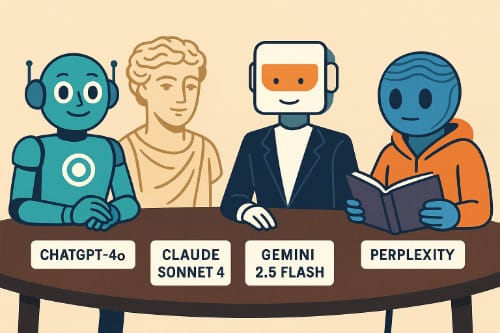
If you’ve ever felt like you’re speed-dating AIs just to find the one that gets your weird mix of questions, creativity, and curiosity—you’re not alone. The new generation of AI assistants in 2025 feels a bit like assembling your dream band: each has its own strengths, quirks, and genre.
In this post, I’ll pit four of the biggest players against each other—OpenAI’s ChatGPT-4o, Anthropic’s Claude Sonnet 4, Google’s Gemini 2.5 Flash, and Perplexity’s Standard model—to see how they stack up across key areas. Keep in mind, these are the free versions of each. If you go for the paid plans (usually around $20 a month), you get even more capabilities.
Intelligence and Understanding
ChatGPT-4o (OpenAI)
OpenAI’s “omnimodel” (that’s what the “o” stands for) is the most balanced conversationalist of the bunch. It’s fast, articulate, and surprisingly good at emotional tone—helping you write blog posts, code, or even untangle your thoughts. It handles math, logic, and creative writing smoothly. And with GPT-4o, it can “see” and “hear” with multimodal abilities, making it a bit of a polymath.
Think of it as your smartest friend who’s also great at explaining things and never tired of brainstorming.
Claude Sonnet 4 (Anthropic)
Claude has a more contemplative, almost philosophical vibe. It excels at reading and analyzing long documents—like if you dropped a dense white paper on AI ethics or a 200-page novel into the chat, Claude wouldn’t blink. It’s also the most cautious of the bunch—polite, filtered, and often offers “consider all sides” responses.
Picture Claude as the liberal arts professor who brings nuance and humanity into every answer.
Gemini 2.5 Flash (Google DeepMind)
Gemini Flash is the speed demon. Designed for snappy, fast interactions, it often responds faster than the others and does so with decent accuracy. However, it can lack the depth or warmth of ChatGPT or Claude in creative or emotionally nuanced tasks. That said, it plays extremely well with other Google tools (Docs, Sheets, Gmail).
Think of Gemini Flash as your super-efficient assistant—less poetic, more productivity.
Perplexity Standard
This one’s a bit different. Perplexity’s model is all about real-time search. Instead of generating answers from a fixed knowledge base, it fetches current information from the internet and cites it directly. It’s like having a search engine with a conversational front end. Great for up-to-the-minute answers.
Perplexity is the librarian who sprints across the stacks and brings you five books and a few recent newspaper articles—fast.
Speed and Responsiveness
- Gemini Flash is fastest, no contest.
- ChatGPT-4o is now extremely quick, even when juggling images or data.
- Claude Sonnet 4 is fast, but thoughtful—it sometimes pauses as if it’s genuinely mulling over your question.
- Perplexity is variable: fast for basic questions, but might take a few seconds for deeper searches.
Creativity and Writing
- ChatGPT-4o is the most versatile: it can write poetry, comedy, scripts, and user-friendly code.
- Claude brings literary depth. If you want something elegant or soulful, it might even outperform ChatGPT.
- Gemini Flash is fine for outlines and quick drafts but lacks flair.
- Perplexity isn’t built for creativity—it’s more like an AI researcher than a storyteller.
Real-Time Knowledge
This is where Perplexity shines. It actively searches the web in real time and shows sources. If you’re looking for the latest news, product comparisons, or niche data, it’s the one to use.
- ChatGPT-4o has web browsing in the Pro plan (but slower and more structured).
- Claude Sonnet 4 does not browse (as of now).
- Gemini Flash is connected to Google Search but isn’t as transparent with citations as Perplexity.
Use Case Match-Ups
| Use Case | Best AI Choice |
|---|
| Writing a blog post | ChatGPT-4o or Claude 4 |
| Answering real-time news | Perplexity Standard |
| Brainstorming a project | ChatGPT-4o |
| Deep document analysis | Claude Sonnet 4 |
| Quick answers + integration | Gemini 2.5 Flash |
| Coding help | ChatGPT-4o |
| Search with citations | Perplexity Standard |
| Creating visual or voice content | ChatGPT-4o |
My Personal Taste
There’s no single winner here—it’s more like a toolkit:
- ChatGPT-4o: Best all-around. If you want one AI to rule them all, this is it.
- Claude Sonnet 4: Best for nuanced thought, long texts, and emotionally intelligent writing.
- Gemini 2.5 Flash: Best if you’re deep in the Googleverse and want speed above all.
- Perplexity Standard: Best for up-to-date facts, live research, and citations.
Personally? I keep ChatGPT-4o as my default, but reach for Perplexity when I need to check the latest headlines or product specs, and use Claude when I want a second opinion that sounds like it came from an AI who’s read more Russian literature than I have.
In the end, the best AI isn’t the smartest—it’s the one that matches how you think, create, and explore.
by Patrix | May 14, 2025
You wouldn’t leave a gold bar on your kitchen counter, right? So why would you leave your Bitcoin sitting on an exchange or in a hot wallet that’s always online?
If you’re serious about crypto—especially as a long-term holder—cold wallets are the digital equivalent of a high-security vault. In this article, we’ll walk through what they are, why they matter, best practices for using them, and how the top cold wallets stack up in 2025.
What Is a Cold Wallet?
A cold wallet is a type of Bitcoin wallet that is not connected to the internet. It stores your private keys offline, drastically reducing the risk of hacks, phishing, and malware.
Why Use a Cold Wallet?
- Protection from hackers: If it’s offline, it can’t be remotely hacked.
- Self-custody: You hold your private keys, not some third-party exchange.
- Resilience: Immune to exchange failures (FTX, anyone?).
- Long-term storage: Ideal for HODLing without worry.
- If you believe in “not your keys, not your coins,” cold storage is your insurance policy.
Best Practices for Cold Wallet Use
Before we get into the gear, here are some time-tested tips:
- Buy directly from the manufacturer: Avoid resellers to prevent tampering.
- Backup your seed phrase (preferably offline, ideally etched in metal).
- Use a passphrase (but don’t forget it—it’s not recoverable).
- Keep your device offline unless signing transactions.
- Don’t take photos of your seed phrase (no, not even “just once”).
The Top Cold Wallets of 2025: Compared
Let’s size up the current heavyweights: Tangem, Ledger, Trezor, and ColdCard.
1. Tangem Wallet (Card-Based Simplicity)
What it is: A smartcard-style wallet that stores keys in a secure chip, used via NFC with your phone.
Pros:
- Extremely easy to use—ideal for beginners.
- No seed phrase to write down (uses backup cards instead).
- Truly “set and forget.”
Cons:
- Trust model depends on their chip provider and firmware transparency.
- Limited transparency vs. fully open-source wallets.
Best for: Casual users or gift-giving, but not for deep cold storage.
2. Ledger Nano X
What it is: A sleek, Bluetooth-enabled hardware wallet with a built-in battery and mobile support.
Pros:
- Very portable and easy to pair with smartphones.
- Secure Element chip for hardware-based protection.
- Supports a wide range of cryptocurrencies.
Cons:
- Firmware is not fully open-source.
- Past controversy around “Ledger Recover” shook community trust.
Best for: Multi-asset users who prioritize convenience and mobility.
3. Trezor Safe 3
What it is: Trezor’s latest wallet, featuring a Secure Element chip and USB-C support.
Pros:
- Combines open-source firmware with modern hardware security.
- Offers a Bitcoin-only version for purists.
- Excellent transparency and usability.
Cons:
- No touchscreen.
- No Bluetooth (which could be a plus for security-focused users).
Best for: Users who value transparency, open-source ethics, and straightforward cold storage.
4. ColdCard Mk4
What it is: Bitcoin-only wallet designed for maximum privacy and air-gapped use.
Pros:
- Completely air-gapped via microSD.
- Built with multisig and PSBT workflows in mind.
- Fully open-source and security-obsessed.
Cons:
- Intimidating for beginners.
- UI feels like a throwback to early computing.
Best for: Advanced users, cypherpunks, and Bitcoin maximalists.
Which Cold Wallet Is Right for You?
It depends on your comfort level, goals, and geek quotient:
- Just getting started? Try Tangem or Ledger Nano X.
- Want transparency with modern security? Go with Trezor Safe 3.
- All in on Bitcoin and privacy? You’ll love ColdCard Mk4.
But no matter what you choose, here’s the real win: You’re moving your Bitcoin off exchanges and into your own custody. That’s where it belongs.
Still storing your Bitcoin on an exchange? Now’s the time to take control. Pick a wallet that matches your style and secure your future. Got questions? Drop a comment or message us at ArtsyGeeky—we’re always up for a good wallet debate.